Zhang Zheng-Wei, Gao Chun-Sheng, Zhang Heng, Yang Jian, Wang Ya-Ping, Pan Li-Bin, Yu Hang, He Chi-Yu, Luo Hai-Bin, Zhao Zhen-Xiong, Zhou Xin-Bo, Wang Yu-Li, Fu Jie, Han Pei, Dong Yu-Hui, Wang Gang, Li Song, Wang Yan, Jiang Jian-Dong, Zhong Wu
State Key Laboratory of Bioactive Substance and Function of Natural Medicines, Institute of Materia Medica, Chinese Academy of Medical Sciences/Peking Union Medical College, Beijing 100050, China.
Beijing Institute of Pharmacology and Toxicology, Beijing 100000, China.
Acta Pharm Sin B. 2022 Aug;12(8):3298-3312. doi: 10.1016/j.apsb.2022.02.032. Epub 2022 Mar 3.
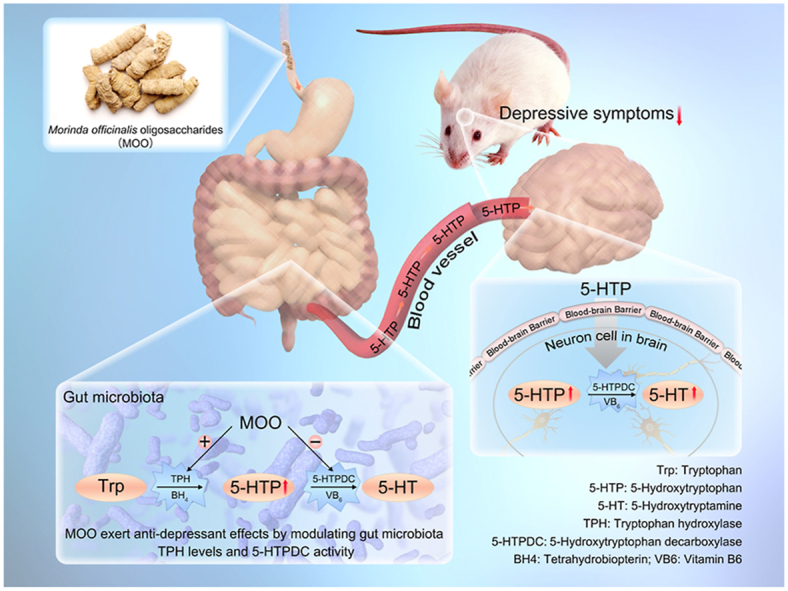
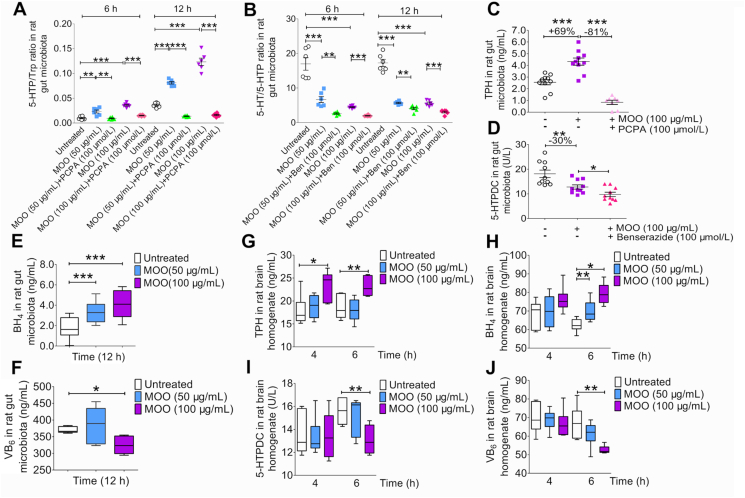
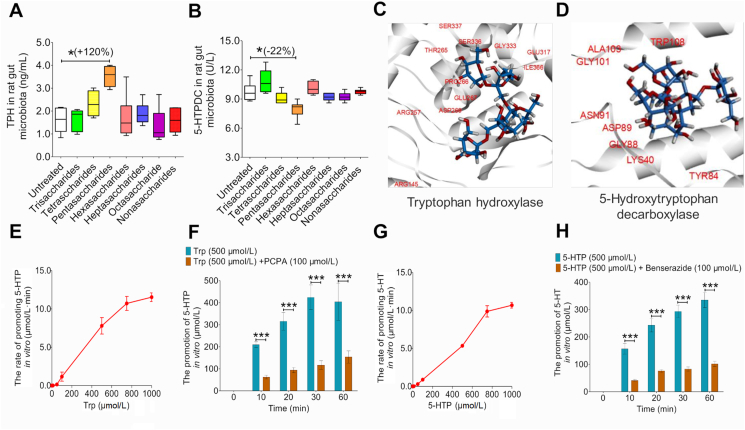
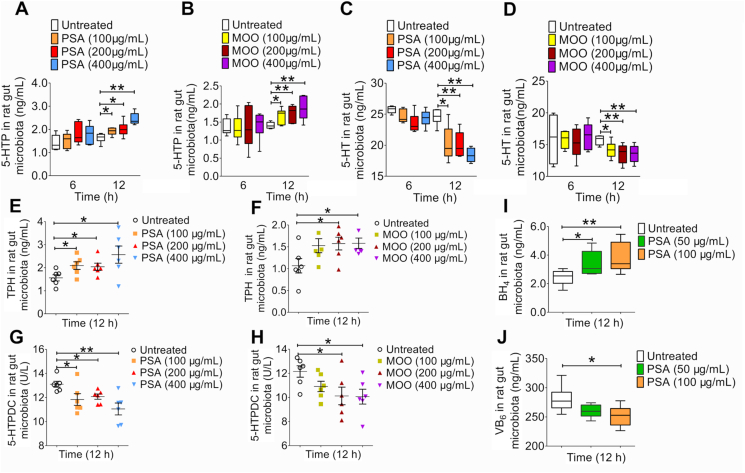
oligosaccharides (MOO) are an oral drug approved in China for the treatment of depression in China. However, MOO is hardly absorbed so that their anti-depressant mechanism has not been elucidated. Here, we show that oral MOO acted on tryptophan → 5-hydroxytryptophan (5-HTP) → serotonin (5-HT) metabolic pathway in the gut microbiota. MOO could increase tryptophan hydroxylase levels in the gut microbiota which accelerated 5-HTP production from tryptophan; meanwhile, MOO inhibited 5-hydroxytryptophan decarboxylase activity, thus reduced 5-HT generation, and accumulated 5-HTP. The raised 5-HTP from the gut microbiota was absorbed to the blood, and then passed across the blood-brain barrier to improve 5-HT levels in the brain. Additionally, pentasaccharide, as one of the main components in MOO, exerted the significant anti-depressant effect through a mechanism identical to that of MOO. This study reveals for the first time that MOO can alleviate depression increasing 5-HTP in the gut microbiota.
寡糖(MOO)是一种在中国被批准用于治疗抑郁症的口服药物。然而,MOO几乎不被吸收,因此其抗抑郁机制尚未阐明。在此,我们表明口服MOO作用于肠道微生物群中的色氨酸→5-羟色氨酸(5-HTP)→血清素(5-HT)代谢途径。MOO可以提高肠道微生物群中色氨酸羟化酶的水平,从而加速从色氨酸生成5-HTP;同时,MOO抑制5-羟色氨酸脱羧酶的活性,从而减少5-HT的生成,并使5-HTP积累。来自肠道微生物群的升高的5-HTP被吸收到血液中,然后穿过血脑屏障以提高大脑中的5-HT水平。此外,五糖作为MOO的主要成分之一,通过与MOO相同的机制发挥显著的抗抑郁作用。这项研究首次揭示MOO可以通过增加肠道微生物群中的5-HTP来缓解抑郁症。