Research Department, Hospital Clínica Nova de Monterrey, San Nicolás de los Garza, Nuevo Leon, Mexico.
Vicerrectoría de Ciencias de la Salud, Escuela de Medicina, Universidad de Monterrey, San Pedro Garza García, Mexico.
Front Immunol. 2022 Jul 28;13:894277. doi: 10.3389/fimmu.2022.894277. eCollection 2022.
Scarce information exists in relation to the comparison of seroconversion and adverse events following immunization (AEFI) with different SARS-CoV-2 vaccines. Our aim was to correlate the magnitude of the antibody response to vaccination with previous clinical conditions and AEFI.
A multicentric comparative study where SARS-CoV-2 spike 1-2 IgG antibodies IgG titers were measured at baseline, 21-28 days after the first and second dose (when applicable) of the following vaccines: BNT162b2 mRNA, mRNA-1273, Gam-COVID-Vac, Coronavac, ChAdOx1-S, Ad5-nCoV and Ad26.COV2. Mixed model and Poisson generalized linear models were performed.
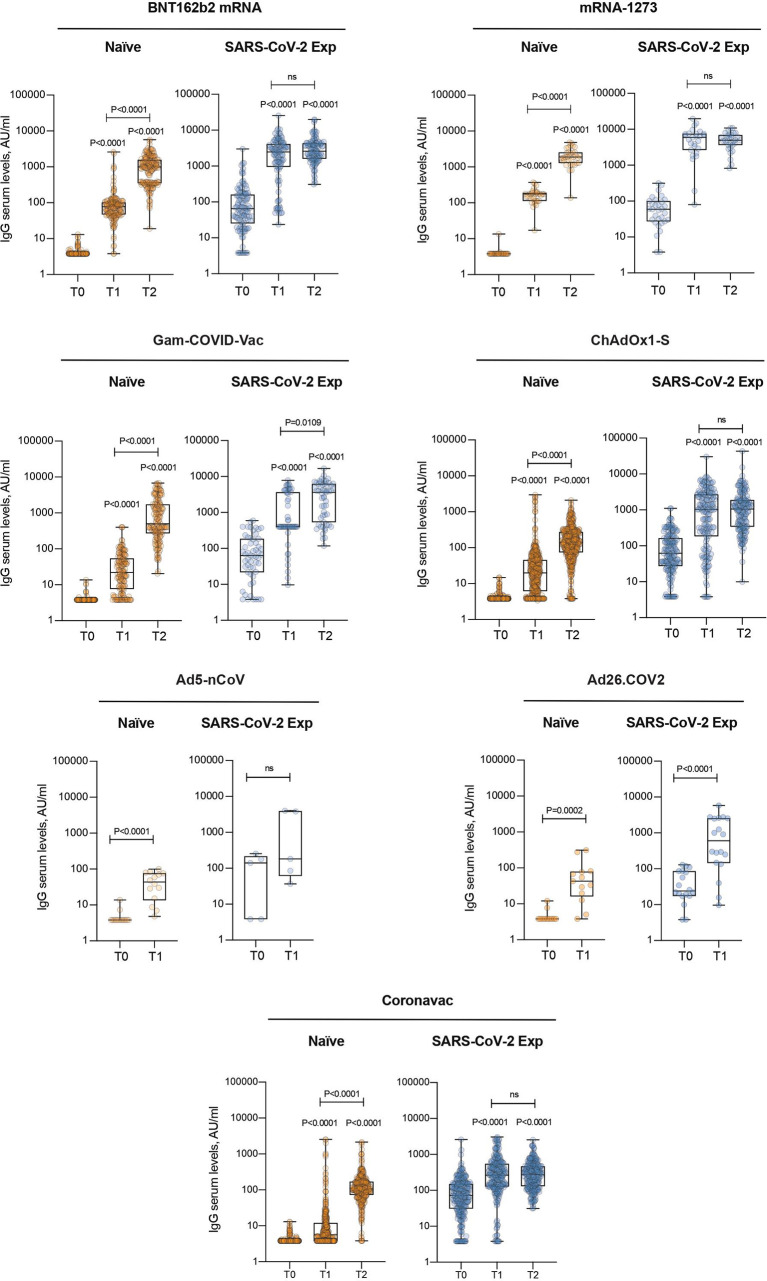
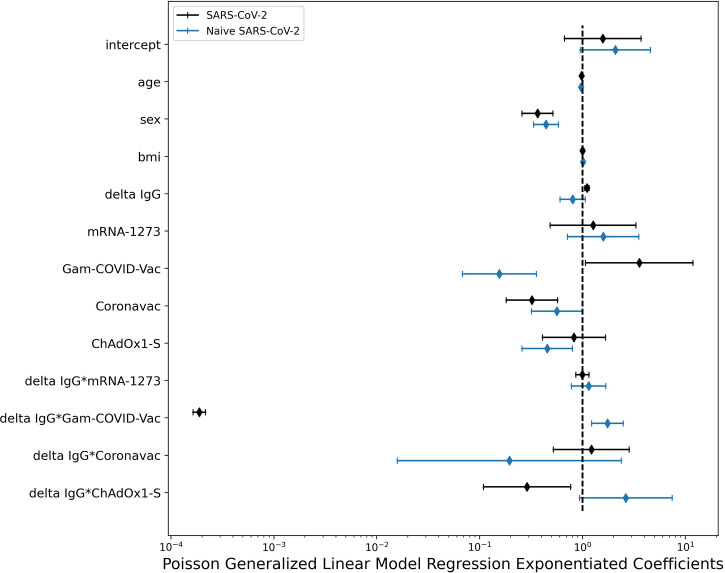
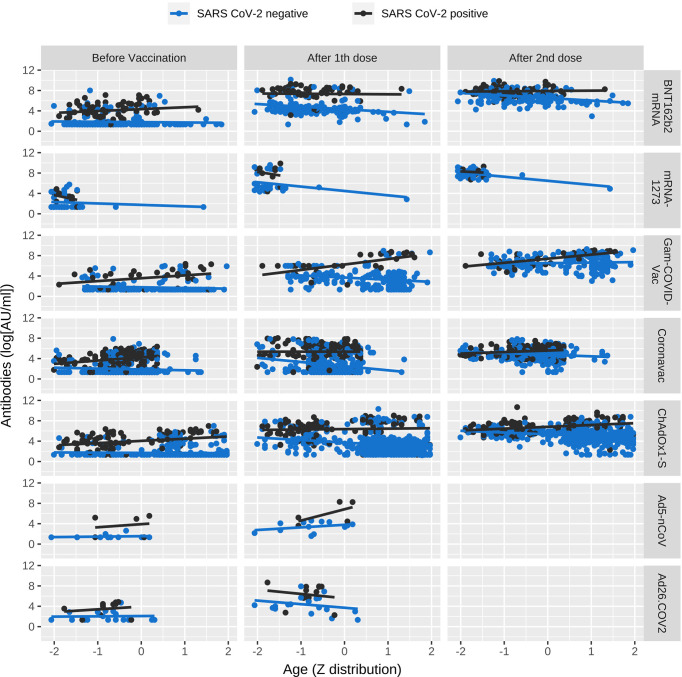
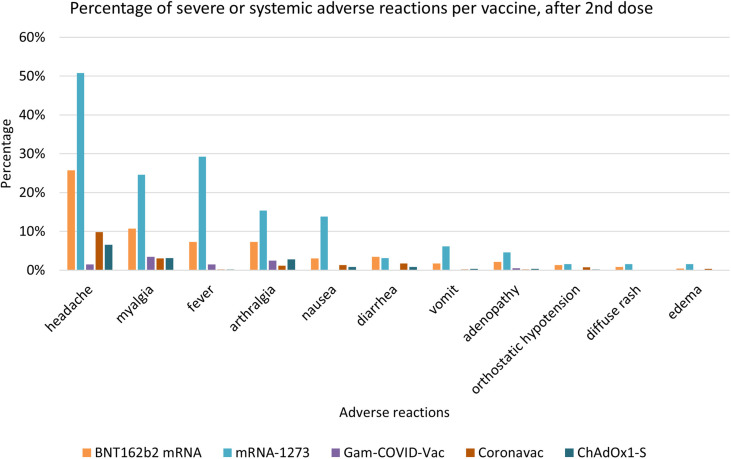
We recruited 1867 individuals [52 (SD 16.8) years old, 52% men]. All vaccines enhanced anti-S1 and anti-S2 IgG antibodies over time (p<0.01). The highest increase after the first and second dose was observed in mRNA-1273 (p<0.001). There was an effect of previous SARS-CoV-2 infection; and an interaction of age with previous SARS-CoV-2 infection, Gam-COVID-Vac and ChAdOx1-S (p<0.01). There was a negative correlation of Severe or Systemic AEFI (AEs) of naïve SARS-CoV-2 subjects with age and sex (p<0.001); a positive interaction between the delta of antibodies with Gam-COVID-Vac (p=0.002). Coronavac, Gam-COVID-Vac and ChAdOx1-S had less AEs compared to BNT162b (p<0.01). mRNA-1273 had the highest number of AEFIs. The delta of the antibodies showed an association with AEFIs in previously infected individuals (p<0.001).
The magnitude of seroconversion is predicted by age, vaccine type and SARS-CoV-2 exposure. AEs are correlated with age, sex, and vaccine type. The delta of the antibody response only correlates with AEs in patients previously exposed to SARS-CoV-2.
ClinicalTrials.gov, identifier NCT05228912.
关于不同 SARS-CoV-2 疫苗接种后的血清转化率和不良事件(AEFI)比较,相关信息十分匮乏。我们的目的是将疫苗接种后的抗体反应程度与既往临床情况和 AEFI 相关联。
这是一项多中心的对比研究,在以下疫苗接种后第 21-28 天(适用时)以及基线时,测量 SARS-CoV-2 刺突 1-2 IgG 抗体 IgG 滴度:BNT162b2 mRNA、mRNA-1273、Gam-COVID-Vac、Coronavac、ChAdOx1-S、Ad5-nCoV 和 Ad26.COV2。采用混合模型和泊松广义线性模型进行分析。
我们共招募了 1867 名个体[52(SD 16.8)岁,52%为男性]。所有疫苗均能随时间提高抗 S1 和抗 S2 IgG 抗体(p<0.01)。mRNA-1273 在第一和第二剂后观察到的增幅最大(p<0.001)。既往 SARS-CoV-2 感染存在影响;年龄与既往 SARS-CoV-2 感染、Gam-COVID-Vac 和 ChAdOx1-S 之间存在交互作用(p<0.01)。无 SARS-CoV-2 既往感染的严重或全身性 AEFI(AE)与年龄和性别呈负相关(p<0.001);Gam-COVID-Vac 的抗体差值与 AE 呈正交互作用(p=0.002)。与 BNT162b 相比,Coronavac、Gam-COVID-Vac 和 ChAdOx1-S 的 AE 更少(p<0.01)。mRNA-1273 的 AEFIs 数量最多。既往感染个体的抗体差值与 AEFIs 相关(p<0.001)。
血清转化率的大小由年龄、疫苗类型和 SARS-CoV-2 暴露情况预测。AE 与年龄、性别和疫苗类型相关。抗体反应的差值仅与既往 SARS-CoV-2 暴露的患者的 AE 相关。
ClinicalTrials.gov,标识符 NCT05228912。