Leconstant Charlène, Spitz Elisabeth
Université de Lorraine, UR 4360 APEMAC, Metz, France.
Front Vet Sci. 2022 Jul 29;9:656833. doi: 10.3389/fvets.2022.656833. eCollection 2022.
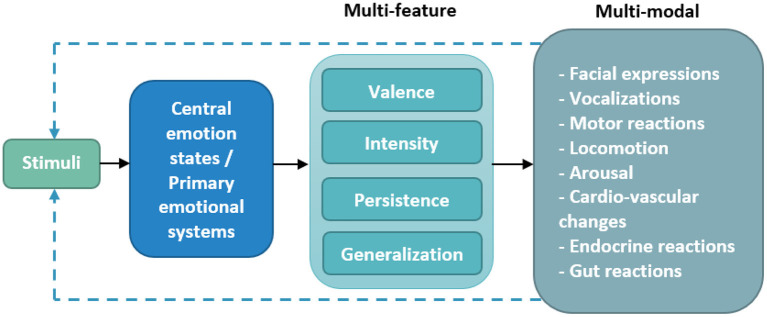
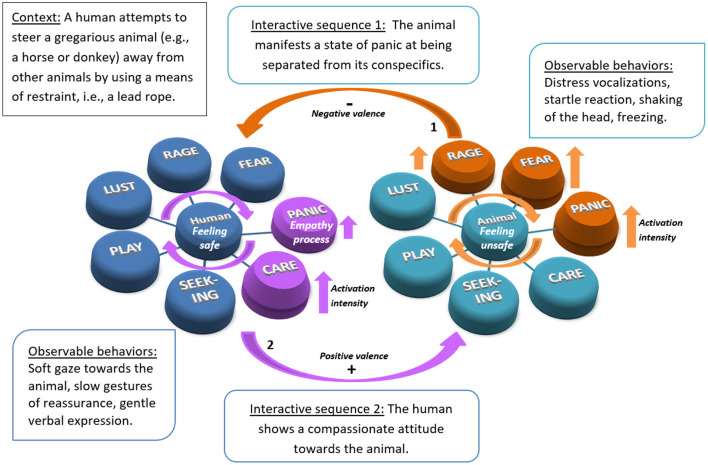
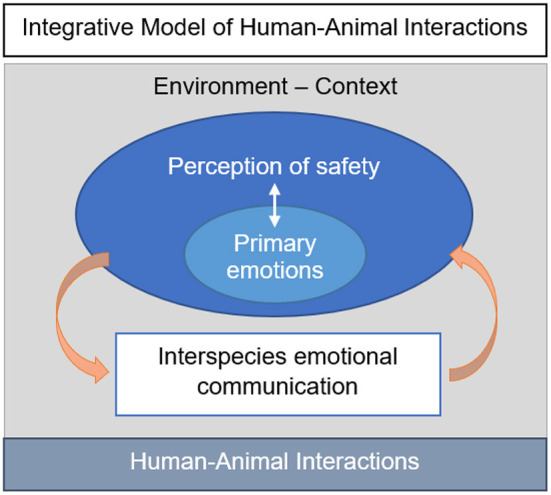
The Integrative Model of Human-Animal Interactions (IMHAI) described herewith provides a conceptual framework for the study of interspecies interactions and aims to model the primary emotional processes involved in human-animal interactions. This model was developed from theoretical inputs from three fundamental disciplines for understanding interspecies interactions: neuroscience, psychology and ethology, with the objective of providing a transdisciplinary approach on which field professionals and researchers can build and collaborate. Seminal works in affective neuroscience offer a common basis between humans and animals and, as such, can be applied to the study of interspecies interactions from a One Health-One Welfare perspective. On the one hand, Jaak Panksepp's research revealed that primary/basic emotions originate in the deep subcortical regions of the brain and are shared by all mammals, including humans. On the other hand, several works in the field of neuroscience show that the basic physiological state is largely determined by the perception of safety. Thus, emotional expression reflects the state of an individual's permanent adaptation to ever-changing environmental demands. Based on this evidence and over 5 years of action research using grounded theory, alternating between research and practice, the IMHAI proposes a systemic approach to the study of primary-process emotional affects during interspecies social interactions, through the processes of emotional transfer, embodied communication and interactive emotional regulation. IMHAI aims to generate new hypotheses and predictions on affective behavior and interspecies communication. Application of such a model should promote risk prevention and the establishment of positive links between humans and animals thereby contributing to their respective wellbeing.
本文所述的人与动物互动整合模型(IMHAI)为跨物种互动研究提供了一个概念框架,旨在对人与动物互动中涉及的主要情感过程进行建模。该模型是根据神经科学、心理学和动物行为学这三门理解跨物种互动的基础学科的理论输入而开发的,目的是提供一种跨学科方法,供该领域的专业人员和研究人员在此基础上开展工作与合作。情感神经科学的开创性研究为人与动物之间提供了一个共同基础,因此可以从“同一健康—同一福利”的角度应用于跨物种互动研究。一方面,雅克·潘克塞普的研究表明,基本情绪起源于大脑深层的皮层下区域,所有哺乳动物(包括人类)都有这些基本情绪。另一方面,神经科学领域的多项研究表明,基本生理状态在很大程度上由安全感决定。因此,情绪表达反映了个体对不断变化的环境需求的永久适应状态。基于这一证据以及5年多来运用扎根理论、在研究与实践之间交替进行的行动研究,IMHAI提出了一种系统方法,通过情绪传递、具身沟通和互动情绪调节过程,研究跨物种社会互动中的初级过程情绪影响。IMHAI旨在生成关于情感行为和跨物种沟通的新假设和预测。应用这样一个模型应能促进风险预防,并在人与动物之间建立积极联系,从而有助于它们各自的福祉。