Balbaa Maha G, Osman Hassan T, Kandil Essam E, Javed Talha, Lamlom Sobhi F, Ali Hayssam M, Kalaji Hazem M, Wróbel Jacek, Telesiñski Arkadiusz, Brysiewicz Adam, Ghareeb Rehab Y, Abdelsalam Nader R, Abdelghany Ahmed M
Maize Research Department, Field Crops Research Institute, Agriculture Research Center, Cairo, Egypt.
Plant Production Department, Faculty of Agriculture (Saba Basha), Alexandria University, Alexandria, Egypt.
Front Plant Sci. 2022 Jul 28;13:959203. doi: 10.3389/fpls.2022.959203. eCollection 2022.
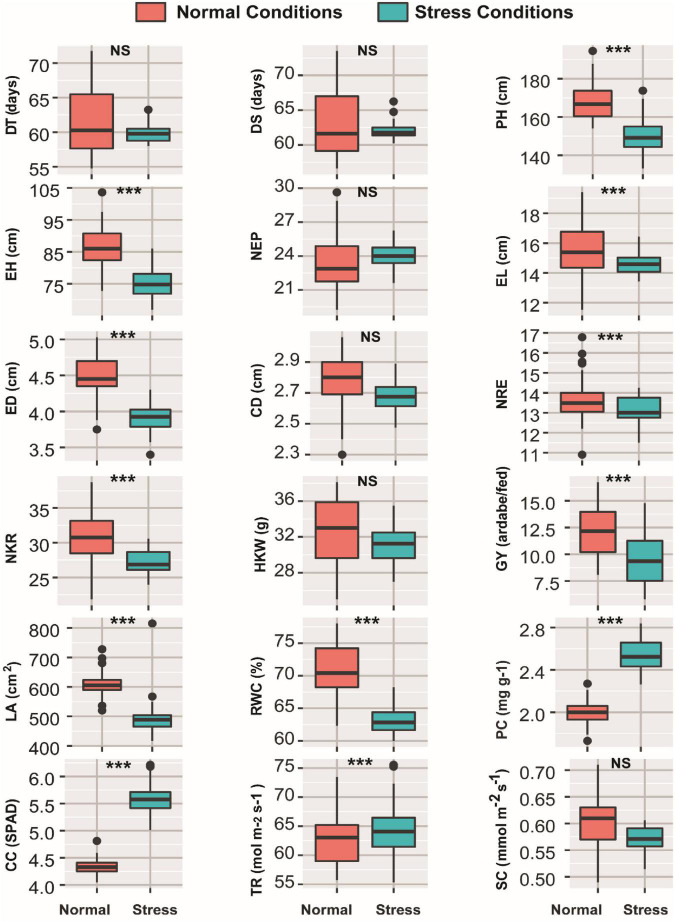
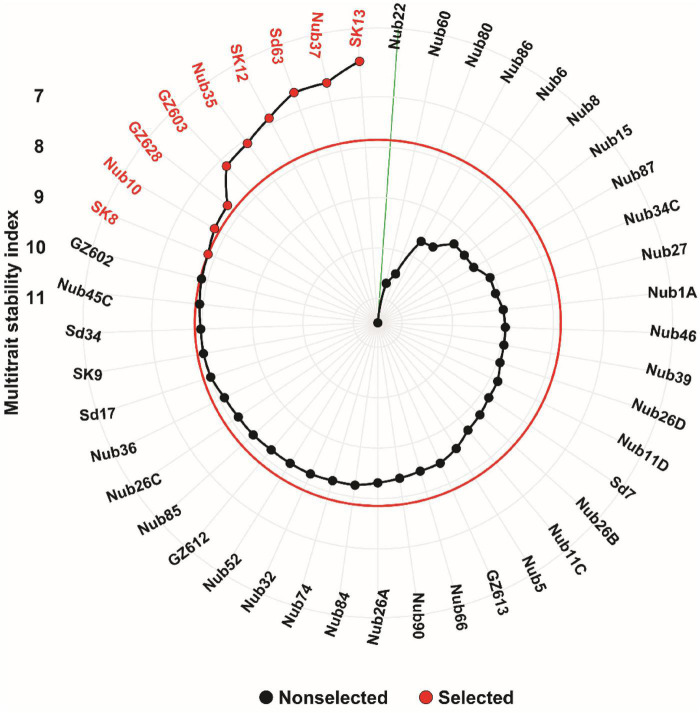
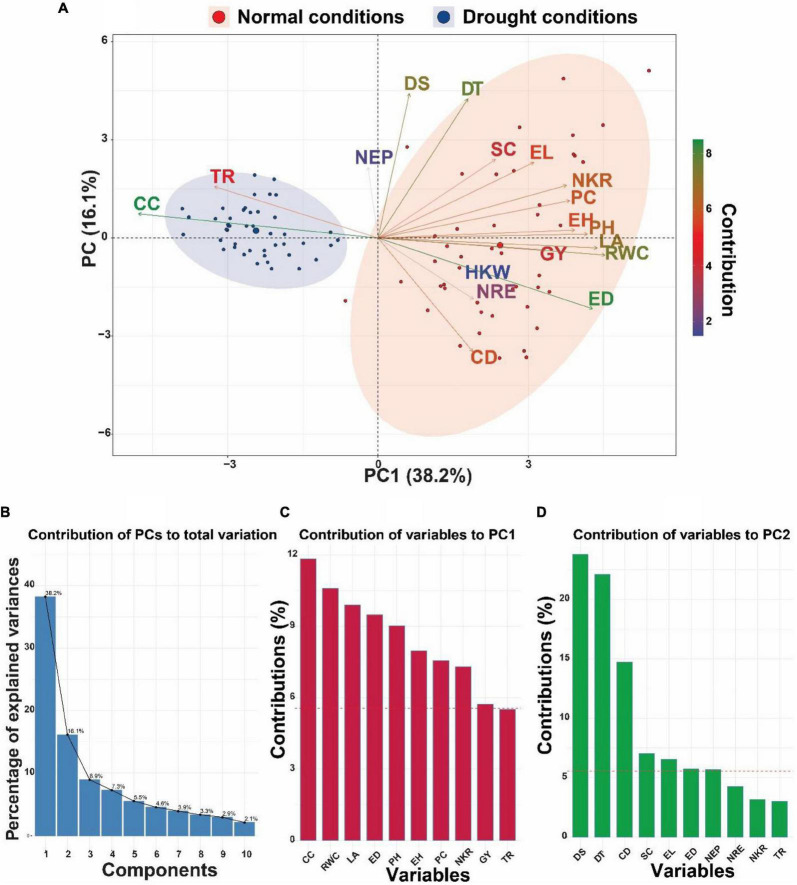
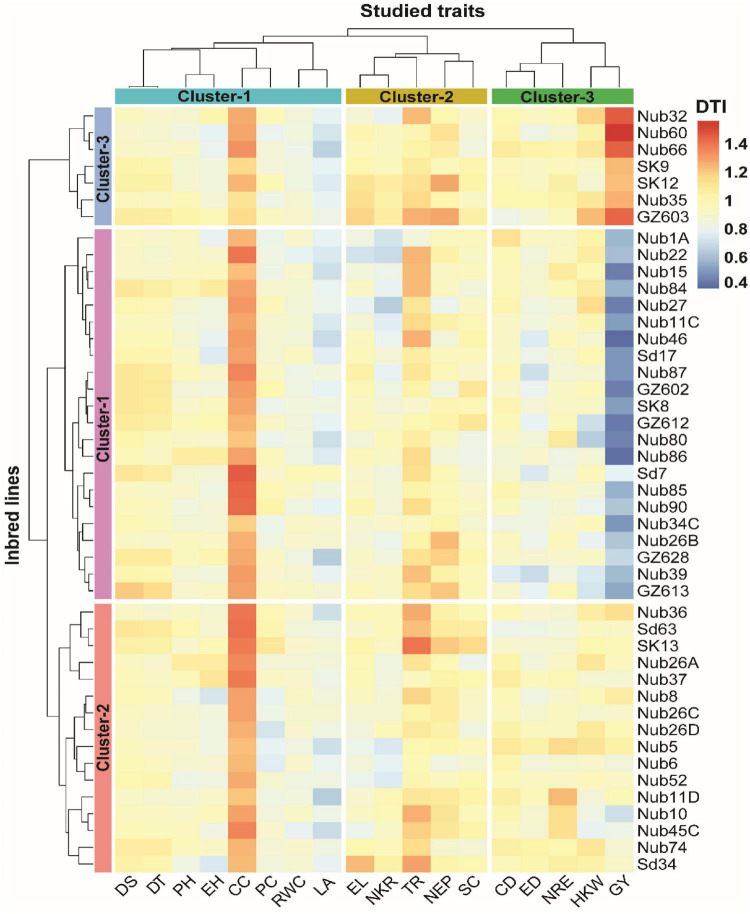
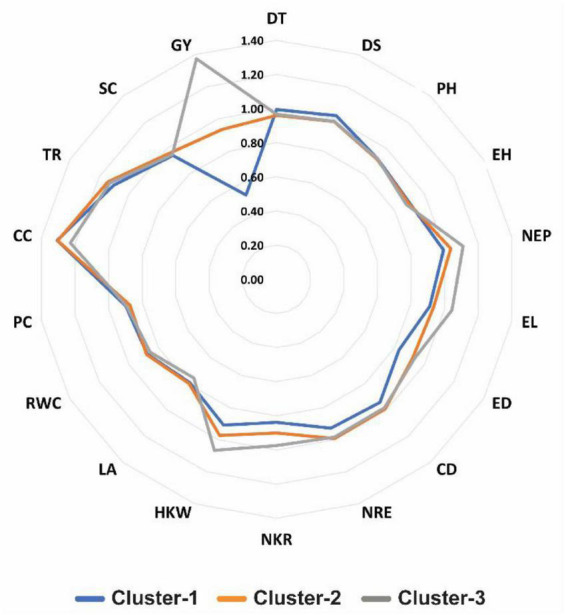
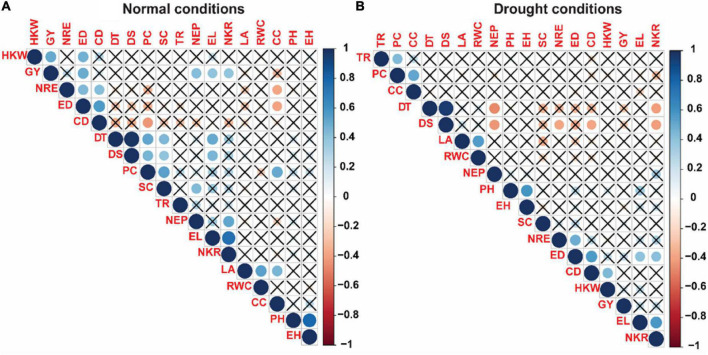
Globally, climate change could hinder future food security that concurrently implies the importance of investigating drought stress and genotype screening under stressed environments. Hence, the current study was performed to screen 45 diverse maize inbred lines for 18 studied traits comprising phenological, physiological, morphological, and yield characters under optimum and water stress conditions for two successive growing seasons (2018 and 2019). The results showed that growing seasons and water regimes significantly influenced ( < 0.01) most of the studied traits, while inbred lines had a significant effect ( < 0.01) on all of the studied traits. The findings also showed a significant increase in all studied characters under normal conditions compared to drought conditions, except chlorophyll content, transpiration rate, and proline content which exhibited higher levels under water stress conditions. Furthermore, the results of the principal component analysis indicated a notable distinction between the performance of the 45 maize inbred lines under normal and drought conditions. In terms of grain yield, the drought tolerance index (DTI) showed that Nub60 (1.56), followed by Nub32 (1.46), Nub66 (1.45), and GZ603 (1.44) were the highest drought-tolerant inbred lines, whereas Nub46 (0.38) was the lowest drought-tolerant inbred line. These drought-tolerant inbred lines were able to maintain a relatively high grain yield under normal and stress conditions, whereas those drought-sensitive inbred lines showed a decline in grain yield when exposed to drought conditions. The hierarchical clustering analysis based on DTI classified the forty-five maize inbred lines and eighteen measured traits into three column- and row-clusters, as inbred lines in cluster-3 followed by those in cluster-2 exhibited greater drought tolerance in most of the studied traits. Utilizing the multi-trait stability index (MTSI) criterion in this study identified nine inbred lines, including GZ603, as stable genotypes in terms of the eighteen studied traits across four environments. The findings of the current investigation motivate plant breeders to explore the genetic potential of the current maize germplasm, especially in water-stressed environments.
在全球范围内,气候变化可能会阻碍未来的粮食安全,这同时意味着在胁迫环境下研究干旱胁迫和基因型筛选的重要性。因此,本研究对45个不同的玉米自交系进行了筛选,研究了在连续两个生长季节(2018年和2019年)的最佳和水分胁迫条件下,包括物候、生理、形态和产量性状在内的18个研究性状。结果表明,生长季节和水分处理对大多数研究性状有显著影响(<0.01),而自交系对所有研究性状都有显著影响(<0.01)。研究结果还表明,与干旱条件相比,正常条件下所有研究性状均显著增加,但叶绿素含量、蒸腾速率和脯氨酸含量在水分胁迫条件下表现出较高水平。此外,主成分分析结果表明,45个玉米自交系在正常和干旱条件下的表现存在显著差异。就籽粒产量而言,耐旱指数(DTI)表明,Nub60(1.56),其次是Nub32(1.46)、Nub66(1.45)和GZ603(1.44)是耐旱性最高的自交系,而Nub46(0.38)是耐旱性最低的自交系。这些耐旱自交系在正常和胁迫条件下能够保持相对较高的籽粒产量,而那些干旱敏感自交系在干旱条件下籽粒产量下降。基于DTI的层次聚类分析将45个玉米自交系和18个测量性状分为三个列簇和行簇,因为簇3中的自交系以及簇2中的自交系在大多数研究性状中表现出更高的耐旱性。本研究利用多性状稳定性指数(MTSI)标准确定了包括GZ603在内的9个自交系在四个环境中的18个研究性状方面是稳定基因型。本研究结果促使植物育种者探索当前玉米种质的遗传潜力,特别是在水分胁迫环境中。