Department of Pediatric Laboratory, Wuxi Children's Hospital, Wuxi, China.
National Health Commission Key Laboratory of Parasitic Disease Control and Prevention, Jiangsu Provincial Key Laboratory on Parasite and Vector Control Technology, Jiangsu Institute of Parasitic Diseases, Wuxi, China.
Microbiol Spectr. 2022 Oct 26;10(5):e0134422. doi: 10.1128/spectrum.01344-22. Epub 2022 Aug 15.
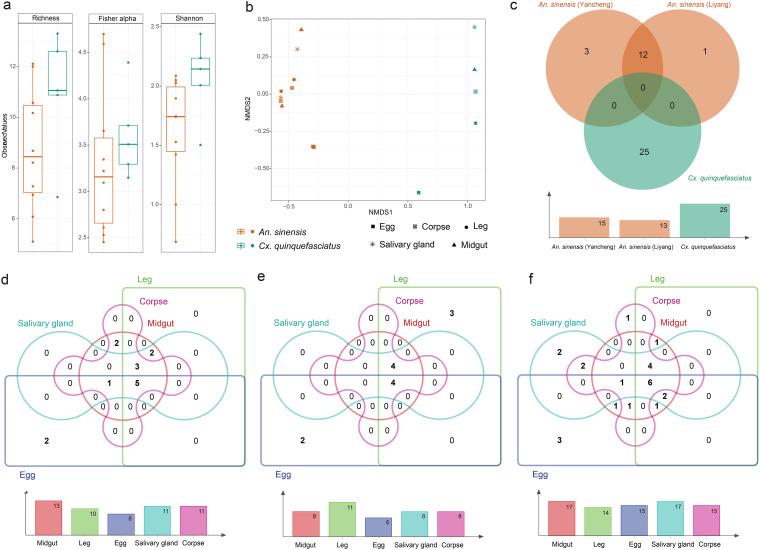
Arboviruses and insect-specific viruses (ISVs) are two major types of viruses harbored by mosquitoes that are distinguished by the involvement of vertebrate hosts in their transmission cycles. While intensive studies have focused on the transmission, tissue tropism, and evolution of arboviruses, these characteristics are poorly investigated in ISVs, which dominate the mosquito virome. Therefore, in this study, we collected two mosquito species, Anopheles sinensis and Culex quinquefasciatus, in the field and used a metatranscriptomics approach to characterize their RNA viromes in different tissues, such as the midgut, legs, salivary gland, eggs, and the remainder of the carcass. Blood-engorged individuals of these species were captured in 3 locations, and 60 mosquitoes were pooled from each species and location. A total of 40 viral species from diverse viral taxa associated with all viral RNA genome types were identified, among which 19 were newly identified in this study. According to the current viral taxonomy, some of these viruses, such as Yancheng associated virus 2 () and Jiangsu -related virus (), were novel. The two investigated mosquito species generally harbored distinct viromes. Nevertheless, the viruses were generally shared among different tissue types to various degrees. Specifically, the eggs possessed a viral community with significantly lower diversity and abundance than those in other tissues, whereas the legs and salivary glands exhibited higher viral abundance. The compositions and distributions of the viromes of different mosquito tissues were demonstrated for the first time in our study, providing important insight into the virome dynamics within individual mosquitoes. ISVs are considered to be ancestral to arboviruses. Because of their medical importance, arboviruses have been well studied from the aspects of their transmission mode, evolution of dual-host tropism, and genetic dynamics within mosquito vectors. However, the mode of ISV maintenance is poorly understood, even though many novel ISVs have been identified with the emergence of sequencing technology. In our study, in addition to the identification of a diverse virus community, the tissue tropism of RNA viromes harbored by two field-collected mosquito species was demonstrated for the first time. According to the results, the virus communities of different tissues, such as the salivary glands, midguts, legs, and eggs, can help us understand the evolution, transmission routes, and maintenance modes of mosquito-specific viruses in nature.
虫媒病毒和昆虫特异性病毒(ISVs)是两种主要的病毒类型,它们通过脊椎动物宿主在其传播周期中的参与而被区分开来。虽然对虫媒病毒的传播、组织嗜性和进化进行了深入研究,但对 ISVs 的这些特征研究甚少,而 ISVs 在蚊子病毒组中占主导地位。因此,在这项研究中,我们收集了野外的两种蚊子,中华按蚊和三带喙库蚊,并用宏转录组学方法来描述它们在不同组织(如中肠、腿、唾液腺、卵和剩余的尸体)中的 RNA 病毒组。在 3 个地点捕获了这些物种吸食血液的个体,每个物种和地点从 60 只蚊子中混合。总共鉴定出 40 种来自不同病毒分类群的病毒,这些病毒与所有病毒 RNA 基因组类型相关,其中 19 种是在本研究中首次发现的。根据目前的病毒分类学,其中一些病毒,如盐城相关病毒 2 () 和江苏相关病毒 (),是新发现的。这两种被调查的蚊子通常携带不同的病毒组。然而,这些病毒通常在不同组织类型之间以不同程度共享。具体来说,与其他组织相比,卵中的病毒群落多样性和丰度显著较低,而腿和唾液腺中的病毒丰度较高。我们的研究首次展示了不同蚊子组织的病毒组的组成和分布,为个体蚊子内的病毒组动态提供了重要的见解。
ISVs 被认为是虫媒病毒的祖先。由于其医学重要性,虫媒病毒的传播模式、双宿主嗜性的进化以及蚊子媒介内的遗传动态都得到了很好的研究。然而,尽管随着测序技术的出现,已经发现了许多新的 ISVs,但 ISV 的维持模式仍知之甚少。在我们的研究中,除了鉴定出多样化的病毒群落外,还首次证明了两种野外采集的蚊子所携带的 RNA 病毒组的组织嗜性。根据研究结果,不同组织(如唾液腺、中肠、腿和卵)的病毒群落可以帮助我们了解自然界中蚊子特异性病毒的进化、传播途径和维持模式。