Sanchez-Vargas Irma, Harrington Laura C, Black William C, Olson Ken E
Arthropod-borne and Infectious Diseases Laboratory, Colorado State University, Ft. Collins, CO 80523, USA.
Department of Entomology, Cornell University, Ithaca, NY 14850, USA.
Insects. 2019 Feb 1;10(2):39. doi: 10.3390/insects10020039.
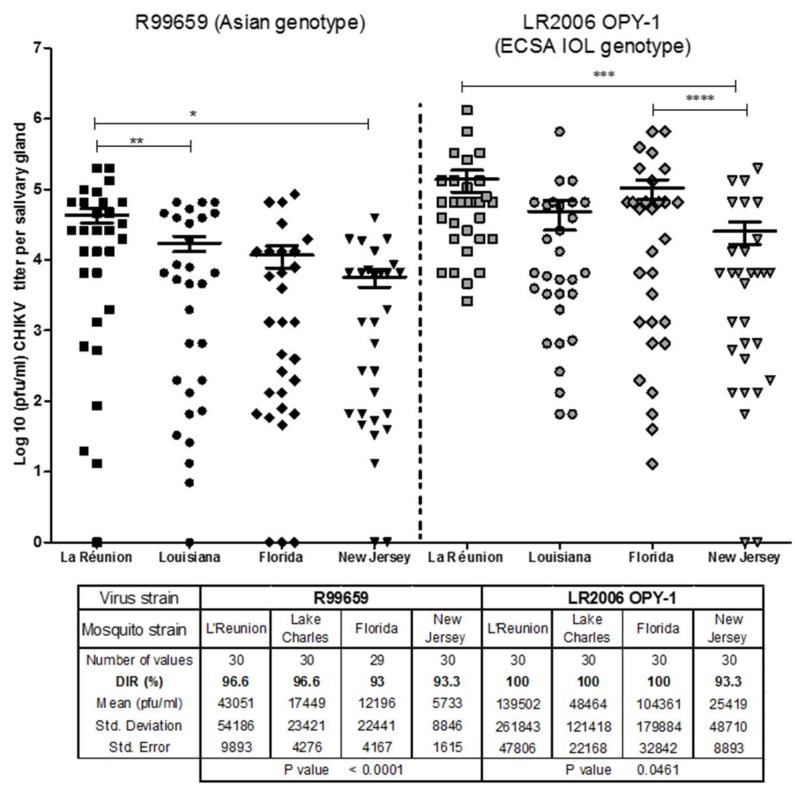
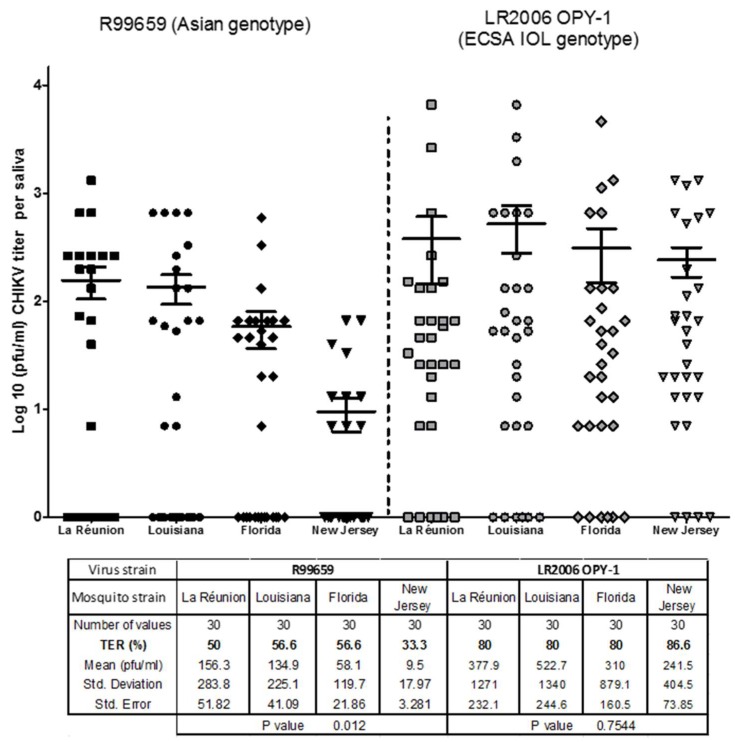
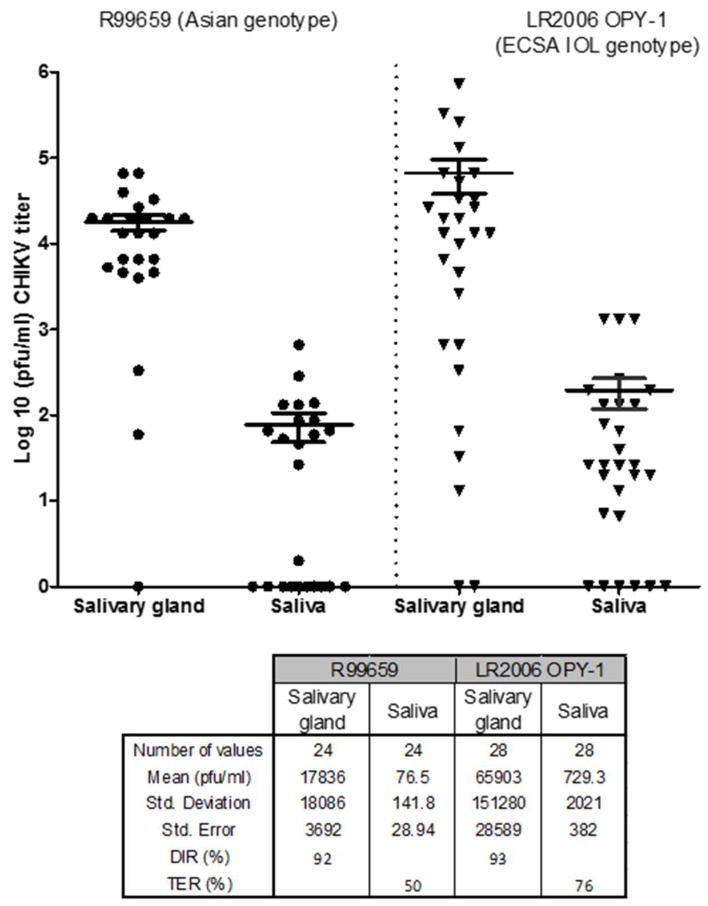
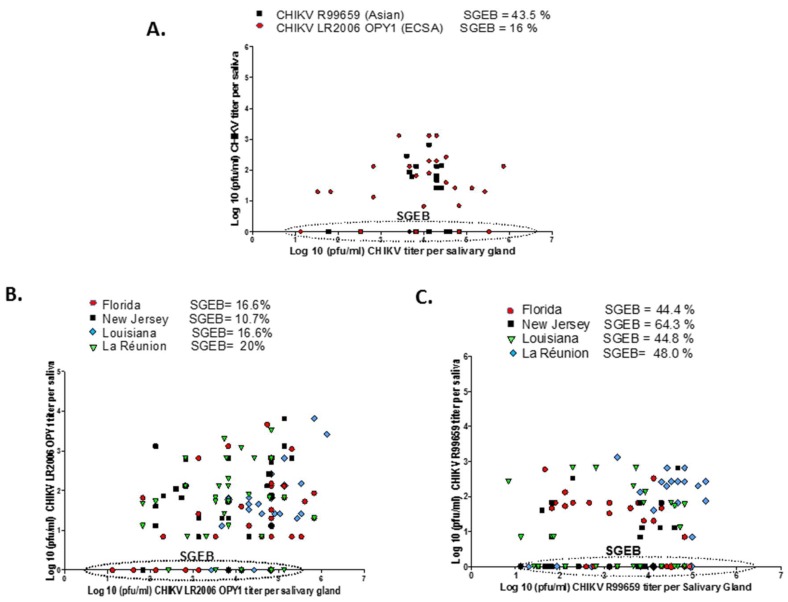
Chikungunya virus (CHIKV) is a medically important mosquito-borne virus transmitted to humans by infected () species. In 2013⁻2014, transmitted CHIKV to humans in the Caribbean and in 2005⁻2006, transmitted CHIKV on La Réunion Island (Indian Ocean basin). CHIKV LR2006 OPY1 from the La Réunion epidemic was associated with a mutation (E1:A226V) in the viral E1 glycoprotein that enhanced CHIKV transmission by . CHIKV R99659 from the Caribbean outbreak did not have the E1:A226V mutation. Here, we analyzed the salivary glands and saliva of strains from New Jersey, Florida, Louisiana and La Réunion after infection with each virus to determine their transmission potential. We infected the strains with blood meals containing 3⁻7 × 10⁷ PFU/mL of each virus and analyzed the mosquitoes nine days later to maximize infection of their salivary glands. All four strains were highly susceptible to LR2006 OPY1 and R99659 viruses and their CHIKV disseminated infection rates (DIR) were statistically similar ( = 0.3916). The transmission efficiency rate (TER) was significantly lower for R99659 virus compared to LR2006 OPY1 virus in all strains and (Poza Rica) ( = 0.012) suggesting a salivary gland exit barrier to R99659 virus not seen with LR2006 OPY1 infections. If introduced, LR2006 OPY1 virus poses an increased risk of transmission by both species in the western hemisphere.
基孔肯雅病毒(CHIKV)是一种具有重要医学意义的蚊媒病毒,通过受感染的()物种传播给人类。2013 - 2014年,()在加勒比地区将CHIKV传播给人类,2005 - 2006年,()在留尼汪岛(印度洋盆地)传播CHIKV。来自留尼汪岛疫情的CHIKV LR2006 OPY1与病毒E1糖蛋白中的一个突变(E1:A226V)相关,该突变增强了CHIKV通过()的传播。来自加勒比地区疫情的CHIKV R99659没有E1:A226V突变。在这里,我们分析了新泽西州、佛罗里达州、路易斯安那州和留尼汪岛的()品系在感染每种病毒后的唾液腺和唾液,以确定它们的传播潜力。我们用含有3 - 7×10⁷ PFU/mL每种病毒的血餐感染()品系,并在九天后分析蚊子,以使它们的唾液腺感染最大化。所有四个()品系对LR2006 OPY1和R99659病毒都高度易感,它们的CHIKV传播感染率(DIR)在统计学上相似(= 0.3916)。在所有()品系和()(波萨里卡)中,R99659病毒的传播效率率(TER)显著低于LR2006 OPY1病毒(= 0.012),这表明R99659病毒存在唾液腺出口屏障,而LR2006 OPY1感染未见此情况。如果引入,LR2006 OPY1病毒在西半球通过这两种()物种传播的风险会增加。