Stacy John, Kim Rachel, Barrett Christopher, Sekar Balaviknesh, Simon Steven, Banaei-Kashani Farnoush, Rosenberg Michael A
Department of Medicine, University of Colorado, Aurora, CO, United States.
Colorado Center for Personalized Medicine, University of Colorado Anschutz Medical Campus, Aurora, CO, United States.
JMIR Form Res. 2022 Aug 11;6(8):e36443. doi: 10.2196/36443.
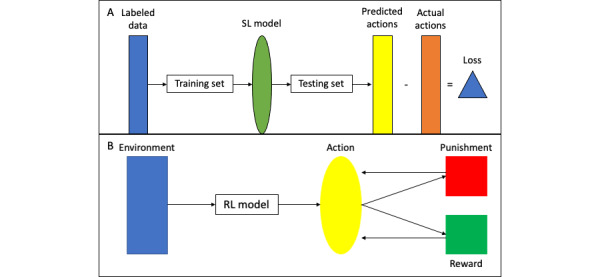
Despite the numerous studies evaluating various rhythm control strategies for atrial fibrillation (AF), determination of the optimal strategy in a single patient is often based on trial and error, with no one-size-fits-all approach based on international guidelines/recommendations. The decision, therefore, remains personal and lends itself well to help from a clinical decision support system, specifically one guided by artificial intelligence (AI). QRhythm utilizes a 2-stage machine learning (ML) model to identify the optimal rhythm management strategy in a given patient based on a set of clinical factors, in which the model first uses supervised learning to predict the actions of an expert clinician and identifies the best strategy through reinforcement learning to obtain the best clinical outcome-a composite of symptomatic recurrence, hospitalization, and stroke.
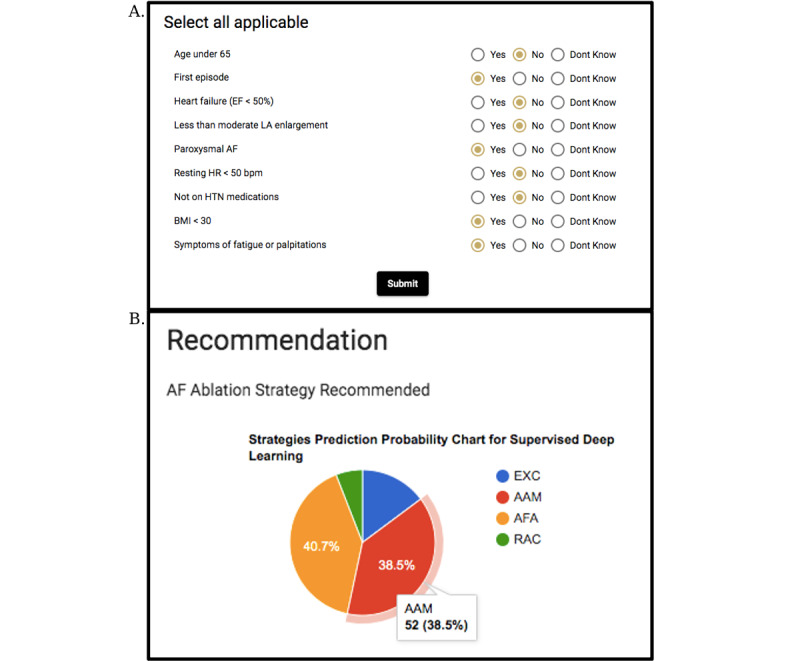
We qualitatively evaluated a novel, AI-based, clinical decision support system (CDSS) for AF rhythm management, called QRhythm, which uses both supervised and reinforcement learning to recommend either a rate control or one of 3 types of rhythm control strategies-external cardioversion, antiarrhythmic medication, or ablation-based on individual patient characteristics.
Thirty-three clinicians, including cardiology attendings and fellows and internal medicine attendings and residents, performed an assessment of QRhythm, followed by a survey to assess relative comfort with automated CDSS in rhythm management and to examine areas for future development.
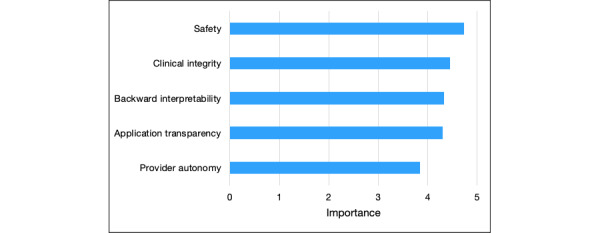
The 33 providers were surveyed with training levels ranging from resident to fellow to attending. Of the characteristics of the app surveyed, safety was most important to providers, with an average importance rating of 4.7 out of 5 (SD 0.72). This priority was followed by clinical integrity (a desire for the advice provided to make clinical sense; importance rating 4.5, SD 0.9), backward interpretability (transparency in the population used to create the algorithm; importance rating 4.3, SD 0.65), transparency of the algorithm (reasoning underlying the decisions made; importance rating 4.3, SD 0.88), and provider autonomy (the ability to challenge the decisions made by the model; importance rating 3.85, SD 0.83). Providers who used the app ranked the integrity of recommendations as their highest concern with ongoing clinical use of the model, followed by efficacy of the application and patient data security. Trust in the app varied; 1 (17%) provider responded that they somewhat disagreed with the statement, "I trust the recommendations provided by the QRhythm app," 2 (33%) providers responded with neutrality to the statement, and 3 (50%) somewhat agreed with the statement.
Safety of ML applications was the highest priority of the providers surveyed, and trust of such models remains varied. Widespread clinical acceptance of ML in health care is dependent on how much providers trust the algorithms. Building this trust involves ensuring transparency and interpretability of the model.
尽管有众多研究评估了心房颤动(AF)的各种节律控制策略,但在确定单个患者的最佳策略时,往往是基于反复试验,没有基于国际指南/建议的通用方法。因此,这一决策仍然因人而异,很适合借助临床决策支持系统,特别是由人工智能(AI)驱动的系统来提供帮助。QRhythm利用两阶段机器学习(ML)模型,根据一组临床因素为特定患者确定最佳节律管理策略,其中该模型首先使用监督学习来预测专家临床医生的行为,并通过强化学习确定最佳策略,以获得最佳临床结果——症状复发、住院和中风的综合结果。
我们对一种用于房颤节律管理的新型、基于AI的临床决策支持系统(CDSS)——QRhythm进行了定性评估,该系统使用监督学习和强化学习,根据患者个体特征推荐心率控制或三种节律控制策略之一——体外电复律、抗心律失常药物或消融。
33名临床医生,包括心脏病学主治医生和住院医生以及内科主治医生和住院医生,对QRhythm进行了评估,随后进行了一项调查,以评估他们在节律管理中对自动化CDSS的相对舒适度,并探讨未来的发展领域。
对33名提供者进行了调查,其培训水平从住院医生到住院医生再到主治医生。在所调查的应用程序的特征中,安全性对提供者最为重要,平均重要性评分为4.7分(满分5分,标准差0.72)。其次是临床完整性(希望提供的建议具有临床意义;重要性评分为4.5分,标准差0.9)、反向可解释性(用于创建算法的人群的透明度;重要性评分为4.3分,标准差0.65)、算法透明度(决策背后的推理;重要性评分为4.3分,标准差0.88)和提供者自主性(挑战模型所做决策的能力;重要性评分为3.85分,标准差0.83)。使用该应用程序的提供者将建议的完整性列为对该模型持续临床使用的最高关注,其次是应用程序的有效性和患者数据安全性。对该应用程序的信任程度各不相同;1名(17%)提供者表示有点不同意“我信任QRhythm应用程序提供的建议”这一说法,2名(33%)提供者对此说法持中立态度,3名(50%)提供者有点同意这一说法。
ML应用的安全性是接受调查的提供者的最高优先事项,对这类模型的信任程度仍然各不相同。ML在医疗保健中的广泛临床接受程度取决于提供者对算法的信任程度。建立这种信任需要确保模型的透明度和可解释性。