de Angel Valeria, Lewis Serena, White Katie M, Matcham Faith, Hotopf Matthew
Department of Psychological Medicine, Institute of Psychiatry, Psychology and Neuroscience, King's College London, London, United Kingdom.
NIHR Maudsley Biomedical Research Centre, South London and Maudsley NHS Foundation Trust, London, United Kingdom.
JMIR Ment Health. 2022 Aug 15;9(8):e38934. doi: 10.2196/38934.
Remote measurement technologies, such as smartphones and wearable devices, can improve treatment outcomes for depression through enhanced illness characterization and monitoring. However, little is known about digital outcomes that are clinically meaningful to patients and clinicians. Moreover, if these technologies are to be successfully implemented within treatment, stakeholders' views on the barriers to and facilitators of their implementation in treatment must be considered.
This study aims to identify clinically meaningful targets for digital health research in depression and explore attitudes toward their implementation in psychological services.
A grounded theory approach was used on qualitative data from 3 focus groups of patients with a current diagnosis of depression and clinicians with >6 months of experience with delivering psychotherapy (N=22).
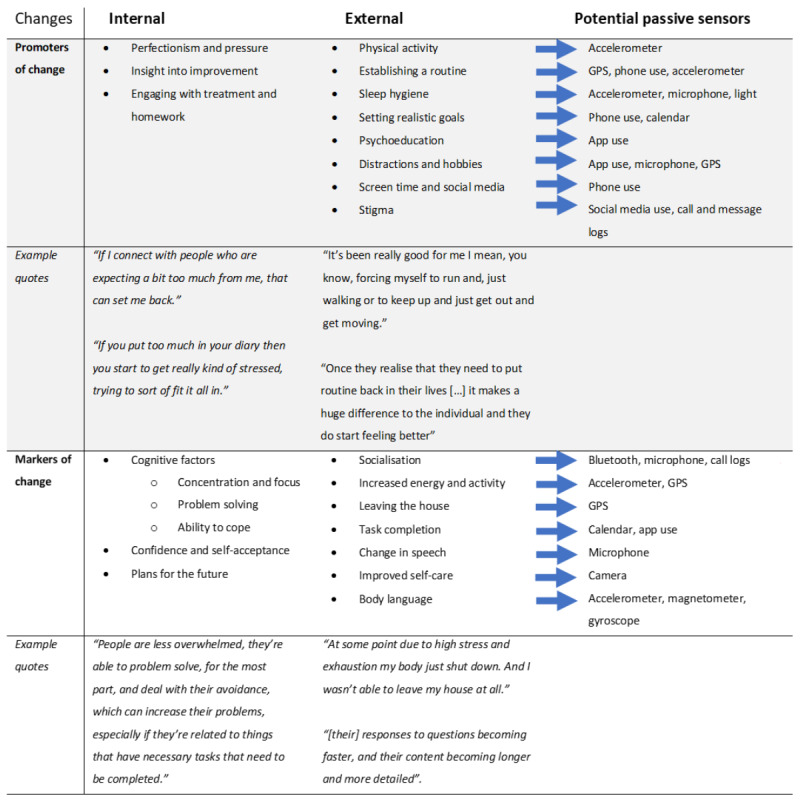
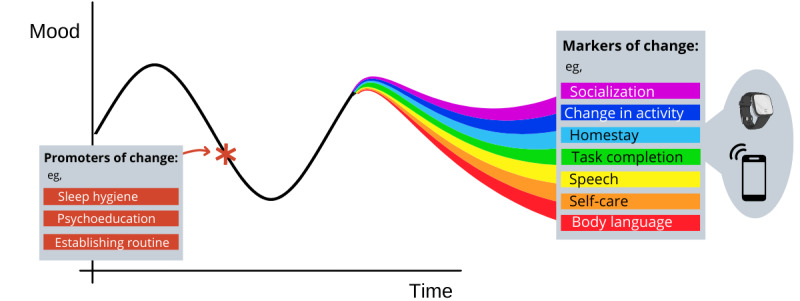
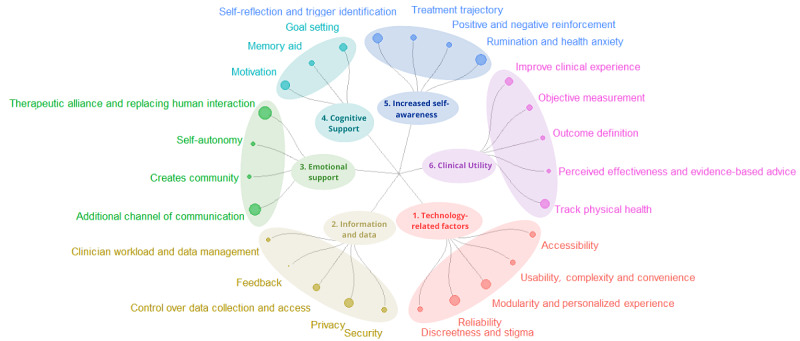
Emerging themes on clinical targets fell into the following two main categories: promoters and markers of change. The former are behaviors that participants engage in to promote mental health, and the latter signal a change in mood. These themes were further subdivided into external changes (changes in behavior) or internal changes (changes in thoughts or feelings) and mapped with potential digital sensors. The following six implementation acceptability themes emerged: technology-related factors, information and data management, emotional support, cognitive support, increased self-awareness, and clinical utility.
The promoters versus markers of change differentiation have implications for a causal model of digital phenotyping in depression, which this paper presents. Internal versus external subdivisions are helpful in determining which factors are more susceptible to being measured by using active versus passive methods. The implications for implementation within psychotherapy are discussed with regard to treatment effectiveness, service provision, and patient and clinician experience.
智能手机和可穿戴设备等远程测量技术可通过加强疾病特征描述和监测来改善抑郁症的治疗效果。然而,对于对患者和临床医生具有临床意义的数字结果知之甚少。此外,如果要在治疗中成功应用这些技术,就必须考虑利益相关者对其在治疗中实施的障碍和促进因素的看法。
本研究旨在确定抑郁症数字健康研究具有临床意义的目标,并探讨对其在心理服务中实施的态度。
采用扎根理论方法对来自3个焦点小组的定性数据进行分析,这些焦点小组的参与者包括目前被诊断为抑郁症的患者以及有超过6个月心理治疗经验的临床医生(N = 22)。
关于临床目标的新出现主题分为以下两个主要类别:改变的促进因素和标志。前者是参与者为促进心理健康而从事的行为,后者表明情绪的变化。这些主题进一步细分为外部变化(行为变化)或内部变化(思想或情感变化),并与潜在的数字传感器进行映射。出现了以下六个实施可接受性主题:技术相关因素、信息和数据管理、情感支持、认知支持、自我意识增强和临床效用。
改变促进因素与标志的区分对本文提出的抑郁症数字表型因果模型具有影响。内部与外部细分有助于确定哪些因素更易于通过主动与被动方法进行测量。本文从治疗效果、服务提供以及患者和临床医生体验方面讨论了在心理治疗中实施的意义。