• 文献检索
  • 文档翻译
  • 深度研究
  • 学术资讯
  • Suppr Zotero 插件Zotero 插件
  • 邀请有礼
  • 套餐&价格
  • 历史记录
应用&插件
Suppr Zotero 插件Zotero 插件浏览器插件Mac 客户端Windows 客户端微信小程序
定价
高级版会员购买积分包购买API积分包
服务
文献检索文档翻译深度研究API 文档MCP 服务
关于我们
关于 Suppr公司介绍联系我们用户协议隐私条款
关注我们

Suppr 超能文献

核心技术专利:CN118964589B侵权必究
粤ICP备2023148730 号-1Suppr @ 2026

文献检索

告别复杂PubMed语法,用中文像聊天一样搜索,搜遍4000万医学文献。AI智能推荐,让科研检索更轻松。

立即免费搜索

文件翻译

保留排版,准确专业,支持PDF/Word/PPT等文件格式,支持 12+语言互译。

免费翻译文档

深度研究

AI帮你快速写综述,25分钟生成高质量综述,智能提取关键信息,辅助科研写作。

立即免费体验

基于互联网的叙事项目(对抗污名的奇妙冒险)对减少精神疾病污名的影响:通过互动和污名内容的中介作用进行随机对照试验。

The Effects of Internet-Based Storytelling Programs (Amazing Adventure Against Stigma) in Reducing Mental Illness Stigma With Mediation by Interactivity and Stigma Content: Randomized Controlled Trial.

机构信息

Department of Psychology, The Chinese University of Hong Kong, Hong Kong, Hong Kong.

出版信息

J Med Internet Res. 2022 Aug 12;24(8):e37973. doi: 10.2196/37973.

DOI:10.2196/37973
PMID:35969460
原文链接:https://pmc.ncbi.nlm.nih.gov/articles/PMC9419045/
Abstract

BACKGROUND

Mental illness stigma has been a global concern, owing to its adverse effects on the recovery of people with mental illness, and may delay help-seeking for mental health because of the concern of being stigmatized. With technological advancement, internet-based interventions for the reduction of mental illness stigma have been developed, and these effects have been promising.

OBJECTIVE

This study aimed to examine the differential effects of internet-based storytelling programs, which varied in the levels of interactivity and stigma content, in reducing mental illness stigma.

METHODS

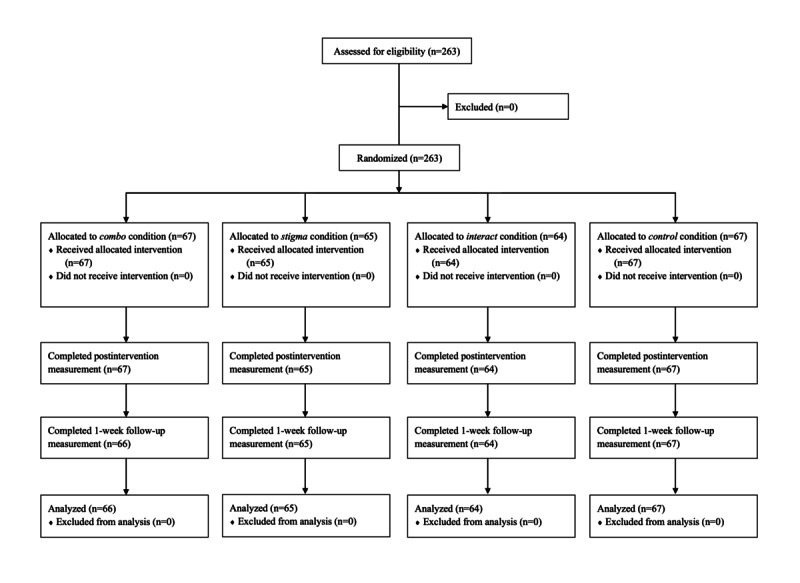
Using an experimental design, this study compared the effects of 4 storytelling websites that varied in the levels of interactivity and stigma content. Specifically, the conditions included an interactive website with stigma-related content (combo condition), a noninteractive website with stigma-related content (stigma condition), an interactive website without stigma-related content (interact condition), and a noninteractive website without stigma-related content (control condition). Participants were recruited via mass emails to all students and staff of a public university and via social networking sites. Eligible participants were randomized into the following four conditions: combo (n=67), stigma (n=65), interact (n=64), or control (n=67). The participants of each group viewed the respective web pages at their own pace. Public stigma, microaggression, and social distance were measured on the web before the experiment, after the experiment, and at the 1-week follow-up. Perceived autonomy and immersiveness, as mediators, were assessed after the experiment.

RESULTS

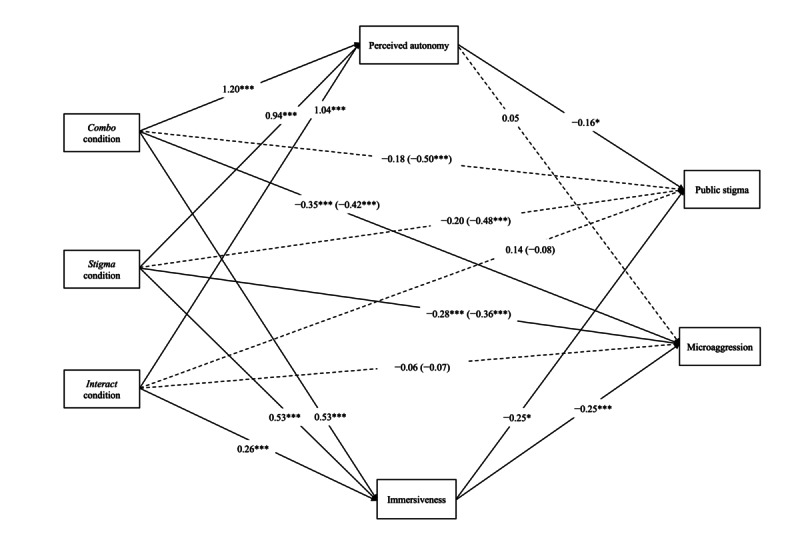
Both the combo (n=66) and stigma (n=65) conditions were effective in reducing public stigma and microaggression toward people with mental illness after the experiment and at the 1-week follow-up. However, none of the conditions had significant time×condition effects in reducing the social distance from people with mental illness. The interact condition (n=64) significantly reduced public stigma after the experiment (P=.02) but not at the 1-week follow-up (P=.22). The control condition (n=67) did not significantly reduce all outcomes associated with mental illness stigma. Perceived autonomy was found to mediate the effect of public stigma (P=.56), and immersiveness mediated the effect of microaggression (P=.99).

CONCLUSIONS

Internet-based storytelling programs with stigma-related content and interactivity elicited the largest effects in stigma reduction, including reductions in public stigma and microaggression, although only its difference with internet-based storytelling programs with stigma-related content was not statistically significant. In other words, although interactivity could strengthen the stigma reduction effect, stigma-related content was more critical than interactivity in reducing stigma. Future stigma reduction efforts should prioritize the production of effective stigma content on their web pages, followed by considering the value of incorporating interactivity in future internet-based storytelling programs.

TRIAL REGISTRATION

ClinicalTrials.gov NCT05333848; https://clinicaltrials.gov/ct2/show/NCT05333848.
https://cdn.ncbi.nlm.nih.gov/pmc/blobs/bedd/9419045/14dafd4b319c/jmir_v24i8e37973_fig2.jpg
https://cdn.ncbi.nlm.nih.gov/pmc/blobs/bedd/9419045/246ae243cc74/jmir_v24i8e37973_fig1.jpg
https://cdn.ncbi.nlm.nih.gov/pmc/blobs/bedd/9419045/14dafd4b319c/jmir_v24i8e37973_fig2.jpg
https://cdn.ncbi.nlm.nih.gov/pmc/blobs/bedd/9419045/246ae243cc74/jmir_v24i8e37973_fig1.jpg
https://cdn.ncbi.nlm.nih.gov/pmc/blobs/bedd/9419045/14dafd4b319c/jmir_v24i8e37973_fig2.jpg
摘要

背景

精神疾病污名化是一个全球性问题,因为它对精神疾病患者的康复有不良影响,而且可能会因为担心被污名化而延迟寻求心理健康帮助。随着技术的进步,已经开发出了基于互联网的干预措施来减少精神疾病污名化,这些措施已经取得了可喜的效果。

目的

本研究旨在检验基于互联网的叙事项目在减少精神疾病污名化方面的不同效果,这些项目在互动性和污名内容方面存在差异。

方法

本研究采用实验设计,比较了 4 个基于互联网的叙事网站的效果,这些网站在互动性和污名内容方面存在差异。具体来说,这些条件包括一个具有污名相关内容的互动网站(组合条件)、一个具有污名相关内容的非互动网站(污名条件)、一个没有污名相关内容的互动网站(互动条件)和一个没有污名相关内容的非互动网站(对照条件)。通过向一所公立大学的所有学生和员工发送群发电子邮件以及通过社交网站招募参与者。符合条件的参与者被随机分配到以下四个条件之一:组合(n=67)、污名(n=65)、互动(n=64)或对照(n=67)。每个组的参与者都可以按照自己的节奏浏览各自的网页。在实验前、实验后和 1 周随访时,在网上测量公众污名、微攻击和社会距离。在实验后评估了感知自主性和沉浸感作为中介变量。

结果

在实验后和 1 周随访时,组合(n=66)和污名(n=65)条件都能有效减少公众对精神疾病患者的污名和微攻击。然而,在减少与精神疾病患者的社会距离方面,没有一个条件具有显著的时间×条件效应。互动条件(n=64)在实验后显著降低了公众污名(P=.02),但在 1 周随访时没有显著降低(P=.22)。对照条件(n=67)并没有显著降低与精神疾病污名相关的所有结果。感知自主性被发现可以中介公众污名的影响(P=.56),而沉浸感则可以中介微攻击的影响(P=.99)。

结论

具有污名相关内容和互动性的基于互联网的叙事项目在减少污名方面产生了最大的效果,包括减少公众污名和微攻击,尽管与具有污名相关内容的基于互联网的叙事项目相比,其差异没有统计学意义。换句话说,尽管互动性可以增强减少污名的效果,但在减少污名方面,污名相关内容比互动性更关键。未来减少污名的努力应优先考虑在其网页上制作有效的污名内容,然后再考虑在未来的基于互联网的叙事项目中纳入互动性的价值。

试验注册

ClinicalTrials.gov NCT05333848;https://clinicaltrials.gov/ct2/show/NCT05333848。

相似文献

1
The Effects of Internet-Based Storytelling Programs (Amazing Adventure Against Stigma) in Reducing Mental Illness Stigma With Mediation by Interactivity and Stigma Content: Randomized Controlled Trial.基于互联网的叙事项目(对抗污名的奇妙冒险)对减少精神疾病污名的影响:通过互动和污名内容的中介作用进行随机对照试验。
J Med Internet Res. 2022 Aug 12;24(8):e37973. doi: 10.2196/37973.
2
The Effects of Immersive Virtual Reality in Reducing Public Stigma of Mental Illness in the University Population of Hong Kong: Randomized Controlled Trial.沉浸式虚拟现实对减少香港大学生群体对精神疾病污名化的影响:随机对照试验。
J Med Internet Res. 2021 Jul 14;23(7):e23683. doi: 10.2196/23683.
3
Do Web-based Mental Health Literacy Interventions Improve the Mental Health Literacy of Adult Consumers? Results From a Systematic Review.基于网络的心理健康素养干预措施能否提高成年消费者的心理健康素养?一项系统评价的结果
J Med Internet Res. 2016 Jun 20;18(6):e165. doi: 10.2196/jmir.5463.
4
From the Experience of Interactivity and Entertainment to Lower Intention to Smoke: A Randomized Controlled Trial and Path Analysis of a Web-Based Smoking Prevention Program for Adolescents.从互动与娱乐体验到降低吸烟意愿:一项针对青少年的网络戒烟预防计划的随机对照试验及路径分析
J Med Internet Res. 2017 Feb 16;19(2):e44. doi: 10.2196/jmir.7174.
5
Challenging the Stigma of Mental Illness Through Creative Storytelling: A Randomized Controlled Trial of This Is My Brave.通过创意叙事挑战精神疾病污名化:《这是我的勇敢》的随机对照试验。
Community Ment Health J. 2021 Jan;57(1):144-152. doi: 10.1007/s10597-020-00625-4. Epub 2020 May 9.
6
A randomised controlled trial of repeated filmed social contact on reducing mental illness-related stigma in young adults.一项随机对照试验研究了重复的录像社会接触对减少青年成年人与精神疾病相关的耻辱感的效果。
Epidemiol Psychiatr Sci. 2018 Apr;27(2):199-208. doi: 10.1017/S2045796016001050. Epub 2016 Dec 19.
7
Internet-based interventions to promote mental health help-seeking in elite athletes: an exploratory randomized controlled trial.基于互联网的促进精英运动员寻求心理健康帮助的干预措施:一项探索性随机对照试验。
J Med Internet Res. 2012 Jun 29;14(3):e69. doi: 10.2196/jmir.1864.
8
The effects of interactivity on information processing and attitude change: implications for mental health stigma.互动对信息处理和态度改变的影响:对心理健康污名化的启示。
Health Commun. 2010 Mar;25(2):142-54. doi: 10.1080/10410230903544936.
9
Effects of a multilingual information website intervention on the levels of depression literacy and depression-related stigma in Greek-born and Italian-born immigrants living in Australia: a randomized controlled trial.多语言信息网站干预对居住在澳大利亚的希腊裔和意大利裔移民抑郁知识水平及抑郁相关耻辱感的影响:一项随机对照试验。
J Med Internet Res. 2011 Apr 19;13(2):e34. doi: 10.2196/jmir.1527.
10
Reducing Stigma Toward People with Serious Mental Illness Through a Virtual Reality Intervention: A Randomized Controlled Trial.通过虚拟现实干预减少对严重精神疾病患者的污名化:一项随机对照试验。
Games Health J. 2024 Feb;13(1):57-64. doi: 10.1089/g4h.2023.0118. Epub 2023 Sep 11.

引用本文的文献

1
Evolving role of the internet in China as a medium for promoting psychological well-being and mental health: a scoping review.互联网在中国作为促进心理健康和精神健康媒介的角色演变:一项范围综述
Lancet Reg Health West Pac. 2025 Mar 19;56:101515. doi: 10.1016/j.lanwpc.2025.101515. eCollection 2025 Mar.
2
Digital empowerment in mental health: A meta-analysis of internet-based interventions for enhancing mental health literacy.心理健康中的数字赋能:基于互联网的增强心理健康素养干预措施的荟萃分析。
Int J Clin Health Psychol. 2024 Jul-Sep;24(3):100489. doi: 10.1016/j.ijchp.2024.100489. Epub 2024 Aug 6.
3
The Impact of Video-Based Microinterventions on Attitudes Toward Mental Health and Help Seeking in Youth: Web-Based Randomized Controlled Trial.

本文引用的文献

1
The use of virtual reality in studying prejudice and its reduction: A systematic review.虚拟现实在研究偏见及其减少方面的应用:系统评价。
PLoS One. 2022 Jul 14;17(7):e0270748. doi: 10.1371/journal.pone.0270748. eCollection 2022.
2
Anti-stigma training and positive changes in mental illness stigma outcomes in medical students in ten countries: a mediation analysis on pathways via empathy development and anxiety reduction.抗污名培训和十国医学生精神疾病污名结局的积极变化:通过同理心发展和焦虑减轻的中介分析。
Soc Psychiatry Psychiatr Epidemiol. 2022 Sep;57(9):1861-1873. doi: 10.1007/s00127-022-02284-0. Epub 2022 Apr 22.
3
基于视频的微干预对青少年心理健康态度及求助行为的影响:网络随机对照试验
J Med Internet Res. 2024 Apr 24;26:e54478. doi: 10.2196/54478.
4
The Promotion of Mental Health and Prevention of First-Episode Psychosis: A Pilot and Feasibility Non-Randomised Clinical Trial.促进心理健康和预防首发精神病:一项试点和可行性非随机临床试验。
Int J Environ Res Public Health. 2023 Nov 20;20(22):7087. doi: 10.3390/ijerph20227087.
5
A Systematic Narrative Review of Implementation, Processes, and Outcomes of Human Library.系统叙事性综述:人类图书馆的实施、过程和结果
Int J Environ Res Public Health. 2023 Jan 30;20(3):2485. doi: 10.3390/ijerph20032485.
Addressing Mental Health Stigma in Low-Income and Middle-Income Countries: A New Frontier for Digital Mental Health.
应对低收入和中等收入国家的心理健康污名化:数字心理健康的新前沿。
Ethics Med Public Health. 2021 Dec;19. doi: 10.1016/j.jemep.2021.100719. Epub 2021 Sep 24.
4
The Effects of Immersive Virtual Reality in Reducing Public Stigma of Mental Illness in the University Population of Hong Kong: Randomized Controlled Trial.沉浸式虚拟现实对减少香港大学生群体对精神疾病污名化的影响:随机对照试验。
J Med Internet Res. 2021 Jul 14;23(7):e23683. doi: 10.2196/23683.
5
A Call to Action. A Critical Review of Mental Health Related Anti-stigma Campaigns.行动呼吁:心理健康相关反污名运动的批判性回顾
Front Public Health. 2021 Jan 8;8:569539. doi: 10.3389/fpubh.2020.569539. eCollection 2020.
6
Instagram as a Window to Societal Perspective on Mental Health, Gender, and Race: Observational Pilot Study.Instagram作为了解社会对心理健康、性别和种族看法的窗口:观察性试点研究。
JMIR Ment Health. 2020 Oct 27;7(10):e19171. doi: 10.2196/19171.
7
Mental health stigma among college students: Test of an interactive online intervention.大学生心理健康污名:一项互动式在线干预的检验。
J Am Coll Health. 2022 Aug-Sep;70(6):1831-1838. doi: 10.1080/07448481.2020.1826492. Epub 2020 Oct 13.
8
Reducing Mental Health Stigma Through Identification With Video Game Avatars With Mental Illness.通过认同患有精神疾病的电子游戏角色来减少心理健康污名化。
Front Psychol. 2020 Sep 9;11:2240. doi: 10.3389/fpsyg.2020.02240. eCollection 2020.
9
Psychiatry teaching amongst medical undergraduates: stories that matter and mediators of better learning outcome.精神医学教学在医学生中的应用:有意义的故事和更好学习成果的中介。
Postgrad Med. 2020 Sep;132(7):590-594. doi: 10.1080/00325481.2020.1774178. Epub 2020 Jun 1.
10
Challenging the Stigma of Mental Illness Through Creative Storytelling: A Randomized Controlled Trial of This Is My Brave.通过创意叙事挑战精神疾病污名化:《这是我的勇敢》的随机对照试验。
Community Ment Health J. 2021 Jan;57(1):144-152. doi: 10.1007/s10597-020-00625-4. Epub 2020 May 9.