Department of Integrative Biology, The University of Texas at Austin, Austin, TX 78712.
World Health Organization Collaborating Centre for Infectious Disease Epidemiology and Control, School of Public Health, Li Ka Shing Faculty of Medicine, The University of Hong Kong, Hong Kong Special Administrative Region, China.
Proc Natl Acad Sci U S A. 2022 Aug 23;119(34):e2200652119. doi: 10.1073/pnas.2200652119. Epub 2022 Aug 15.
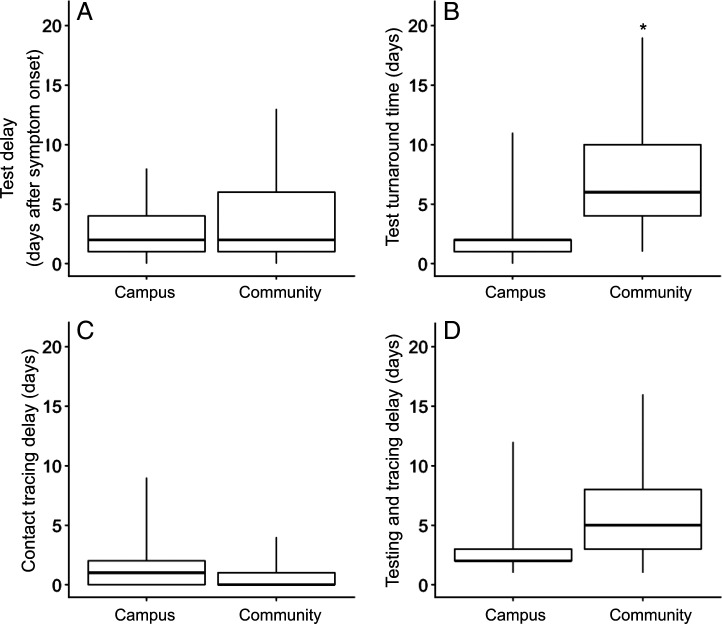
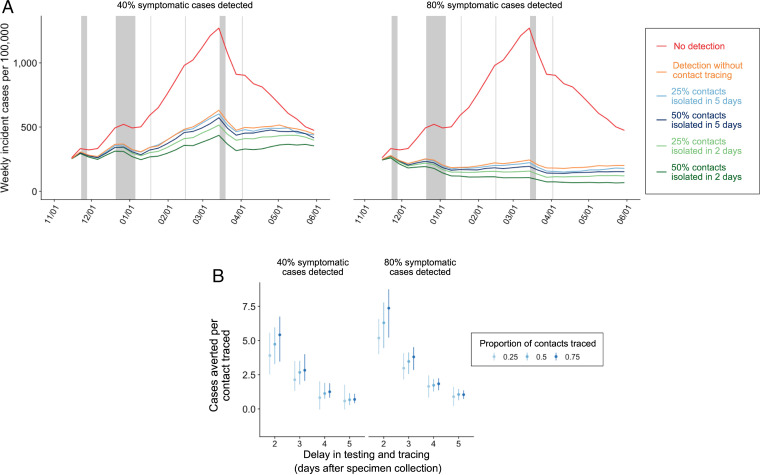
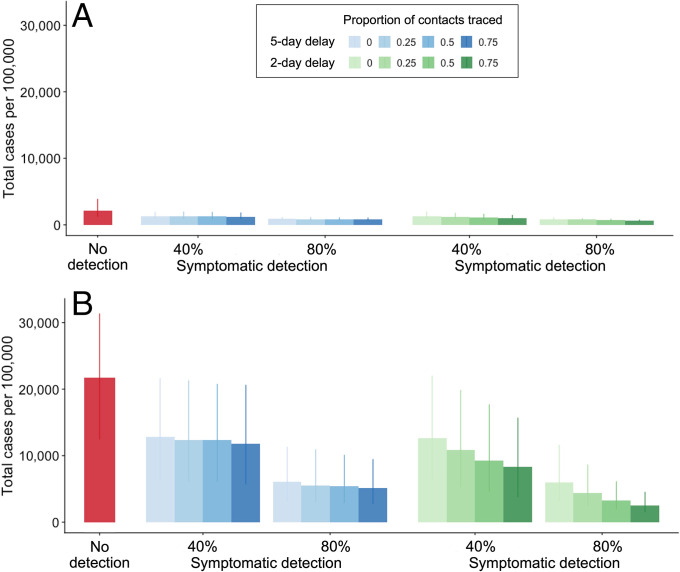
Although testing, contact tracing, and case isolation programs can mitigate COVID-19 transmission and allow the relaxation of social distancing measures, few countries worldwide have succeeded in scaling such efforts to levels that suppress spread. The efficacy of test-trace-isolate likely depends on the speed and extent of follow-up and the prevalence of SARS-CoV-2 in the community. Here, we use a granular model of COVID-19 transmission to estimate the public health impacts of test-trace-isolate programs across a range of programmatic and epidemiological scenarios, based on testing and contact tracing data collected on a university campus and surrounding community in Austin, TX, between October 1, 2020, and January 1, 2021. The median time between specimen collection from a symptomatic case and quarantine of a traced contact was 2 days (interquartile range [IQR]: 2 to 3) on campus and 5 days (IQR: 3 to 8) in the community. Assuming a reproduction number of 1.2, we found that detection of 40% of all symptomatic cases followed by isolation is expected to avert 39% (IQR: 30% to 45%) of COVID-19 cases. Contact tracing is expected to increase the cases averted to 53% (IQR: 42% to 58%) or 40% (32% to 47%), assuming the 2- and 5-day delays estimated on campus and in the community, respectively. In a tracing-accelerated scenario, in which 75% of contacts are notified the day after specimen collection, cases averted increase to 68% (IQR: 55% to 72%). An accelerated contact tracing program leveraging rapid testing and electronic reporting of test results can significantly curtail local COVID-19 transmission.
尽管测试、接触者追踪和病例隔离计划可以减轻 COVID-19 的传播,并允许放宽社会距离措施,但全球很少有国家成功地将这些努力扩大到能够抑制传播的水平。测试-追踪-隔离的效果可能取决于后续的速度和程度,以及社区中 SARS-CoV-2 的流行程度。在这里,我们使用 COVID-19 传播的细粒度模型,根据 2020 年 10 月 1 日至 2021 年 1 月 1 日在德克萨斯州奥斯汀的一所大学校园和周边社区收集的测试和接触者追踪数据,在一系列计划和流行病学场景下估计测试-追踪-隔离计划对公共卫生的影响。从有症状的病例采集样本到追踪到的接触者隔离的中位数时间为校园内 2 天(四分位距[IQR]:2 至 3)和社区内 5 天(IQR:3 至 8)。假设繁殖数为 1.2,我们发现检测到所有有症状病例的 40%,然后进行隔离,预计可以避免 39%(IQR:30%至 45%)的 COVID-19 病例。接触者追踪预计将避免的病例增加到 53%(IQR:42%至 58%)或 40%(32%至 47%),分别假设在校园和社区中估计的 2 天和 5 天的延迟。在加速追踪的情况下,如果 75%的接触者在标本采集后的第二天被通知,避免的病例增加到 68%(IQR:55%至 72%)。利用快速测试和测试结果的电子报告的加速接触者追踪计划可以显著遏制当地 COVID-19 的传播。