Department of Nutrition and Food Hygiene, School of Public Health, Capital Medical University, No.10, Xitoutiao, Youanmenwai, Fengtai District, Beijing, 100069, People's Republic of China.
Obstetrical Department, Fuxing Hospital, Capital Medical University, Beijing, 100045, People's Republic of China.
Lipids Health Dis. 2022 Aug 15;21(1):71. doi: 10.1186/s12944-022-01688-w.
Maternal lipid levels during pregnancy are critical for fetal development. Recent studies revealed that high-density lipoprotein cholesterol (HDL-c) levels during pregnancy were negatively correlated with birthweight. High-density lipoprotein 2 cholesterol (HDL2-c) is one of the major subclasses of HDL-c, and its relationship with birthweight is unclear. Association of HDL2-c concentration in the first trimester and risk of large for gestational age (LGA) was explored.
This study recruited pregnant women who registered in Fuxing Hospital from October 2018 to January 2020, had regular obstetric examinations during pregnancy, and delivered between June 2019 and September 2020. Finally, 549 participants were recruited for the study. Maternal demographic characteristics and venous blood were collected at the 6th-14th gestational week, and serum total cholesterol (TC), triglyceride (TG), HDL-c, HDL2-c, high-density lipoprotein 3 cholesterol (HDL3-c), and low-density lipoprotein cholesterol (LDL-c) concentrations were detected. Neonatal characteristics were collected at delivery. A logistic regression model was used to explore the relationship between the first trimester HDL2-c concentration and LGA incidence. A nomogram was developed, and the performance was evaluated with a concordance index.
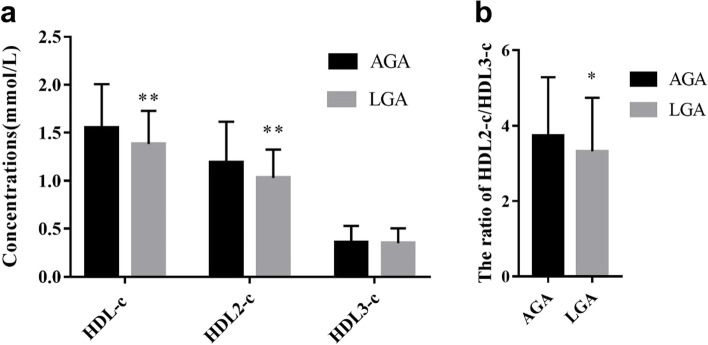
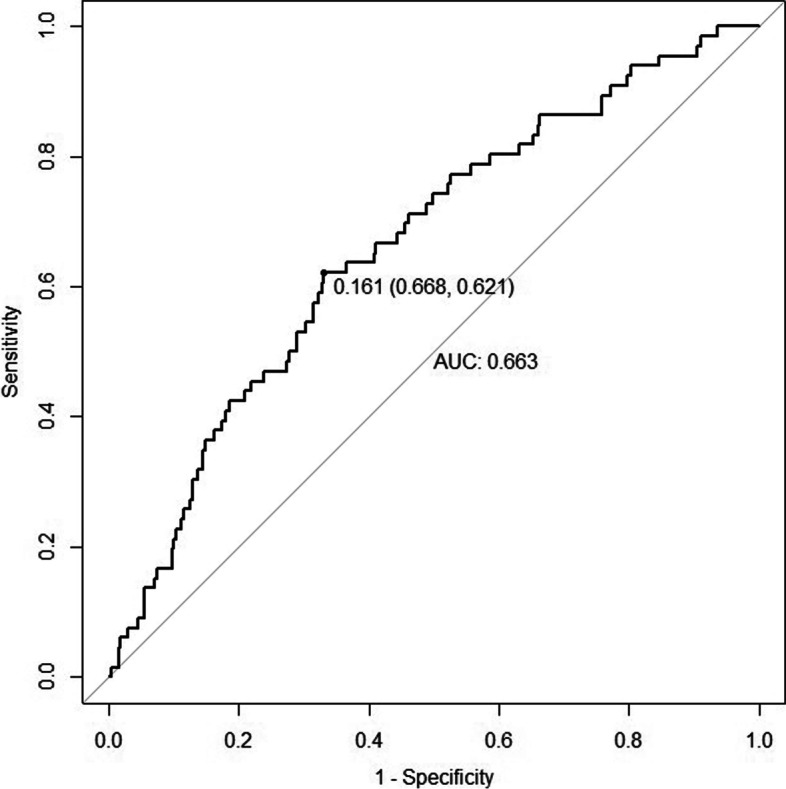
Seventy-five mothers delivered LGA infants, and the LGA incidence was 13.66%. LGA mothers had significantly lower serum HDL-c and HDL2-c concentrations than appropriate for gestational age (AGA) mothers. A logistic regression model showed that HDL2-c concentration was negatively correlated with LGA risk (odds ratio (OR) = 0.237, 95% confidence intervals (CI): 0.099-0.567, P = 0.001) when adjusted for age, prepregnancy body mass index (BMI), and parity. A nomogram was generated using all these risk factors. The area under the curve (AUC) was 0.663 (95% CI: 0.593-0.732).
Maternal HDL2-c concentration in the first trimester was negatively correlated with the risk of LGA.
孕妇的血脂水平对胎儿发育至关重要。最近的研究表明,孕妇的高密度脂蛋白胆固醇(HDL-c)水平与出生体重呈负相关。高密度脂蛋白 2 胆固醇(HDL2-c)是 HDL-c 的主要亚类之一,但其与出生体重的关系尚不清楚。本研究探讨了孕早期 HDL2-c 浓度与巨大儿(LGA)风险的关系。
本研究招募了 2018 年 10 月至 2020 年 1 月在复兴医院登记、孕期定期产检、2019 年 6 月至 2020 年 9 月分娩的孕妇,最终纳入 549 名研究对象。收集孕妇第 6-14 孕周的一般人口学特征及静脉血,检测血清总胆固醇(TC)、三酰甘油(TG)、高密度脂蛋白胆固醇(HDL-c)、HDL2-c、高密度脂蛋白 3 胆固醇(HDL3-c)和低密度脂蛋白胆固醇(LDL-c)浓度。分娩时收集新生儿特征。采用 logistic 回归模型探讨孕早期 HDL2-c 浓度与 LGA 发生率的关系。建立列线图,并采用一致性指数评估其性能。
75 名母亲分娩的婴儿为 LGA,LGA 发生率为 13.66%。与适于胎龄(AGA)母亲相比,LGA 母亲的血清 HDL-c 和 HDL2-c 浓度显著降低。logistic 回归模型显示,在校正年龄、孕前体质量指数(BMI)和产次后,HDL2-c 浓度与 LGA 风险呈负相关(比值比(OR)=0.237,95%置信区间(CI):0.099-0.567,P=0.001)。使用所有这些危险因素生成了一个列线图。曲线下面积(AUC)为 0.663(95%CI:0.593-0.732)。
孕早期母体 HDL2-c 浓度与 LGA 风险呈负相关。