Li Jiamin, Zhang Qiuwen, Wu Xinjuan, Pang Dong
Department of Nursing, Peking Union Medical College Hospital, Chinese Academy of Medical Sciences & Peking Union Medical College, Beijing, People's Republic of China.
School of Nursing, Health Science Center for Evidence-Based Nursing, Peking University, Beijing, People's Republic of China.
Risk Manag Healthc Policy. 2022 Aug 9;15:1517-1529. doi: 10.2147/RMHP.S378684. eCollection 2022.
To systematically search ostomy clinical practice guidelines, critically assess their quality and clinical applicability of recommendations, and summarize the recommendations.
Systematic review.
The PubMed, ProQuest and CINAHL databases, eight guideline databases, and three ostomy institution websites were searched on September 3, 2021.
Appraisal of Guidelines for Research and Evaluation II (AGREE II) and AGREE Recommendation EXcellence (AGREE-REX) were used to assess the guideline.
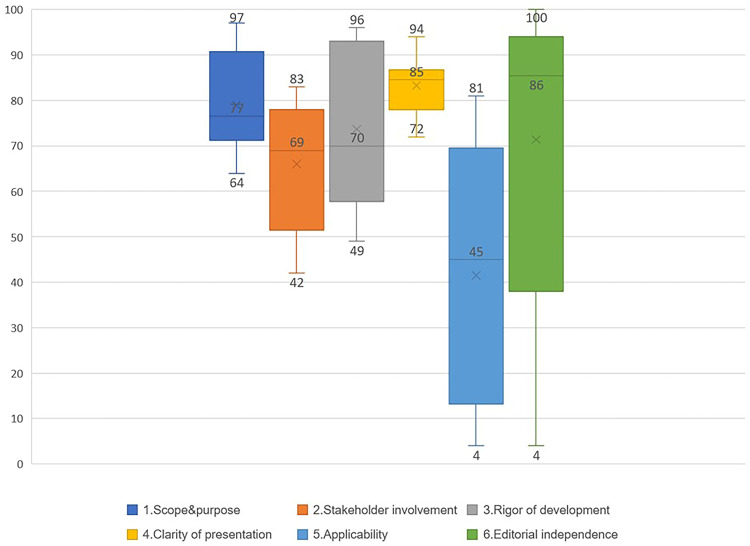
The initial search identified 1475 documents. Of these, 27 full-text documents were reviewed. Finally, 10 guidelines were included. Among these, the 2019 Registered Nurses' Association of Ontario (RNAO) guidelines had the highest total scores using AGREE II and AGREE-REX. The 2019 National Institute for Health and Care Excellence (NICE) and 2018 European Hernia Society (EHS) were also ranked as high-quality and evaluated as "recommended." The median of the "applicability" domain was the lowest (45%) among the six AGREE II domains. The median of the "values and preferences" domain was the lowest (38%) among the three AGREE-REX domains. In total, 172 recommendations were summarized and parastomal hernia received the most attention among the recommendations.
The quality of the 10 clinical practice guidelines varied widely. The three identified high-quality guidelines might be appropriate first choices in daily ostomy care and management practice and can be tailored to the local context. Ostomy guidelines require further improvement in the "applicability" and "values and preferences" domains.
This review only searched and evaluated relevant documents, so such details do not apply to this review.
系统检索造口术临床实践指南,严格评估其质量及推荐意见的临床适用性,并总结推荐意见。
系统评价。
于2021年9月3日检索了PubMed、ProQuest和CINAHL数据库、八个指南数据库以及三个造口术机构网站。
采用《研究与评价指南II》(AGREE II)和《AGREE推荐卓越性》(AGREE-REX)对指南进行评估。
初步检索共识别出1475篇文献。其中,对27篇全文文献进行了综述。最终纳入10项指南。其中,2019年安大略省注册护士协会(RNAO)指南在AGREE II和AGREE-REX评估中总分最高。2019年英国国家卫生与临床优化研究所(NICE)指南和2018年欧洲疝学会(EHS)指南也被评为高质量并被评估为“推荐”。在AGREE II的六个领域中,“适用性”领域的中位数最低(45%)。在AGREE-REX的三个领域中,“价值观和偏好”领域的中位数最低(38%)。共总结出172条推荐意见,其中造口旁疝在推荐意见中受到的关注最多。
10项临床实践指南的质量差异很大。所确定的三项高质量指南可能是日常造口护理和管理实践中的合适首选,并可根据当地情况进行调整。造口术指南在“适用性”和“价值观和偏好”领域需要进一步改进。
本综述仅检索和评估了相关文献,因此此类细节不适用于本综述。