Institute of Nutrition and Functional Foods (INAF), Faculty of Agriculture and Food Sciences, Laval University, Québec, Quebec, Canada.
Centre de Recherche en Organogenèse Expérimentale de l Université Laval/LOEX, Centre de Recherche du CHU de Québec-Université Laval, Axe Médecine Régénératrice, Québec, Quebec, Canada.
Microbiol Spectr. 2022 Oct 26;10(5):e0243221. doi: 10.1128/spectrum.02432-21. Epub 2022 Aug 16.
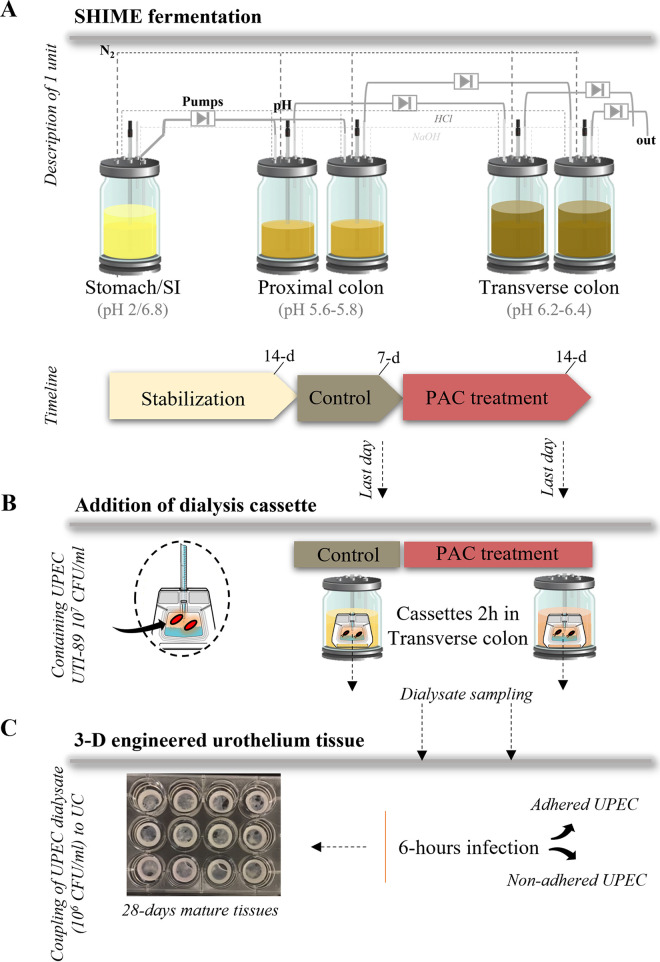
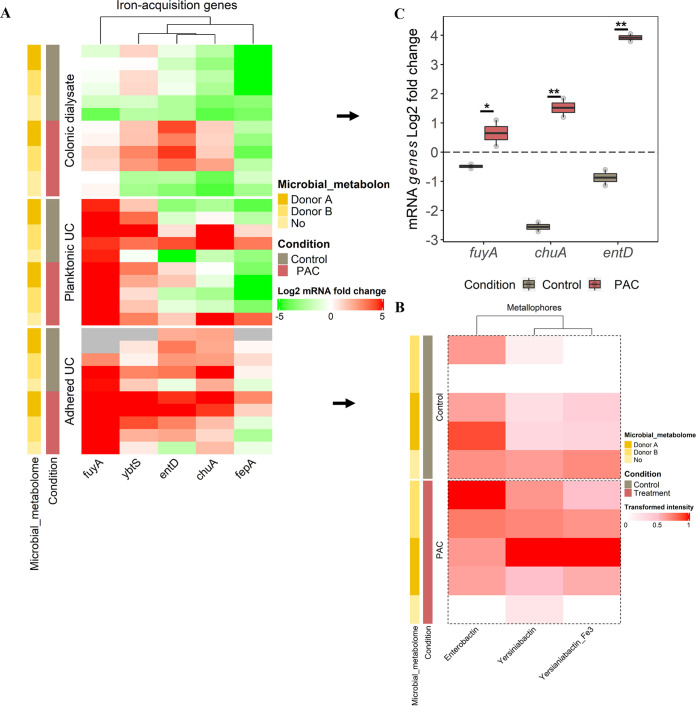
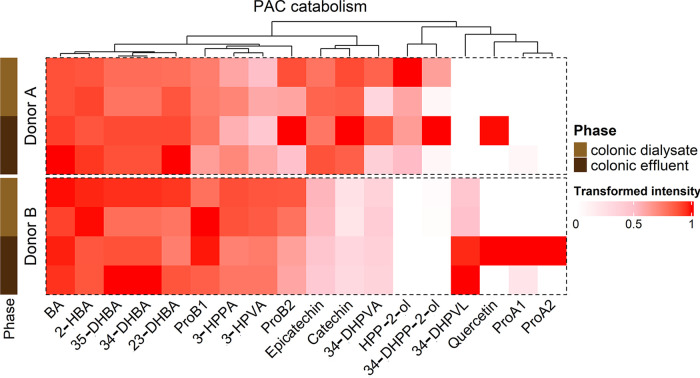
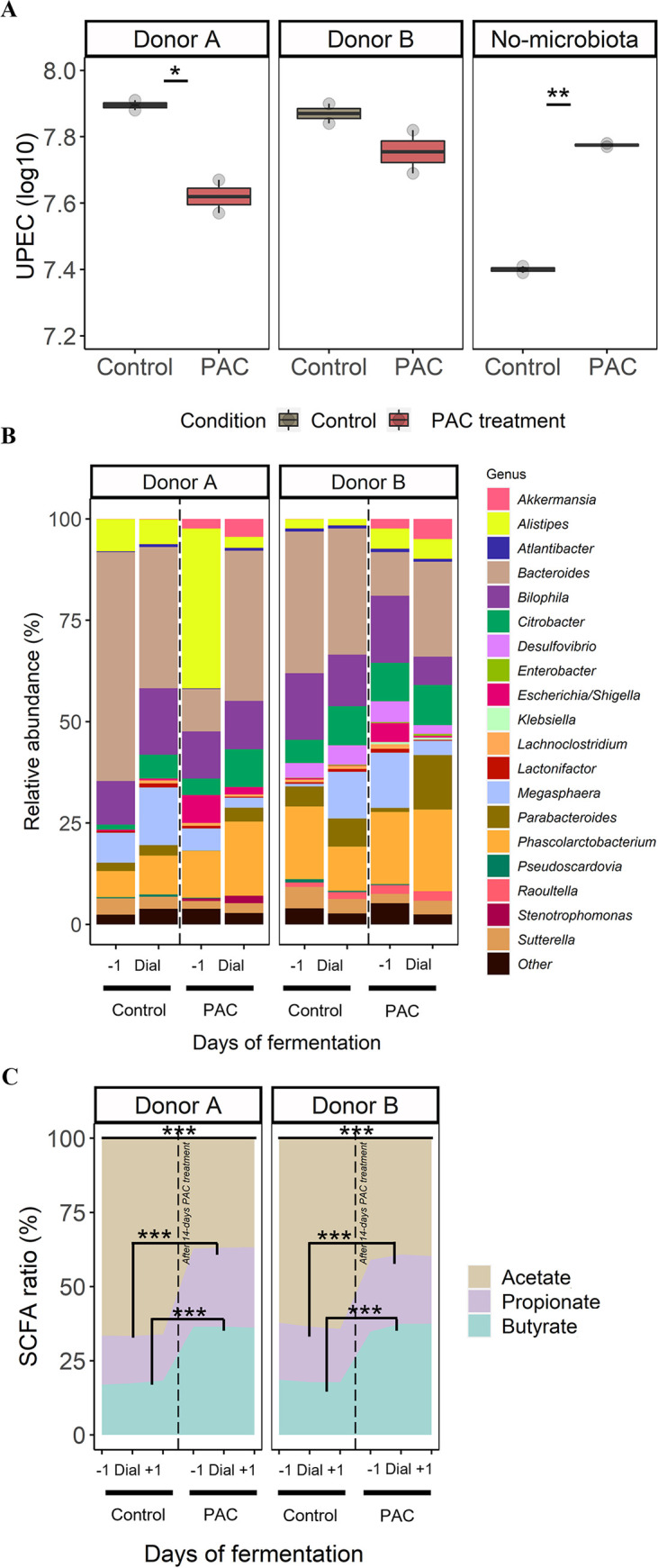
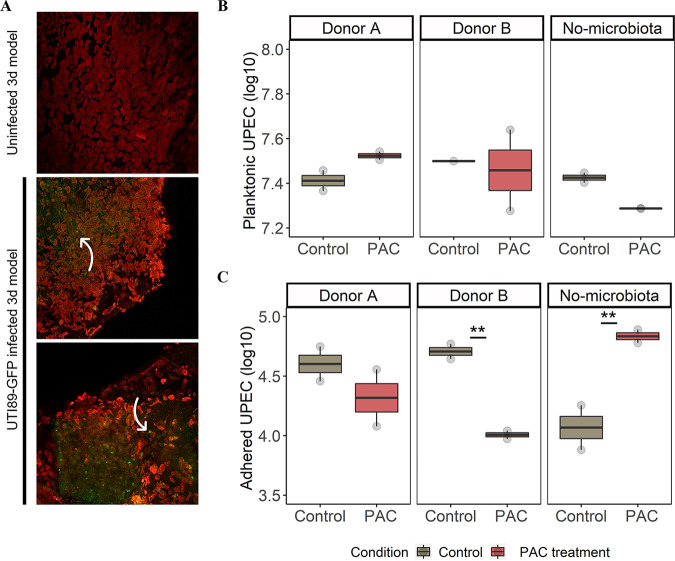
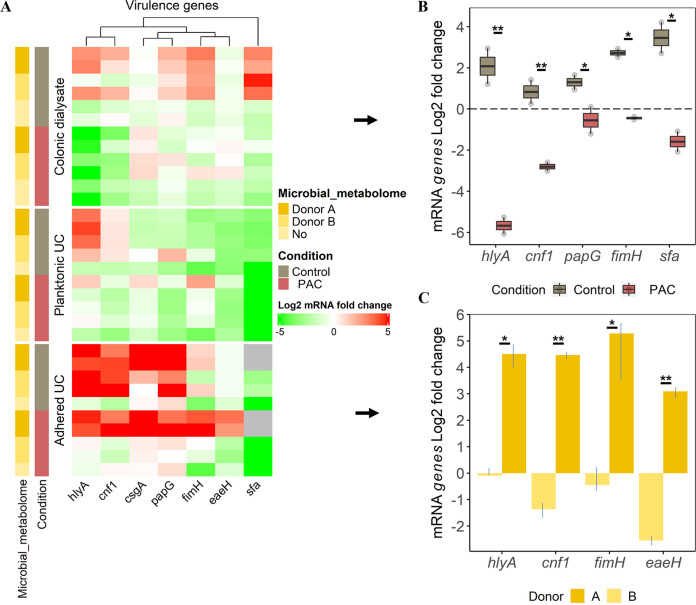
Uropathogenic Escherichia coli (UPEC) ecology-pathophysiology from the gut reservoir to its urothelium infection site is poorly understood, resulting in equivocal benefits in the use of cranberry as prophylaxis against urinary tract infections. To add further understanding from the previous findings on PAC antiadhesive properties against UPEC, we assessed in this study the effects of proanthocyanidins (PAC) rich cranberry extract microbial metabolites on UTI89 virulence and fitness in contrasting ecological UPEC's environments. For this purpose, we developed an original model combining a colonic fermentation system (SHIME) with a dialysis cassette device enclosing UPEC and a 3D tissue-engineered urothelium. Two healthy fecal donors inoculated the colons. Dialysis cassettes containing 7log CFU/mL UTI89 were immersed for 2h in the SHIME colons to assess the effect of untreated (7-day control diet)/treated (14-day PAC-rich extract) metabolomes on UPEC behavior. Engineered urothelium were then infected with dialysates containing UPEC for 6 h. This work demonstrated for the first time that in the control fecal microbiota condition without added PAC, the UPEC virulence genes were activated upstream the infection site, in the gut. However, PAC microbial-derived cranberry metabolites displayed a remarkable propensity to blunt activation of genes encoding toxin, adhesin/invasins in the gut and on the urothelium, in a donor-dependent manner. Variability in subjects' gut microbiota and ensuing contrasting cranberry PAC metabolism affects UPEC virulence and should be taken into consideration when designing cranberry efficacy clinical trials. Uropathogenic Escherichia coli (UPEC) are the primary cause of recurrent urinary tract infections (UTI). The poor understanding of UPEC ecology-pathophysiology from its reservoir-the gut, to its infection site-the urothelium, partly explains the inadequate and abusive use of antibiotics to treat UTI, which leads to a dramatic upsurge in antibiotic-resistance cases. In this context, we evaluated the effect of a cranberry proanthocyanidins (PAC)-rich extract on the UPEC survival and virulence in a bipartite model of a gut microbial environment and a 3D urothelium model. We demonstrated that PAC-rich cranberry extract microbial metabolites significantly blunt activation of UPEC virulence genes at an early stage in the gut reservoir. We also showed that altered virulence in the gut affects infectivity on the urothelium in a microbiota-dependent manner. Among the possible mechanisms, we surmise that specific microbial PAC metabolites may attenuate UPEC virulence, thereby explaining the preventative, yet contentious properties of cranberry against UTI.
尿路致病性大肠杆菌(UPEC)从肠道储库到尿路上皮感染部位的生态病理生理学知之甚少,这导致使用蔓越莓作为预防尿路感染的方法效果存在争议。为了在前人关于 PAC 抗粘附特性对抗 UPEC 的研究基础上进一步深入了解,我们在这项研究中评估了富含原花青素(PAC)的蔓越莓提取物微生物代谢物对不同生态 UPEC 环境中 UTI89 毒力和适应性的影响。为此,我们开发了一种原始模型,将结肠发酵系统(SHIME)与包含 UPEC 的透析盒装置以及 3D 组织工程尿路上皮结合在一起。两名健康的粪便供体接种了结肠。将含有 7log CFU/mL UTI89 的透析盒浸入 SHIME 结肠中 2 小时,以评估未经处理(7 天对照饮食)/处理(14 天富含 PAC 的提取物)代谢物对 UPEC 行为的影响。然后,用含有 UPEC 的透析液感染工程化的尿路上皮 6 小时。这项工作首次证明,在没有添加 PAC 的对照粪便微生物群条件下,UPEC 的毒力基因在上游感染部位被激活,在肠道中被激活。然而,PAC 微生物衍生的蔓越莓代谢物以一种依赖供体的方式显示出显著的倾向,可以阻止毒素、粘附素/侵袭素在肠道和尿路上皮中的基因激活。受试者肠道微生物群的变异性以及随之而来的蔓越莓 PAC 代谢的差异会影响 UPEC 的毒力,在设计蔓越莓疗效临床试验时应考虑到这一点。
尿路致病性大肠杆菌(UPEC)是复发性尿路感染(UTI)的主要原因。UPEC 从其储库-肠道到感染部位-尿路上皮的生态病理生理学知之甚少,这部分解释了抗生素治疗 UTI 的不充分和滥用,导致抗生素耐药性病例急剧增加。在这种情况下,我们评估了富含蔓越莓原花青素(PAC)的提取物对肠道微生物环境和 3D 尿路上皮模型中 UPEC 存活和毒力的影响。我们证明,富含 PAC 的蔓越莓提取物微生物代谢物可显著阻止 UPEC 毒力基因在肠道储库的早期激活。我们还表明,肠道中改变的毒力以依赖微生物群的方式影响尿路上皮的感染性。在可能的机制中,我们推测特定的微生物 PAC 代谢物可能会减弱 UPEC 的毒力,从而解释了蔓越莓预防尿路感染的有争议的特性。