Lab of Experimental Oncology, State Key Laboratory of Biotherapy and Cancer Center, and Frontiers Science Center for Disease-Related Molecular Network, West China Hospital, Sichuan University, Chengdu, Sichuan, 610041, China.
Signal Transduct Target Ther. 2022 Aug 17;7(1):275. doi: 10.1038/s41392-022-01096-7.
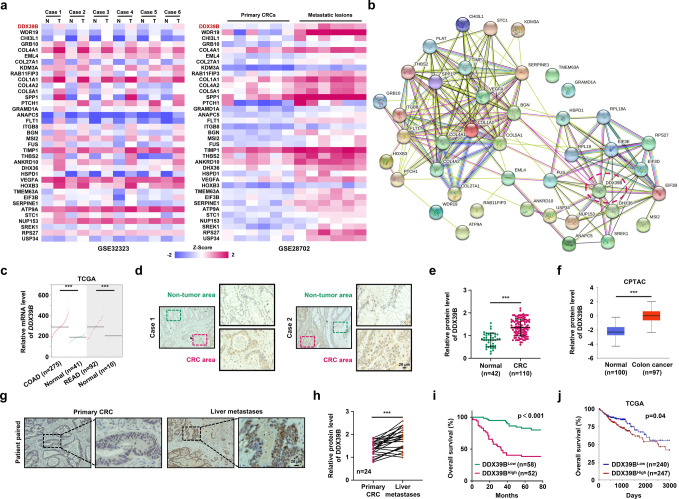
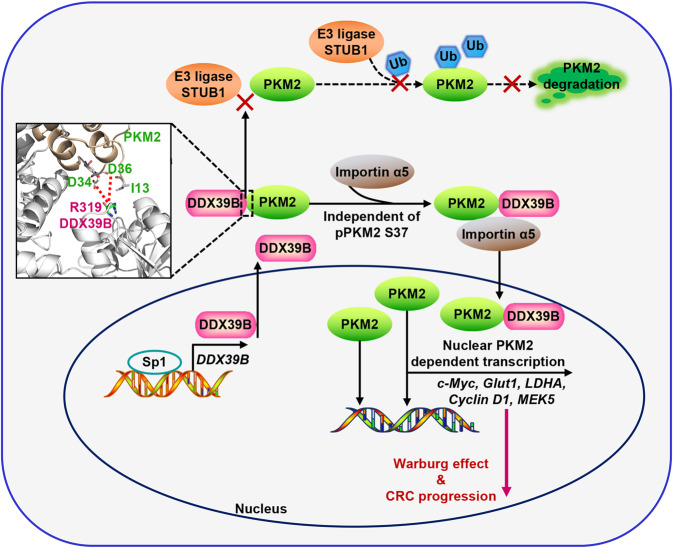
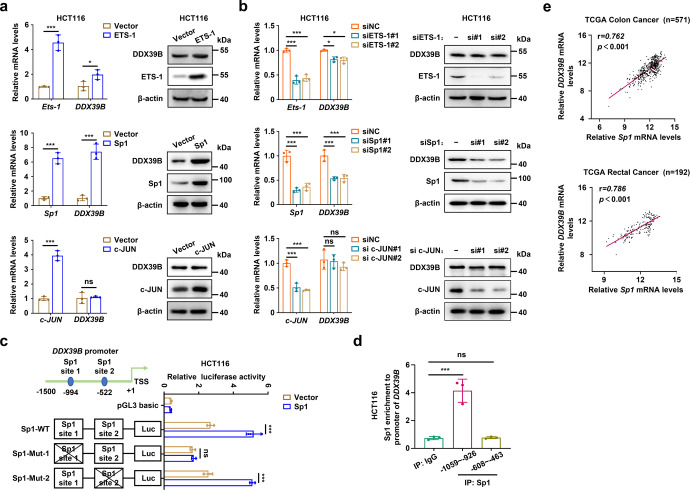
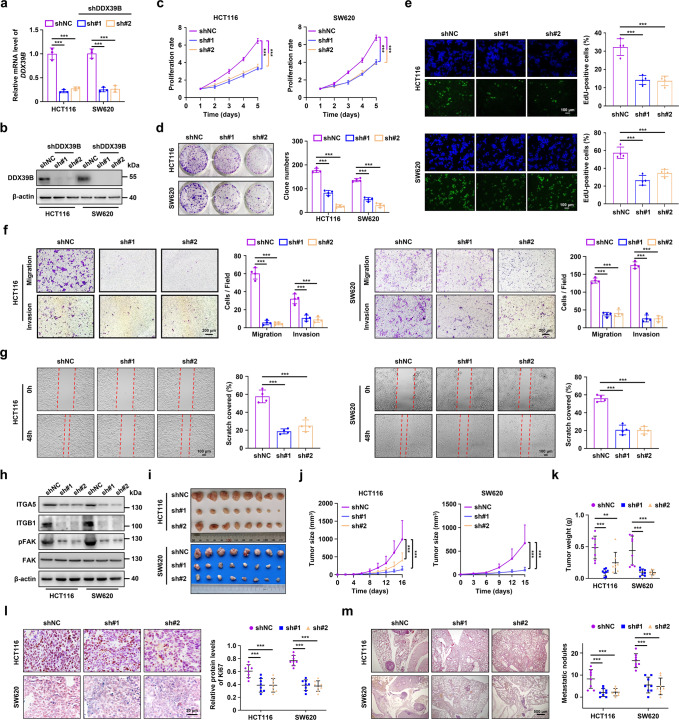
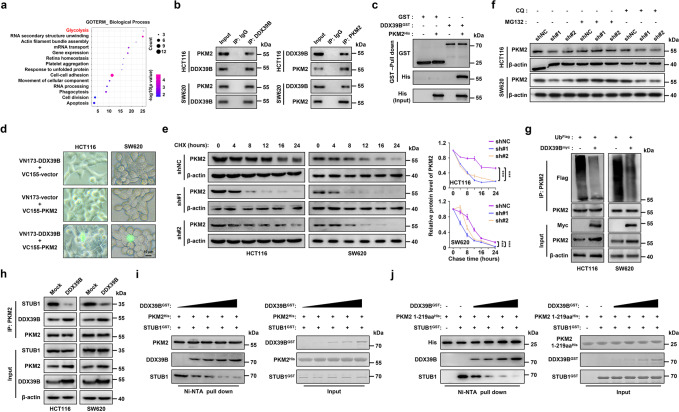
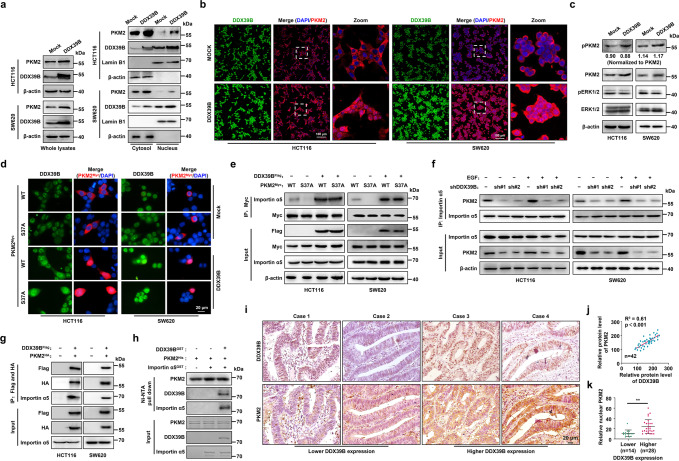
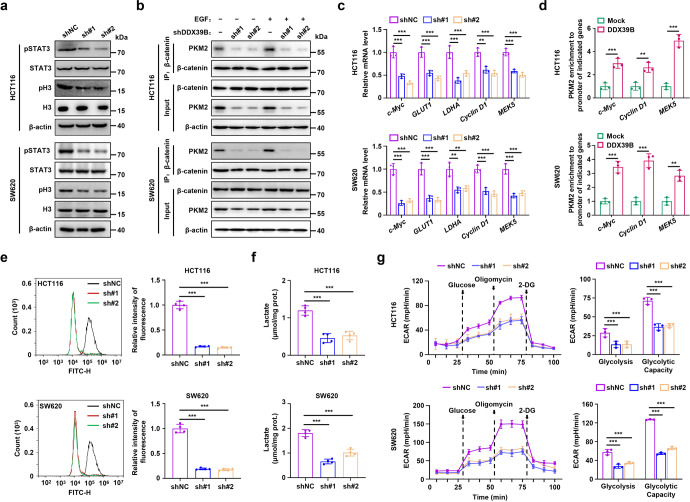
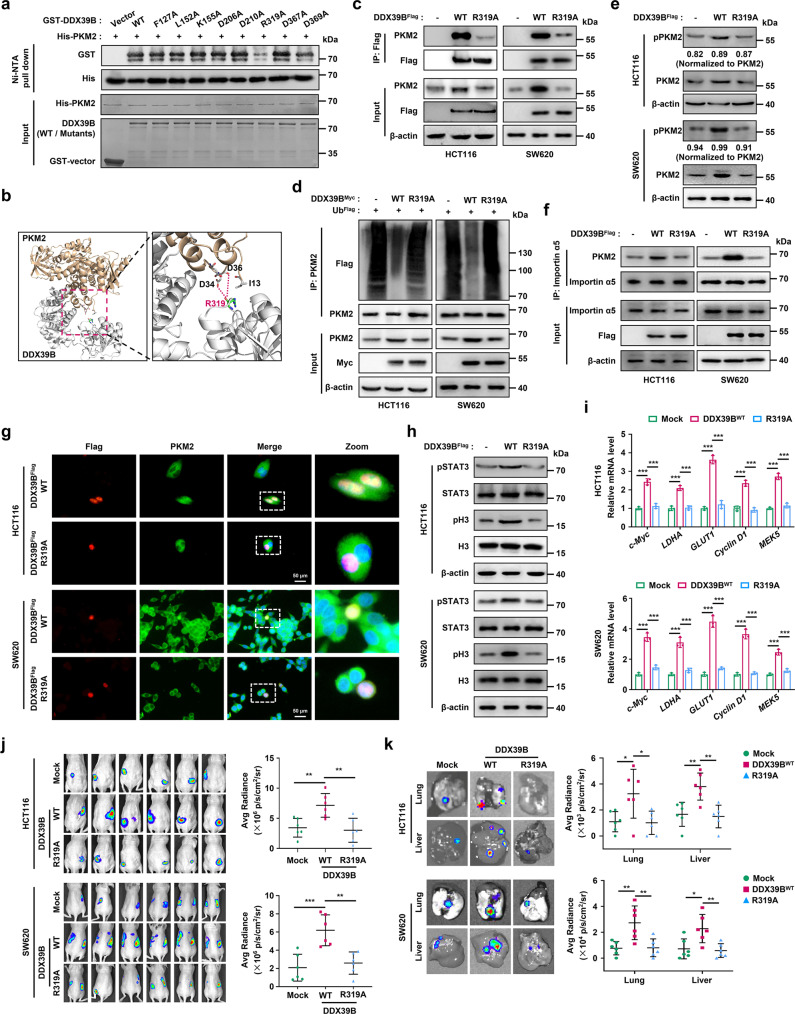
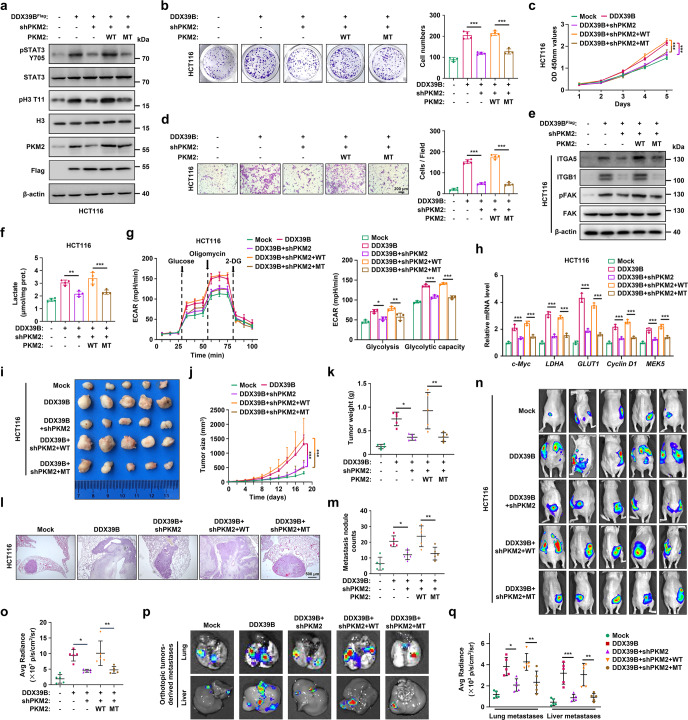
Metastasis is a major cause of colorectal cancer (CRC) mortality, but its molecular mechanisms are still not fully understood. Here, we show that upregulated DDX39B correlates with liver metastases and aggressive phenotypes in CRC. DDX39B is an independent prognostic factor associated with poor clinical outcome in CRC patients. We demonstrate that Sp1 potently activates DDX39B transcription by directly binding to the GC box of the DDX39B promoter in CRC cells. DDX39B overexpression augments the proliferation, migration, and invasion of CRC cells, while the opposite results are obtained in DDX39B-deficient CRC cells. Mechanistically, DDX39B interacts directly with and stabilizes PKM2 by competitively suppressing STUB1-mediated PKM2 ubiquitination and degradation. Importantly, DDX39B recruits importin α5 to accelerate the nuclear translocation of PKM2 independent of ERK1/2-mediated phosphorylation of PKM2, leading to the transactivation of oncogenes and glycolysis-related genes. Consequently, DDX39B enhances glucose uptake and lactate production to activate Warburg effect in CRC. We identify that Arg319 of DDX39B is required for PKM2 binding as well as PKM2 nuclear accumulation and for DDX39B to promote CRC growth and metastasis. In addition, blocking PKM2 nuclear translocation or treatment with glycolytic inhibitor 2-deoxy-D-glucose efficiently abolishes DDX39B-triggered malignant development in CRC. Taken together, our findings uncover a key role for DDX39B in modulating glycolytic reprogramming and aggressive progression, and implicate DDX39B as a potential therapeutic target in CRC.
转移是结直肠癌(CRC)死亡的主要原因,但它的分子机制仍不完全清楚。在这里,我们表明上调的 DDX39B 与 CRC 的肝转移和侵袭表型相关。DDX39B 是与 CRC 患者不良临床结局相关的独立预后因素。我们证明 Sp1 通过直接结合 CRC 细胞中 DDX39B 启动子的 GC 盒,有力地激活了 DDX39B 的转录。DDX39B 的过表达增强了 CRC 细胞的增殖、迁移和侵袭,而在 DDX39B 缺陷型 CRC 细胞中则得到相反的结果。在机制上,DDX39B 通过竞争性抑制 STUB1 介导的 PKM2 泛素化和降解,直接与 PKM2 相互作用并稳定 PKM2。重要的是,DDX39B 招募 importin α5 来加速 PKM2 的核转位,而不依赖于 ERK1/2 介导的 PKM2 磷酸化,导致癌基因和糖酵解相关基因的反式激活。因此,DDX39B 增强葡萄糖摄取和乳酸产生,以激活 CRC 中的瓦博格效应。我们确定 DDX39B 的 Arg319 对于 PKM2 结合以及 PKM2 的核积累以及 DDX39B 促进 CRC 生长和转移都是必需的。此外,阻断 PKM2 的核转位或用糖酵解抑制剂 2-脱氧-D-葡萄糖处理可有效消除 DDX39B 触发的 CRC 恶性发展。总之,我们的研究结果揭示了 DDX39B 在调节糖酵解重编程和侵袭性进展中的关键作用,并表明 DDX39B 是 CRC 的潜在治疗靶点。