Department for the Ecology of Animal Societies, Max Planck Institute of Animal Behavior, Constance, Germany.
Department of Biology, University of Konstanz, Constance, Germany.
Sci Rep. 2022 Aug 16;12(1):13844. doi: 10.1038/s41598-022-17259-z.
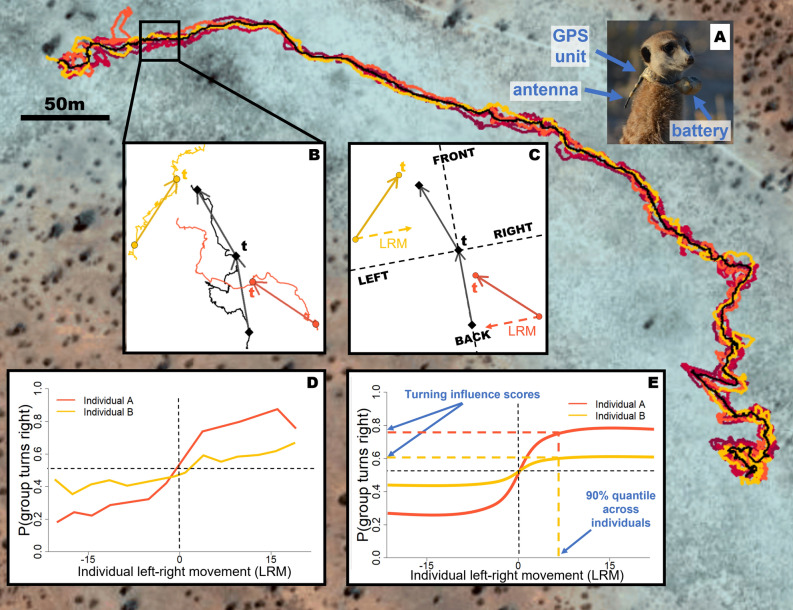
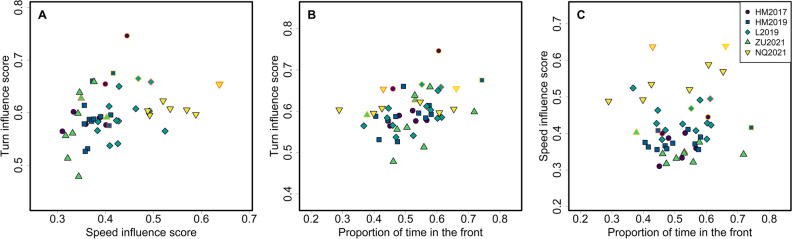
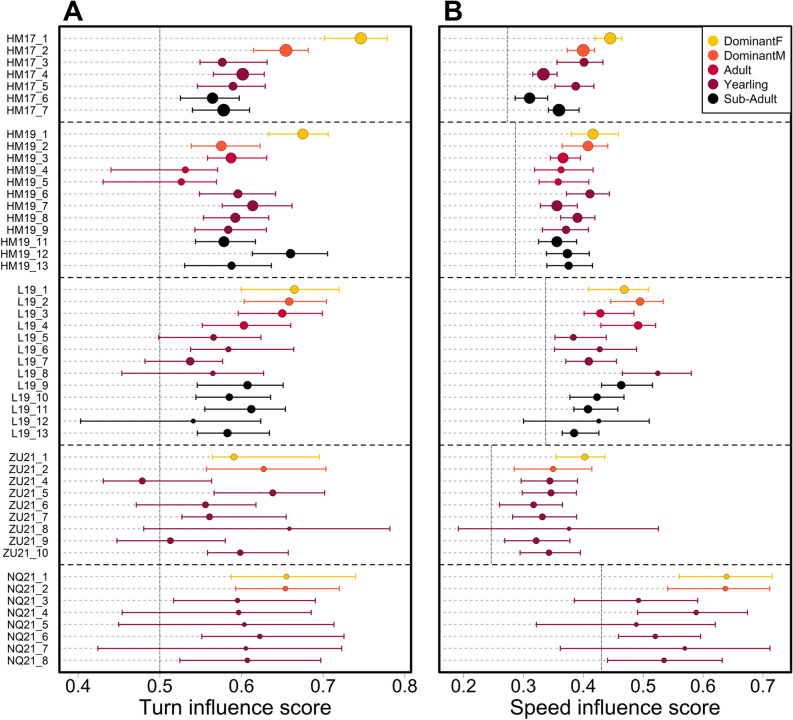
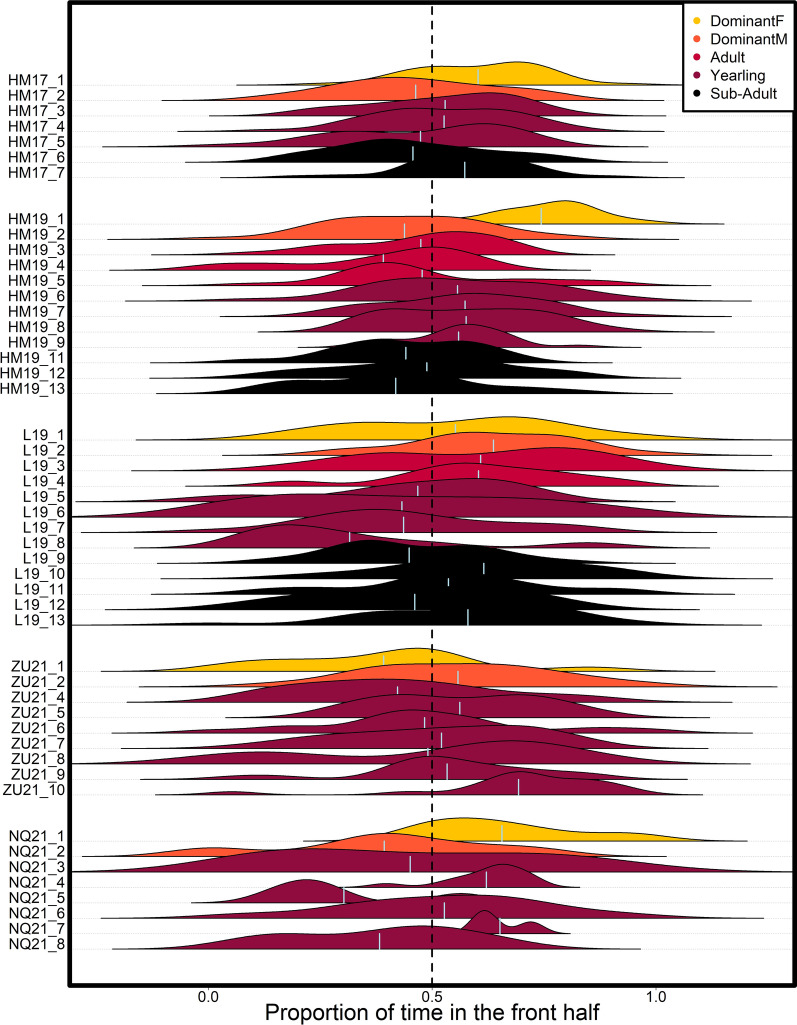
Animals that travel together in groups must constantly come to consensus about both the direction and speed of movement, often simultaneously. Contributions to collective decisions may vary among group members, yet inferring who has influence over group decisions is challenging, largely due to the multifaceted nature of influence. Here we collected high-resolution GPS data from five habituated meerkat groups in their natural habitat during foraging and developed a method to quantify individual influence over both group direction and speed. We find that individual influence over direction and speed are correlated, but also exhibit substantial variation. Comparing patterns across social statuses reveals that dominant females have higher influence than other individuals over both group direction and speed. Individuals with high influence also tend to spend more time in the front of the group. We discuss our results in light of meerkat life-history and current literature on influence during group movement. Our method provides a general approach which can be applied to disentangle individual influence over group direction and speed in a wide range of species with cohesive movement, emphasizing the importance of integrating multiple lines of inquiry when inferring influence in moving animal groups.
动物在群体中一起旅行时,必须经常就运动的方向和速度达成一致,通常是同时进行。群体成员对集体决策的贡献可能有所不同,但推断谁对群体决策有影响具有挑战性,这主要是由于影响的多面性。在这里,我们在自然栖息地收集了五只习惯化的猫鼬群体在觅食过程中的高分辨率 GPS 数据,并开发了一种方法来量化个体对群体方向和速度的影响。我们发现,个体对方向和速度的影响是相关的,但也存在很大的差异。比较不同社会地位的模式表明,优势雌性对群体方向和速度的影响高于其他个体。具有高影响力的个体也往往会在群体的前面花费更多的时间。我们根据猫鼬的生活史和关于群体运动中影响的现有文献讨论了我们的结果。我们的方法提供了一种通用的方法,可以应用于分离具有凝聚力运动的广泛物种中个体对群体方向和速度的影响,强调在推断移动动物群体中的影响时,综合多种研究方法的重要性。