Farine D R, Strandburg-Peshkin A, Couzin I D, Berger-Wolf T Y, Crofoot M C
Department of Anthropology, University of California, 1 Shields Avenue, Davis, CA, USA
Smithsonian Tropical Research Institute, Ancon, Panama.
Proc Biol Sci. 2017 Apr 26;284(1853). doi: 10.1098/rspb.2016.2243.
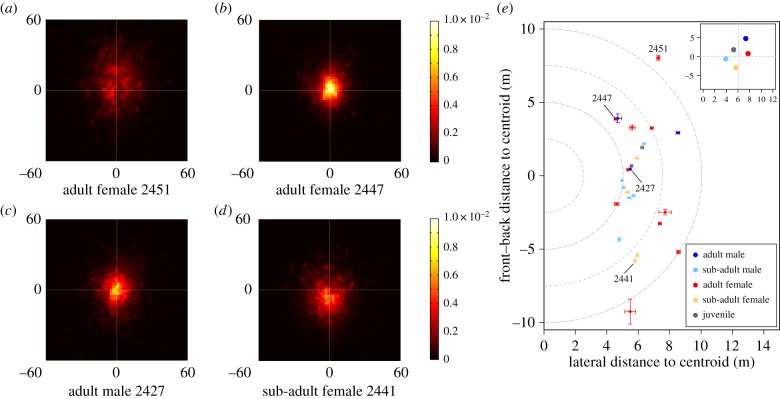
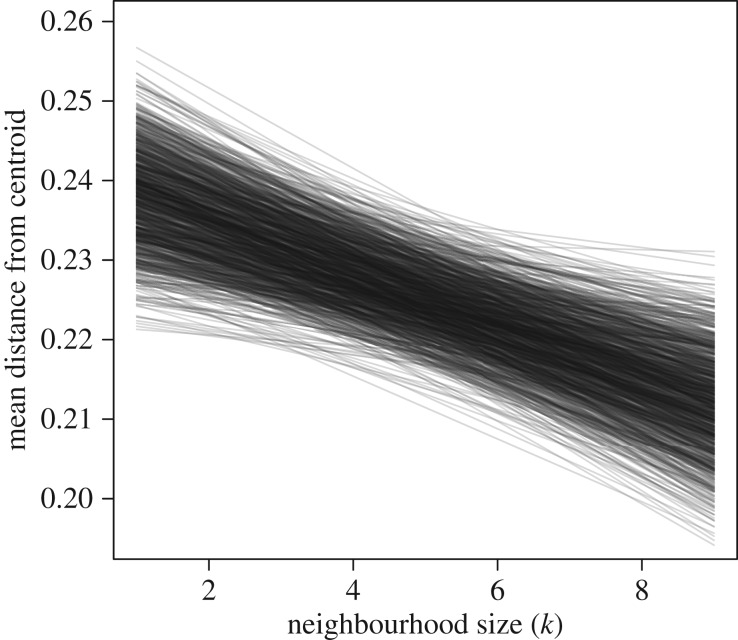
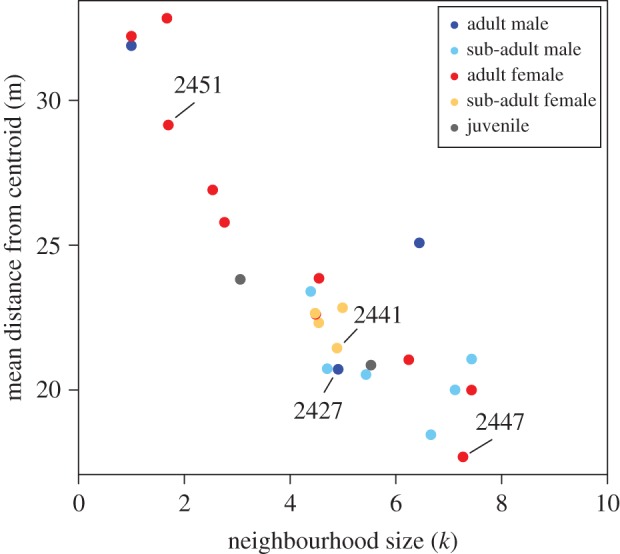
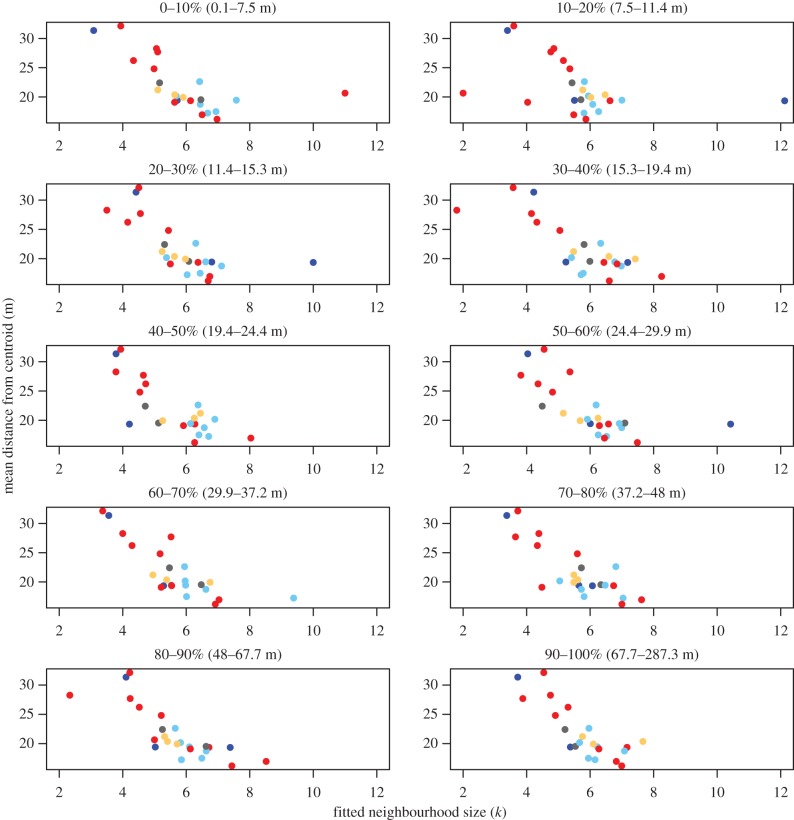
Researchers have long noted that individuals occupy consistent spatial positions within animal groups. However, an individual's position depends not only on its own behaviour, but also on the behaviour of others. Theoretical models of collective motion suggest that global patterns of spatial assortment can arise from individual variation in local interaction rules. However, this prediction remains untested. Using high-resolution GPS tracking of members of a wild baboon troop, we identify consistent inter-individual differences in within-group spatial positioning. We then apply an algorithm that identifies what number of conspecific group members best predicts the future location of each individual (we call this the individual's ) while the troop is moving. We find clear variation in the most predictive neighbourhood size, and this variation relates to individuals' propensity to be found near the centre of their group. Using simulations, we show that having different neighbourhood sizes is a simple candidate mechanism capable of linking variation in local individual interaction rules-in this case how many conspecifics an individual interacts with-to global patterns of spatial organization, consistent with the patterns we observe in wild primates and a range of other organisms.
研究人员长期以来一直指出,个体在动物群体中占据着一致的空间位置。然而,个体的位置不仅取决于其自身行为,还取决于其他个体的行为。集体运动的理论模型表明,空间分类的全局模式可能源于局部相互作用规则中的个体差异。然而,这一预测尚未得到验证。通过对一个野生狒狒群体成员进行高分辨率GPS跟踪,我们识别出群体内空间定位中个体间一致的差异。然后,我们应用一种算法,该算法能确定在群体移动时,多少数量的同种群体成员能最好地预测每个个体的未来位置(我们将此称为个体的 )。我们发现最具预测性的邻域大小存在明显差异,且这种差异与个体在群体中心附近被发现的倾向有关。通过模拟,我们表明具有不同的邻域大小是一种简单的候选机制,能够将局部个体相互作用规则的差异——在这种情况下是一个个体与多少同种个体相互作用——与空间组织的全局模式联系起来,这与我们在野生灵长类动物和一系列其他生物中观察到的模式一致。