Health Economics Research Unit, KEMRI-Wellcome Trust Research Programme, Nairobi, Kenya.
Health Systems and Research Ethics Department, KEMRI-Wellcome Trust Research Programme, Kilifi, Kenya.
BMC Health Serv Res. 2022 Aug 16;22(1):1046. doi: 10.1186/s12913-022-08432-1.
Human resources for health consume a substantial share of healthcare resources and determine the efficiency and overall performance of health systems. Under Kenya's devolved governance, human resources for health are managed by county governments. The aim of this study was to examine how the management of human resources for health influences the efficiency of county health systems in Kenya.
We conducted a case study using a mixed methods approach in two purposively selected counties in Kenya. We collected data through in-depth interviews (n = 46) with national and county level HRH stakeholders, and document and secondary data reviews. We analyzed qualitative data using a thematic approach, and quantitative data using descriptive analysis.
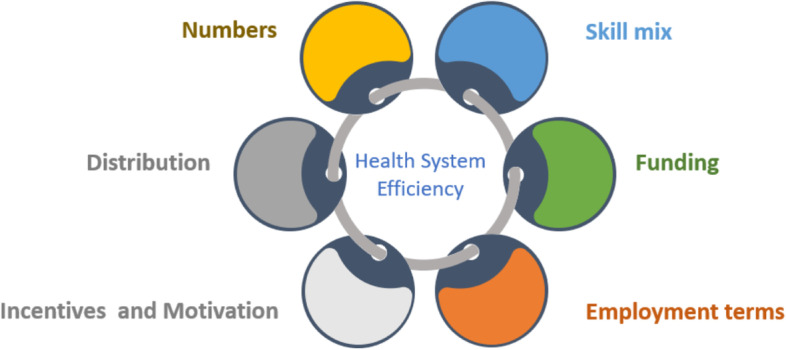
Human resources for health in the selected counties was inadequately financed and there were an insufficient number of health workers, which compromised the input mix of the health system. The scarcity of medical specialists led to inappropriate task shifting where nonspecialized staff took on the roles of specialists with potential undesired impacts on quality of care and health outcomes. The maldistribution of staff in favor of higher-level facilities led to unnecessary referrals to higher level (referral) hospitals and compromised quality of primary healthcare. Delayed salaries, non-harmonized contractual terms and incentives reduced the motivation of health workers. All of these effects are likely to have negative effects on health system efficiency.
Human resources for health management in counties in Kenya could be reformed with likely positive implications for county health system efficiency by increasing the level of funding, resolving funding flow challenges to address the delay of salaries, addressing skill mix challenges, prioritizing the allocation of health workers to lower-level facilities, harmonizing the contractual terms and incentives of health workers, and strengthening monitoring and supervision.
卫生人力资源在医疗保健资源中占有相当大的份额,并决定卫生系统的效率和整体绩效。在肯尼亚权力下放的治理下,卫生人力资源由县政府管理。本研究旨在探讨卫生人力资源管理如何影响肯尼亚县卫生系统的效率。
我们在肯尼亚两个有针对性选择的县进行了一项案例研究,采用混合方法。我们通过与国家和县级人力资源利益攸关方进行深入访谈(n=46),以及对文件和二手数据进行审查,收集数据。我们使用主题方法对定性数据进行分析,对定量数据进行描述性分析。
所选县的卫生人力资源资金不足,卫生工作者人数不足,这影响了卫生系统的投入组合。缺乏医学专家导致了不适当的任务转移,非专业人员承担了专家的角色,可能对护理质量和健康结果产生不利影响。人员在较高层次设施的分布不均导致不必要的向较高层次(转诊)医院转诊,从而影响初级卫生保健的质量。工资延迟发放、非统一合同条款和激励措施降低了卫生工作者的积极性。所有这些影响都可能对卫生系统效率产生负面影响。
肯尼亚县的卫生人力资源管理可以进行改革,增加资金水平,解决资金流动挑战以解决工资延迟问题,解决技能组合挑战,优先向较低层次设施分配卫生工作者,统一卫生工作者的合同条款和激励措施,并加强监测和监督,这可能对县卫生系统的效率产生积极影响。