Department of Epidemiology, School of Public Health, Key Laboratory of Public Health Safety of Ministry of Education, Fudan University, Shanghai, 200032, China.
Songjiang District Center for Disease Control and Prevention, Shanghai, 201600, China.
Lipids Health Dis. 2022 Aug 16;21(1):72. doi: 10.1186/s12944-022-01683-1.
The correlation between nontraditional lipids and ischemic stroke (IS) is inconsistent and controversial. This study aimed to examine the association of four nontraditional lipids with IS risk in Chinese adults.
This prospective community-based cohort study was performed in Songjiang District, Shanghai, China. The study began in 2016 and included 34,294 participants without stroke before the investigation. The association between nontraditional lipids (nonhigh-density lipoprotein cholesterol [non-HDL-C], total cholesterol/high-density lipoprotein cholesterol [TC/HDL-C], triglyceride [TG]/HDL-C, and low-density lipoprotein cholesterol [LDL-C]/HDL-C) and IS was studied with multivariate Cox regression models. The dose-response associations between these four serum lipids and IS were explored using restricted cubic spline (RCS) analysis.
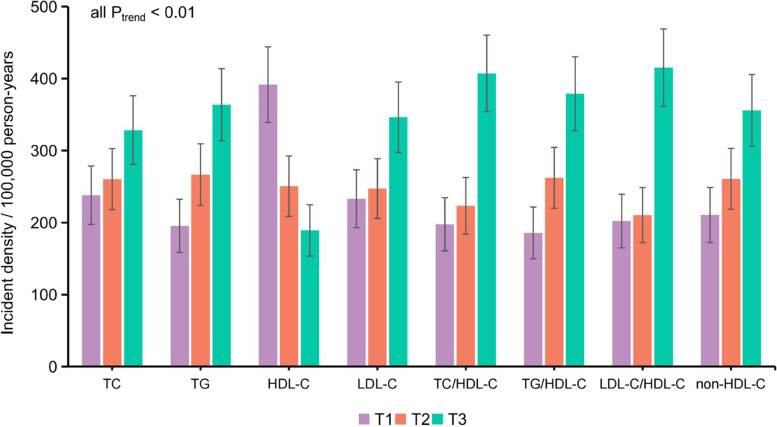
There were a total of 458 IS cases with 166,380 person-years of follow-up. Compared with the lowest tertiles, the highest tertiles of the nontraditional blood lipids showed greater IS risk after controlling for potential confounders. The hazard ratios (HRs) and 95% confidence intervals (95% CIs) were as follows: TC/HDL-C, 1.63 (1.28-2.07); TG/HDL-C, 1.65 (1.28-2.13); LDL-C/HDL-C, 1.51 (1.18-1.92); and non-HDL-C, 1.43 (1.13-1.81). The fully adjusted RCS curves presented a nonlinear relationship, and the risk increased when the TC/HDL-C, TG/HDL-C, and LDL-C/HDL-C levels were > 3.47, > 0.92, and > 1.98, respectively.
This community-based cohort study presents a positive association between the four nontraditional lipids and IS incidence. Maintaining relatively low lipid ratios can be beneficial for preventing stroke. Nontraditional lipids can be considered targets for managing blood lipids.
非传统脂质与缺血性脑卒中(IS)之间的相关性不一致且存在争议。本研究旨在探讨中国成年人中四种非传统脂质与 IS 风险的关系。
本前瞻性基于社区的队列研究在中国上海市松江区进行。研究始于 2016 年,纳入了在调查前无卒中的 34294 名参与者。使用多变量 Cox 回归模型研究非传统脂质(非高密度脂蛋白胆固醇[非-HDL-C]、总胆固醇/高密度脂蛋白胆固醇[TC/HDL-C]、甘油三酯/高密度脂蛋白胆固醇[TG/HDL-C]和低密度脂蛋白胆固醇[LDL-C]/高密度脂蛋白胆固醇)与 IS 之间的关系。使用限制性立方样条(RCS)分析探讨这四种血清脂质与 IS 之间的剂量反应关系。
共有 458 例 IS 病例,随访 166380 人年。与最低三分位相比,在校正潜在混杂因素后,非传统血脂的最高三分位显示出更大的 IS 风险。风险比(HRs)和 95%置信区间(95%CI)如下:TC/HDL-C,1.63(1.28-2.07);TG/HDL-C,1.65(1.28-2.13);LDL-C/HDL-C,1.51(1.18-1.92);非-HDL-C,1.43(1.13-1.81)。完全调整的 RCS 曲线呈现出非线性关系,当 TC/HDL-C、TG/HDL-C 和 LDL-C/HDL-C 水平分别>3.47、>0.92 和>1.98 时,风险增加。
本基于社区的队列研究表明,四种非传统脂质与 IS 发生率之间存在正相关关系。保持相对较低的脂质比值有助于预防中风。非传统脂质可以作为血脂管理的目标。