Funato Tetsuro, Hattori Noriaki, Yozu Arito, An Qi, Oya Tomomichi, Shirafuji Shouhei, Jino Akihiro, Miura Kyoichi, Martino Giovanni, Berger Denise, Miyai Ichiro, Ota Jun, Ivanenko Yury, d'Avella Andrea, Seki Kazuhiko
Department of Mechanical Engineering and Intelligent Systems, The University of Electro-communications, Tokyo 182-8585, Japan.
Neurorehabilitation Research Institute, Morinomiya Hospital, Osaka 536-0025, Japan.
Brain Commun. 2022 Aug 9;4(4):fcac200. doi: 10.1093/braincomms/fcac200. eCollection 2022.
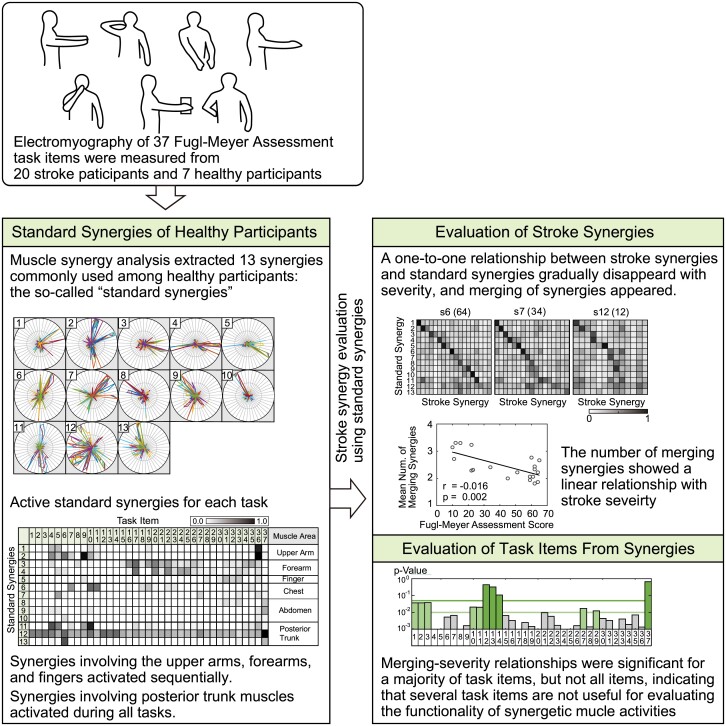
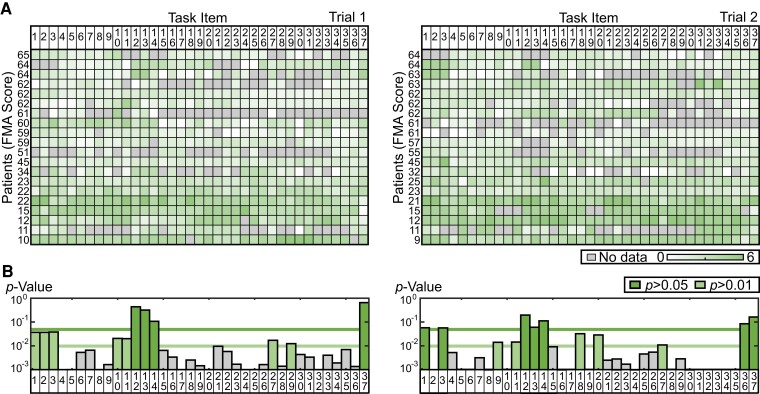
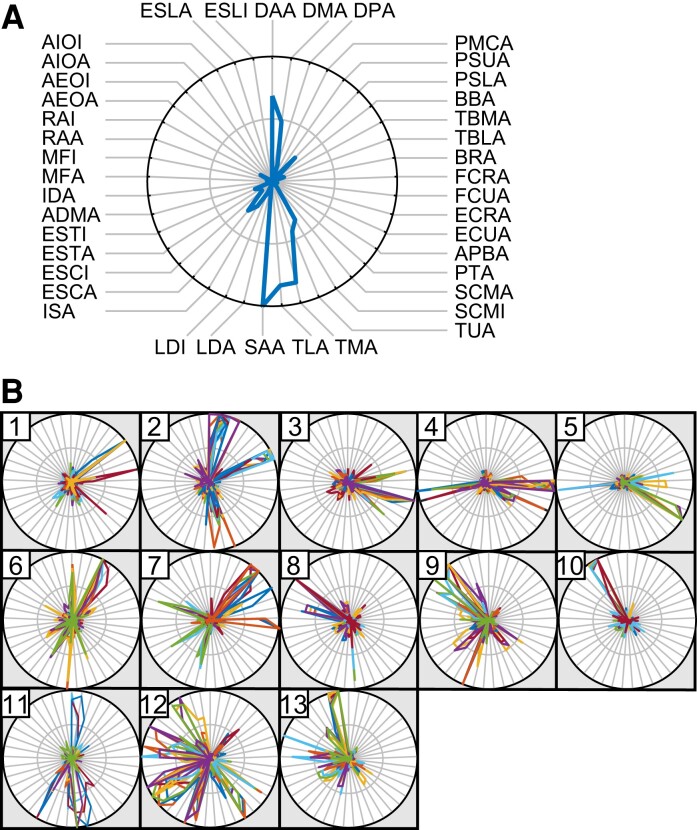
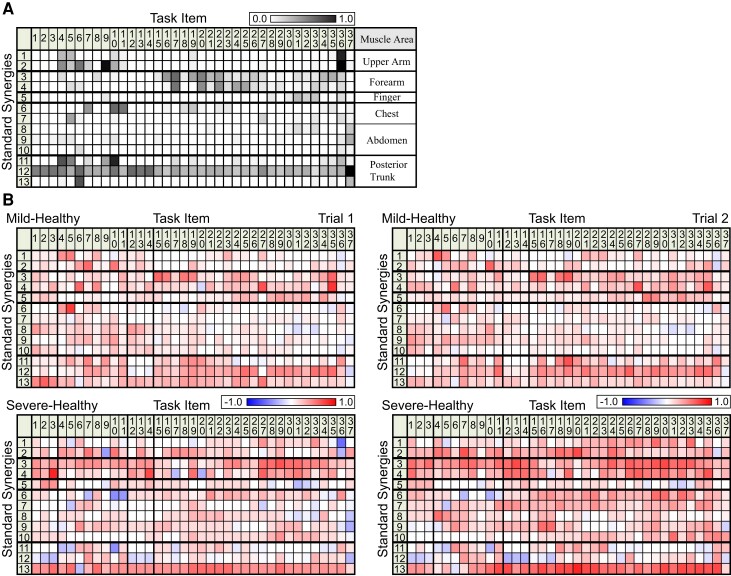
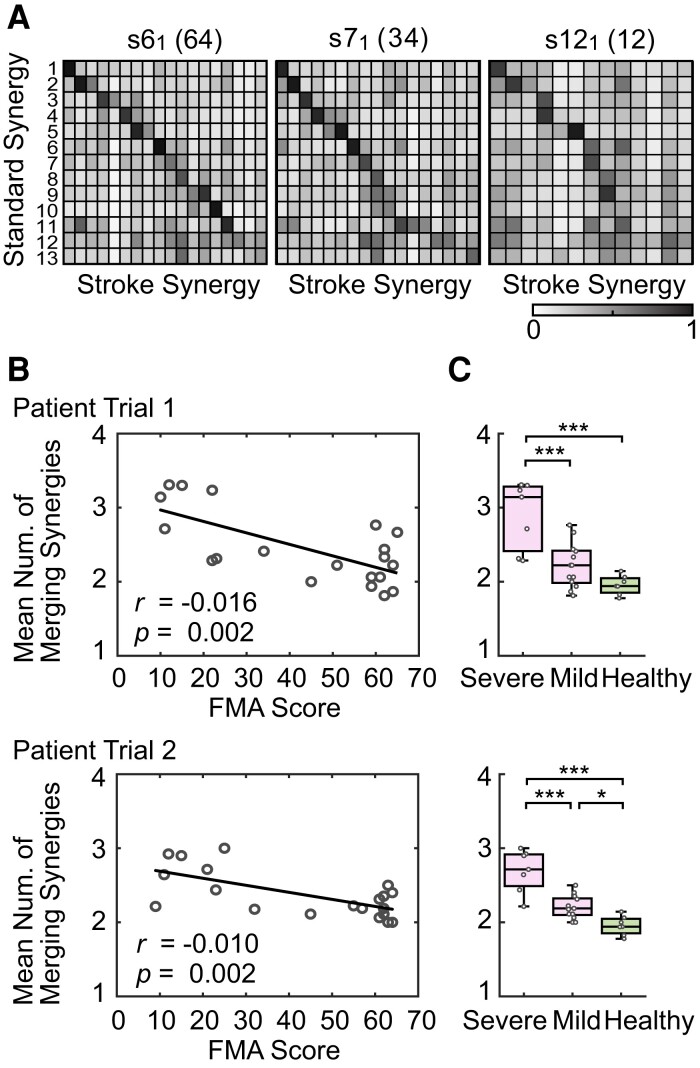
The Fugl-Meyer Assessment is widely used to test motor function in stroke survivors. In the Fugl-Meyer Assessment, stroke survivors perform several movement tasks and clinicians subjectively rate the performance of each task item. The individual task items in the Fugl-Meyer Assessment are selected on the basis of clinical experience, and their physiological relevance has not yet been evaluated. In the present study, we aimed to objectively rate the performance of task items by measuring the muscle activity of 41 muscles from the upper body while stroke survivors and healthy participants performed 37 Fugl-Meyer Assessment upper extremity task items. We used muscle synergy analysis to compare muscle activity between subjects and found that 13 muscle synergies in the healthy participants (which we defined as standard synergies) were able to reconstruct all of the muscle activity in the Fugl-Meyer Assessment. Among the standard synergies, synergies involving the upper arms, forearms and fingers were activated to varying degrees during different task items. In contrast, synergies involving posterior trunk muscles were activated during all tasks, which suggests the importance of posterior trunk muscle synergies throughout all sequences. Furthermore, we noted the inactivation of posterior trunk muscle synergies in stroke survivors with severe but not mild impairments, suggesting that lower trunk stability and the underlying activity of posterior trunk muscle synergies may have a strong influence on stroke severity and recovery. By comparing the synergies of stroke survivors with standard synergies, we also revealed that some synergies in stroke survivors corresponded to merged standard synergies; the merging rate increased with the impairment of stroke survivors. Moreover, the degrees of severity-dependent changes in the merging rate (the merging rate-severity relationship) were different among different task items. This relationship was significant for 26 task items only and not for the other 11 task items. Because muscle synergy analysis evaluates coordinated muscle activities, this different dependency suggests that these 26 task items are appropriate for evaluating muscle coordination and the extent of its impairment in stroke survivors. Overall, we conclude that the Fugl-Meyer Assessment reflects physiological function and muscle coordination impairment and suggest that it could be performed using a subset of the 37 task items.
Fugl-Meyer评估广泛用于测试中风幸存者的运动功能。在Fugl-Meyer评估中,中风幸存者执行多项运动任务,临床医生对每个任务项目的表现进行主观评分。Fugl-Meyer评估中的各个任务项目是根据临床经验选择的,其生理相关性尚未得到评估。在本研究中,我们旨在通过测量中风幸存者和健康参与者执行37项Fugl-Meyer评估上肢任务项目时上半身41块肌肉的肌肉活动,来客观地评估任务项目的表现。我们使用肌肉协同分析来比较受试者之间的肌肉活动,发现健康参与者中的13种肌肉协同作用(我们将其定义为标准协同作用)能够重建Fugl-Meyer评估中的所有肌肉活动。在标准协同作用中,涉及上臂、前臂和手指的协同作用在不同任务项目中被不同程度地激活。相比之下,涉及后躯干肌肉的协同作用在所有任务中均被激活,这表明后躯干肌肉协同作用在所有序列中的重要性。此外,我们注意到严重但非轻度受损的中风幸存者中后躯干肌肉协同作用失活,这表明下躯干稳定性和后躯干肌肉协同作用的潜在活动可能对中风严重程度和恢复有很大影响。通过将中风幸存者的协同作用与标准协同作用进行比较,我们还发现中风幸存者中的一些协同作用对应于合并的标准协同作用;合并率随着中风幸存者的损伤程度增加。此外,合并率的严重程度依赖性变化程度(合并率-严重程度关系)在不同任务项目中有所不同。这种关系仅在26个任务项目中显著,而在其他11个任务项目中不显著。由于肌肉协同分析评估的是协调性肌肉活动,这种不同的依赖性表明这26个任务项目适合评估中风幸存者的肌肉协调性及其受损程度。总体而言,我们得出结论,Fugl-Meyer评估反映了生理功能和肌肉协调性损伤,并建议可以使用37个任务项目中的一个子集来进行该评估。