Medizinische Klinik B, Klinikum Ludwigshafen, Klinik für Innere Medizin/Kardiologie, Bremserstr. 79, 67063, Ludwigshafen, Germany.
Institut für Herzinfarktforschung, Ludwigshafen, Germany.
Clin Res Cardiol. 2023 Apr;112(4):539-549. doi: 10.1007/s00392-022-02082-3. Epub 2022 Aug 17.
Reports about the influence of the COVID-19 pandemic on the number of hospital admissions and in-hospital mortality during the first wave between March and May 2020 showed conflicting results and are limited by single-center or limited regional multicenter datasets. Aim of this analysis covering all German federal states was the comprehensive description of hospital admissions and in-hospital mortality during the first wave of the COVID-19 pandemic.
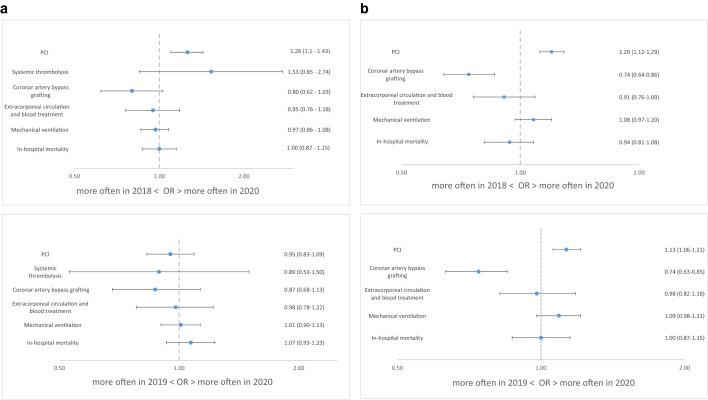
We conducted an observational study on hospital routine data (§21 KHEntgG) and included patients with the main diagnosis of acute myocardial infarction (ICD 21 and ICD 22). A total of 159 hospitals included 36,329 patients in the database, with 12,497 patients admitted with ST-elevation myocardial infarction (STEMI) and 23,832 admitted with non-ST-elevation myocardial infarction (NSTEMI). There was a significant reduction in the number of patients admitted with STEMI (3748 in 2020, 4263 in 2019 and 4486 in 2018; p < 0.01) and NSTEMI (6957 in 2020, 8437 in 2019 and 8438 in 2020; p < 0.01). These reductions were different between the Federal states of Germany. Percutaneous coronary intervention was performed more often in 2020 than in 2019 (odds ratio 1.13, 95% confidence interval [CI] 1.06-1.21) and 2018 (odds ratio 1.20, 95% CI 1.12-1.29) in NSTEMI and more often than in 2018 (odds ratio 1.26, 95% CI 1.10-1.43) in STEMI. The in-hospital mortality did not differ between the years for STEMI and NSTEMI, respectively.
In this large representative sample size of hospitals in Germany, we observed significantly fewer admissions for NSTEMI and STEMI during the first COVID-19 wave, while quality of in-hospital care and in-hospital mortality were not affected. Admissions for STEMI and NSTEMI during the months March to May over 3 years and corresponding in-hospital mortality for patients with STEMI and NSTEMI in 159 German hospitals. (p-value for admissions 2020 versus 2019 and 2018: < 0.01; p-value for mortality: n.s.).
关于 2020 年 3 月至 5 月第一波 COVID-19 大流行期间医院入院人数和院内死亡率影响的报告结果相互矛盾,并且受到单中心或有限区域多中心数据集的限制。本分析旨在全面描述 COVID-19 大流行第一波期间德国所有联邦州的医院入院和院内死亡率。
我们对医院常规数据(§21 KHEntgG)进行了观察性研究,并纳入了急性心肌梗死(ICD 21 和 ICD 22)的主要诊断患者。共有 159 家医院纳入了 36329 名患者,其中 12497 名患者因 ST 段抬高型心肌梗死(STEMI)入院,23832 名患者因非 ST 段抬高型心肌梗死(NSTEMI)入院。STEMI 患者入院人数(2020 年 3748 例,2019 年 4263 例,2018 年 4486 例;p<0.01)和 NSTEMI 患者入院人数(2020 年 6957 例,2019 年 8437 例,2018 年 8438 例;p<0.01)均显著减少。这些减少在德国各州之间有所不同。与 2019 年(比值比 1.13,95%置信区间[CI] 1.06-1.21)和 2018 年(比值比 1.20,95%CI 1.12-1.29)相比,2020 年 NSTEMI 患者接受经皮冠状动脉介入治疗的比例更高,与 2018 年相比,STEMI 患者接受经皮冠状动脉介入治疗的比例也更高(比值比 1.26,95%CI 1.10-1.43)。STEMI 和 NSTEMI 的院内死亡率在各年份之间没有差异。
在德国的这个大型代表性医院样本中,我们观察到 COVID-19 第一波期间 NSTEMI 和 STEMI 的入院人数明显减少,而院内治疗质量和院内死亡率没有受到影响。3 年来 3 月至 5 月期间 STEMI 和 NSTEMI 的入院人数和 159 家德国医院 STEMI 和 NSTEMI 患者的相应院内死亡率。(入院人数 2020 年与 2019 年和 2018 年的 p 值:<0.01;死亡率的 p 值:无意义)。