Department of Cardiovascular Medicine, The Third Xiangya Hospital, Central South University, 138 Tongzipo Road, Changsha, 410013, Hunan, China.
Department of Geriatric Medicine, Center of Coronary Circulation, Xiangya Hospital, Central South University, 87 Xiangya Road, Changsha, 410008, China.
BMC Med. 2022 Aug 18;20(1):273. doi: 10.1186/s12916-022-02456-4.
Although the association between beverages and a single cardiometabolic disease has been well studied, their role in disease progression from the single cardiometabolic disease state to cardiometabolic multimorbidity (CMM) state remains unclear. This study examined the associations between three types of beverages: sugar-sweetened beverages (SSBs), artificially sweetened beverages (ASBs), and pure fruit/vegetable juices, and the incidence of CMM in patients with a single cardiometabolic disease.
Our analysis included 37,994 participants from the UK Biobank who completed at least one dietary questionnaire and were diagnosed with only one cardiometabolic disease at the time of recruitment. Competing risk models were used to examine the association between the three types of beverages and incidence of CMM. We conducted analysis both in patients with any single cardiometabolic disease and in patients with specific cardiometabolic disease.
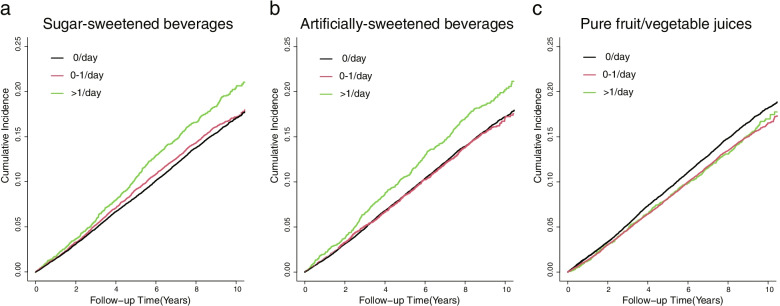
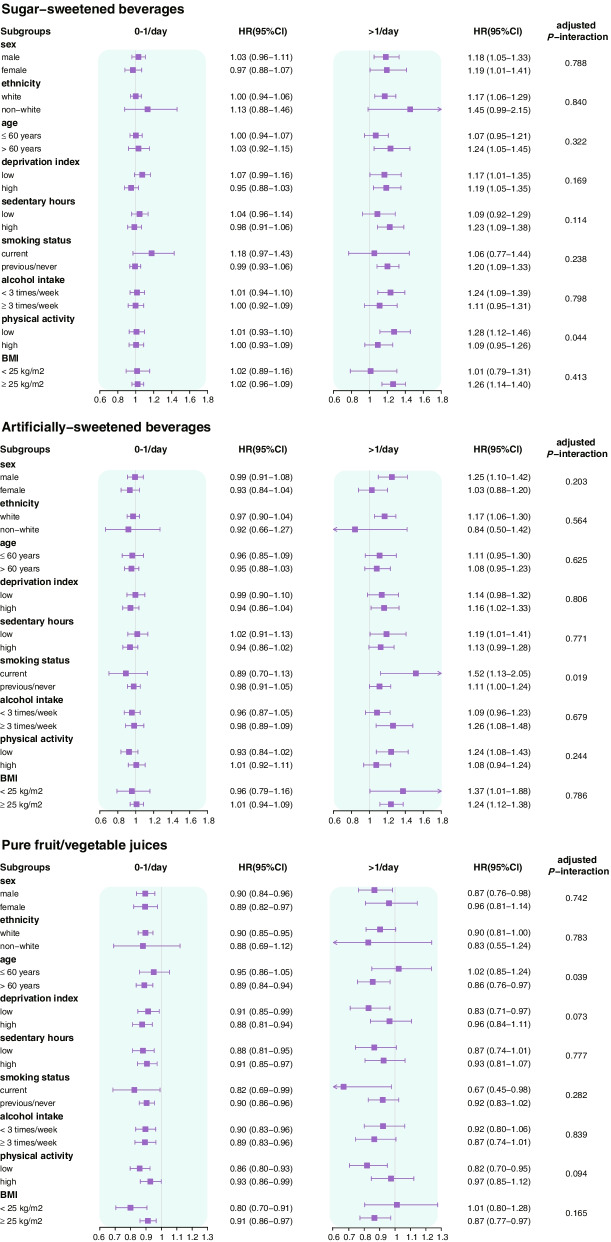
During a median follow-up of 9.1 years (interquartile range [IQR] 9.0-9.8), a total of 6399 participants developed CMM. The consumption of SSBs and ASBs (>1 serving per day) was associated with a higher risk of CMM (SSBs: hazard ratio [HR] 1.19, 95% confidence interval [95% CI] 1.08-1.31; ASBs: HR 1.15, 95% CI 1.04-1.27). Intake of pure fruit/vegetable juices was inversely associated with the incidence of CMM (0-1 serving per day: HR 0.90, 95% CI 0.85-0.94; >1 serving per day: HR 0.90, 95% CI 0.81-0.99). However, the association of the high-level consumption of pure fruit/vegetable juices (>1 serving per day) was not statistically significant after correcting for multiple testing. In the analysis of patients with specific cardiometabolic diseases, positive associations were observed in patients with hypertension for SSBs consumption, while inverse associations persisted in patients with cardiovascular disease (coronary heart disease or stroke) and in hypertensive patients for pure fruit/vegetable juice consumption.
Consuming >1 serving of SSBs and ASBs per day was associated with a higher risk of CMM in patients with a single cardiometabolic disease. In contrast, intake of pure fruit/vegetable juices was inversely associated with the risk of CMM. Our findings highlight the need to limit the use of SSBs and ASBs in patients with a single cardiometabolic disease.
尽管饮料与单一心血管代谢疾病之间的关联已得到充分研究,但它们在从单一心血管代谢疾病状态向心血管代谢多种疾病(CMM)状态发展过程中的作用尚不清楚。本研究探讨了三种饮料(含糖饮料、人工甜味饮料和纯水果/蔬菜汁)与患有单一心血管代谢疾病患者的 CMM 发生率之间的关联。
我们的分析包括来自英国生物库的 37994 名参与者,他们至少完成了一次饮食问卷,并在招募时被诊断患有单一心血管代谢疾病。使用竞争风险模型来检查三种类型的饮料与 CMM 发生率之间的关联。我们在患有任何单一心血管代谢疾病的患者和患有特定心血管代谢疾病的患者中进行了分析。
在中位随访 9.1 年(四分位距[IQR]9.0-9.8)期间,共有 6399 名参与者发生 CMM。每天饮用 SSB 和 ASB(>1 份)与 CMM 风险增加相关(SSB:风险比[HR]1.19,95%置信区间[95%CI]1.08-1.31;ASB:HR 1.15,95%CI 1.04-1.27)。摄入纯水果/蔬菜汁与 CMM 的发生率呈负相关(每天 0-1 份:HR 0.90,95%CI 0.85-0.94;每天>1 份:HR 0.90,95%CI 0.81-0.99)。然而,在进行多次检验校正后,高剂量纯水果/蔬菜汁(>1 份/天)摄入与 CMM 发生率之间的关联不再具有统计学意义。在对特定心血管代谢疾病患者的分析中,在高血压患者中观察到 SSB 消费的阳性关联,而在心血管疾病(冠心病或中风)患者和高血压患者中,纯水果/蔬菜汁消费与 CMM 风险呈负相关。
每天饮用>1 份 SSB 和 ASB 与患有单一心血管代谢疾病患者的 CMM 风险增加相关。相反,摄入纯水果/蔬菜汁与 CMM 风险呈负相关。我们的研究结果强调需要限制患有单一心血管代谢疾病患者使用 SSB 和 ASB。