Wang Shu, Guan Yu-Guang, Zhu Yan-Hua, Wang Min-Zhong
Department of Neurosurgery, Beijing Tiantan Hospital, Capital Medical University, Beijing 100070, China.
Department of Neurosurgery, Sanbo Brain Hospital, Capital Medical University, Beijing 100093, China.
World J Psychiatry. 2022 Jun 19;12(6):779-786. doi: 10.5498/wjp.v12.i6.779.
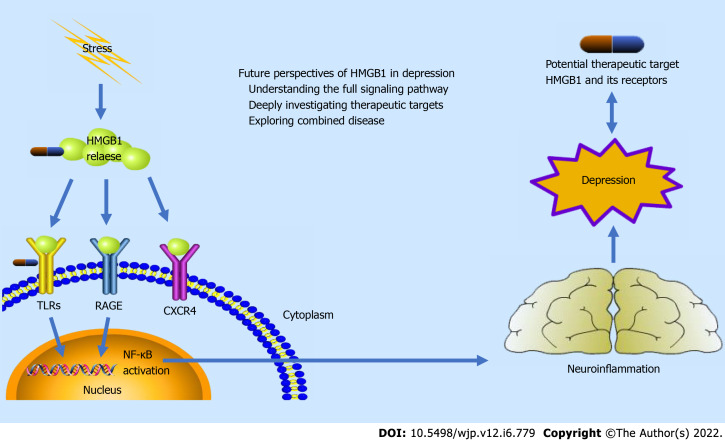
As a common and serious psychiatric disorder, depression significantly affects psychosocial functioning and quality of life. However, the mechanism of depression is still enigmatic and perplexing, which limits its precise and effective therapeutic methods. Recent studies demonstrated that neuroinflammation activation plays an important role in the pathophysiology of depression. In this respect, high mobility group box 1 (HMGB1) may be a possible signaling inducer of neuroinflammation and can be a potential mechanistic and therapeutic target for depression. Herein, we review recent studies on the mechanistic and therapeutic targets of HMGB1 in depression and propose potential perspectives on this topic.
作为一种常见且严重的精神疾病,抑郁症显著影响心理社会功能和生活质量。然而,抑郁症的发病机制仍然神秘且令人困惑,这限制了其精确有效的治疗方法。最近的研究表明,神经炎症激活在抑郁症的病理生理学中起重要作用。在这方面,高迁移率族蛋白B1(HMGB1)可能是神经炎症的一种潜在信号诱导物,并且可能成为抑郁症的潜在机制和治疗靶点。在此,我们综述了关于HMGB1在抑郁症中的机制和治疗靶点的最新研究,并提出了关于该主题的潜在观点。