Department of Pathology and Pathophysiology, School of Medicine, Jianghan University, Wuhan, China.
Department of Immunology, School of Basic Medicine, Tongji Medical College, Huazhong University of Science and Technology, Wuhan, China.
Front Immunol. 2021 Apr 1;12:584097. doi: 10.3389/fimmu.2021.584097. eCollection 2021.
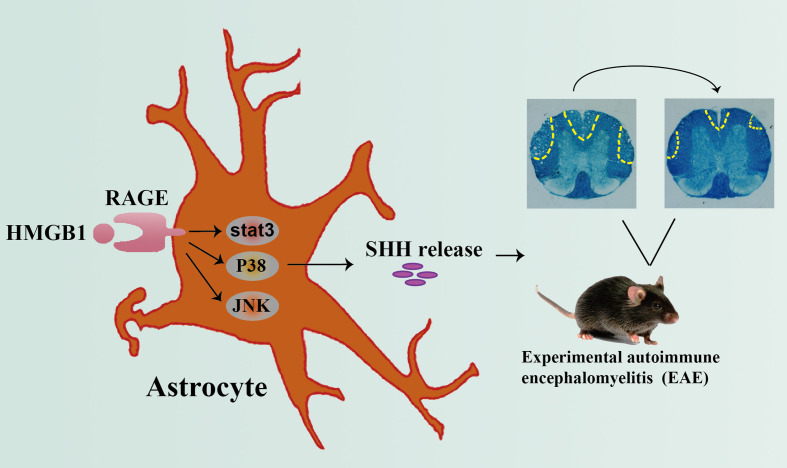
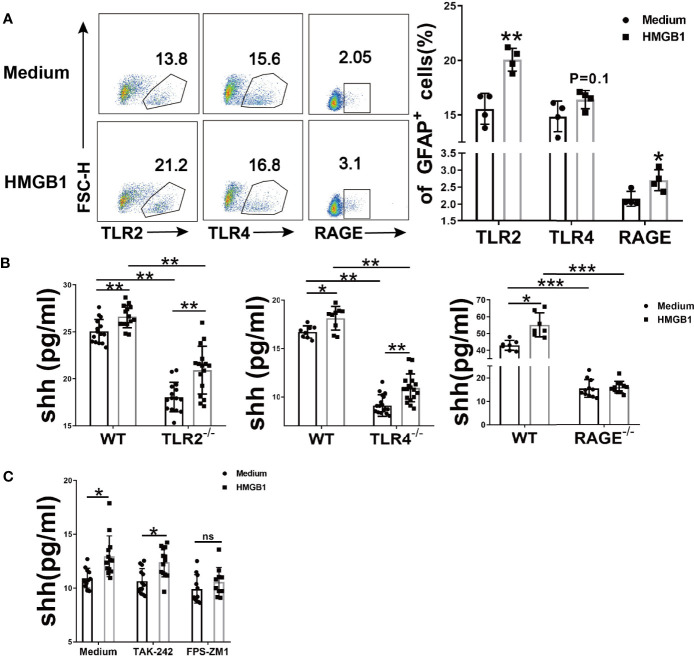
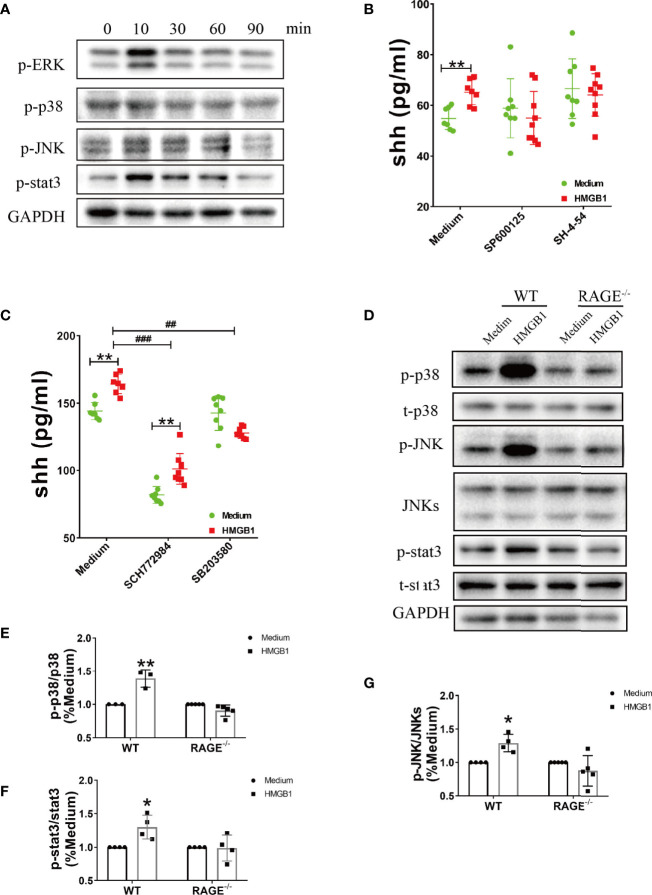
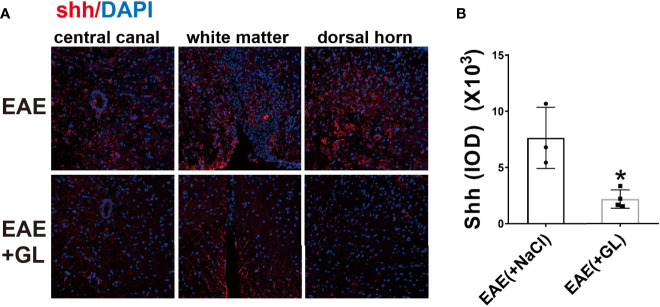
High mobility group box 1 protein (HMGB1) is known to be a trigger of inflammation in experimental autoimmune encephalomyelitis (EAE), an animal model of multiple sclerosis (MS). However, it may play a different role in some way. Here we investigated the effect of HMGB1 on promoting sonic hedgehog (shh) release from astrocytes as well as the possible signal pathway involved in it. Firstly, shh increased in astrocytes after administration of recombinant HMGB1 or decreased after HMGB1 was blocked when stimulated by homogenate of the onset stage of EAE. Moreover, the expression of HMGB1 receptors, toll-like receptor (TLR) 2 and receptor for advanced glycation end products (RAGE) increased after HMGB1 administration in primary astrocytes. However, the enhancing effect of HMGB1 on shh release from astrocytes was suppressed only after RAGE was knocked out or blocked. Mechanistically, HMGB1 functioned by activating RAGE-mediated JNK, p38, stat3 phosphorylation. Moreover, HMGB1 could induce shh release in EAE. Additionally, intracerebroventricular injection of recombinant shh protein on the onset stage of EAE alleviated the progress of disease and decreased demylination, compared to the mice with normal saline treatment. Overall, HMGB1 promoted the release of shh from astrocytes through signal pathway JNK, p38 and stat3 mediated by receptor RAGE, which may provide new insights of HMGB1 function in EAE.
高迁移率族蛋白 B1(HMGB1)已知是实验性自身免疫性脑脊髓炎(EAE),多发性硬化症(MS)的动物模型中的炎症触发物。然而,它可能以某种方式发挥不同的作用。在这里,我们研究了 HMGB1 促进星形胶质细胞中 sonic hedgehog(shh)释放的作用以及可能涉及的信号通路。首先,在用重组 HMGB1 处理后,星形胶质细胞中的 shh 增加,在用 EAE 发病期匀浆刺激时,HMGB1 被阻断后 shh 减少。此外,在原代星形胶质细胞中给予 HMGB1 后,HMGB1 受体、Toll 样受体(TLR)2 和晚期糖基化终产物受体(RAGE)的表达增加。然而,只有在敲除或阻断 RAGE 后,HMGB1 对星形胶质细胞中 shh 释放的增强作用才被抑制。从机制上讲,HMGB1 通过激活 RAGE 介导的 JNK、p38、stat3 磷酸化起作用。此外,HMGB1 可以在 EAE 中诱导 shh 释放。此外,在 EAE 的发病期向脑室内注射重组 shh 蛋白可减轻疾病的进展并减少脱髓鞘,与生理盐水治疗的小鼠相比。总的来说,HMGB1 通过 RAGE 受体介导的 JNK、p38 和 stat3 信号通路促进星形胶质细胞中 shh 的释放,这可能为 HMGB1 在 EAE 中的功能提供新的见解。