Greer Melody L, Zayas Cilia E, Bhattacharyya Sudeepa
Department of Biomedical Informatics, University of Arkansas for Medical Sciences, Little Rock, AR, United States.
Department of Biological Sciences, Arkansas Biosciences Institute, Arkansas State University, Jonesboro, AR, United States.
Front Big Data. 2022 Aug 1;5:894598. doi: 10.3389/fdata.2022.894598. eCollection 2022.
Social and behavioral aspects of our lives significantly impact our health, yet minimal social determinants of health (SDOH) data elements are collected in the healthcare system.
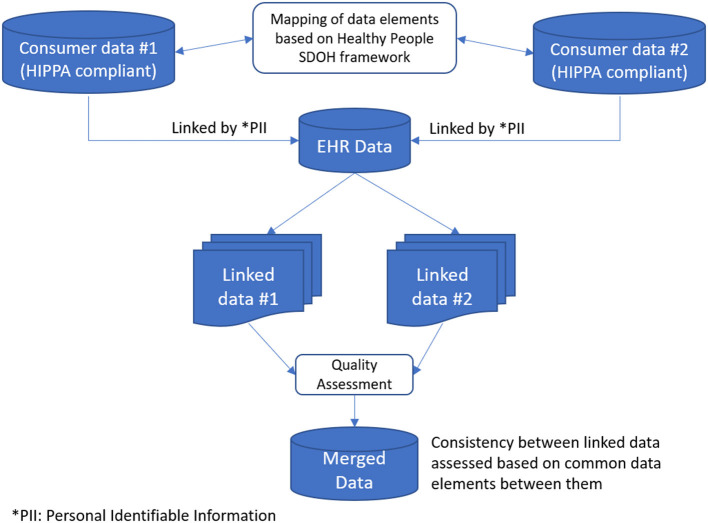
In this proof-of-concept study we developed a repeatable SDOH enrichment and integration process to incorporate dynamically evolving SDOH domain concepts from consumers into clinical data. This process included SDOH mapping, linking compiled consumer data to patient records in Electronic Health Records, data quality analysis and preprocessing, and storage.
Consumer compilers data coverage ranged from ~90 to ~54% and the percentage match rate between compilers was between ~21 and 64%. Our preliminary analysis showed that apart from demographic factors, several SDOH factors like home-ownership, marital-status, presence of children, number of members per household, economic stability and education were significantly different between the COVID-19 positive and negative patient groups while estimated family-income and home market-value were not.
Our preliminary analysis shows commercial consumer data can be a viable source of SDOH factor at an individual-level for clinical data thus providing a path for clinicians to improve patient treatment and care.
我们生活中的社会和行为方面会对我们的健康产生重大影响,但医疗保健系统中收集的健康的社会决定因素(SDOH)数据元素却极少。
在这项概念验证研究中,我们开发了一个可重复的SDOH充实和整合过程,将来自消费者的动态演变的SDOH领域概念纳入临床数据。这个过程包括SDOH映射、将汇编的消费者数据与电子健康记录中的患者记录相链接、数据质量分析和预处理以及存储。
消费者汇编数据的覆盖率在90%到54%之间,汇编者之间的匹配率在21%到64%之间。我们的初步分析表明,除了人口统计学因素外,COVID-19阳性和阴性患者组之间,一些SDOH因素如房屋所有权、婚姻状况、子女情况、每户家庭成员数量、经济稳定性和教育程度存在显著差异,而估计家庭收入和房屋市场价值则没有。
我们的初步分析表明,商业消费者数据可以成为临床数据中个体层面SDOH因素的可行来源,从而为临床医生改善患者治疗和护理提供一条途径。