Center for Artificial Intelligence Technology (CAIT), Faculty of Information Science and Technology, Universiti Kebangsaan Malaysia, Bangi, Malaysia.
Department of Communication Engineering, School of Electrical Engineering, Universiti Teknologi Malaysia (UTM) Johor, Bahru, Malaysia.
Front Public Health. 2022 Aug 1;10:925901. doi: 10.3389/fpubh.2022.925901. eCollection 2022.
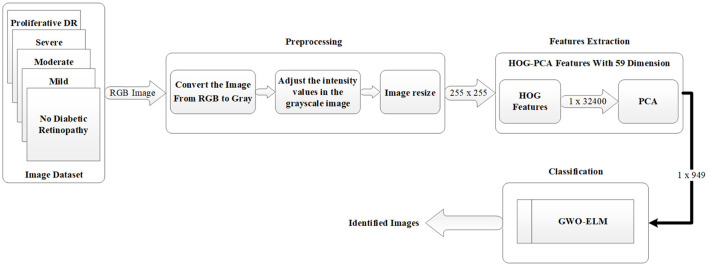
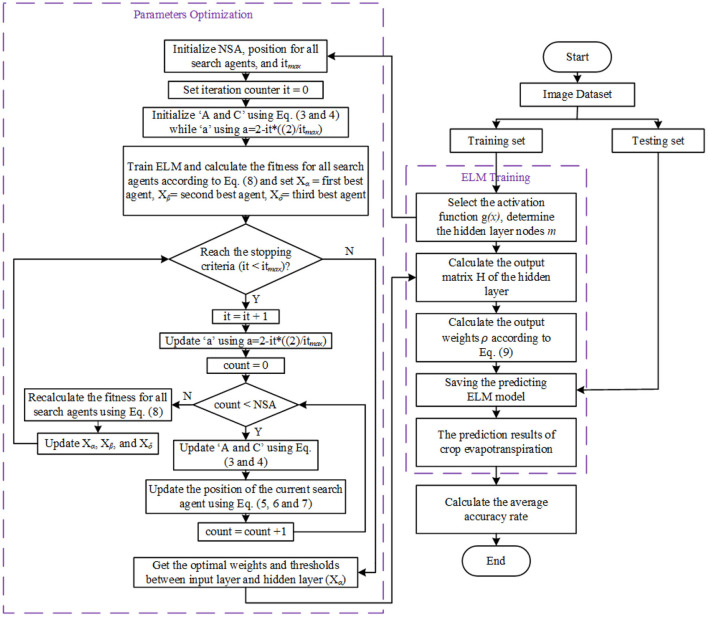
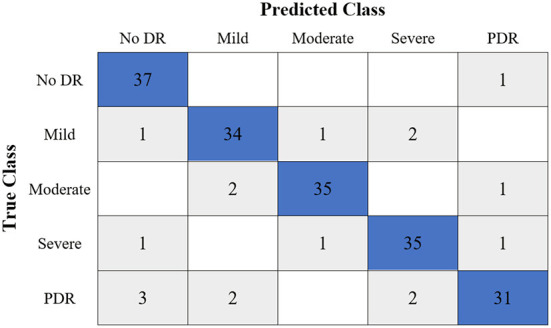
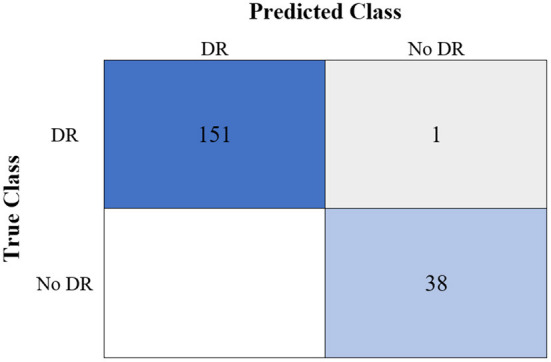
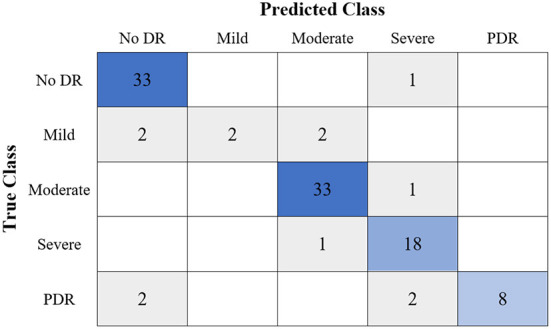
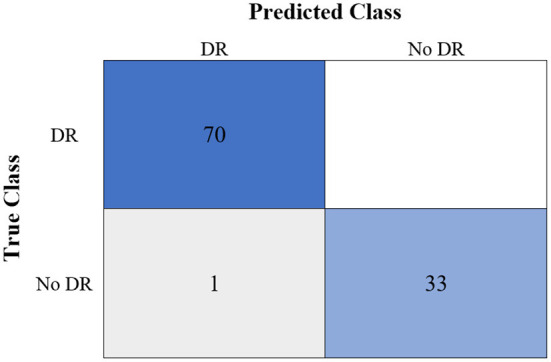
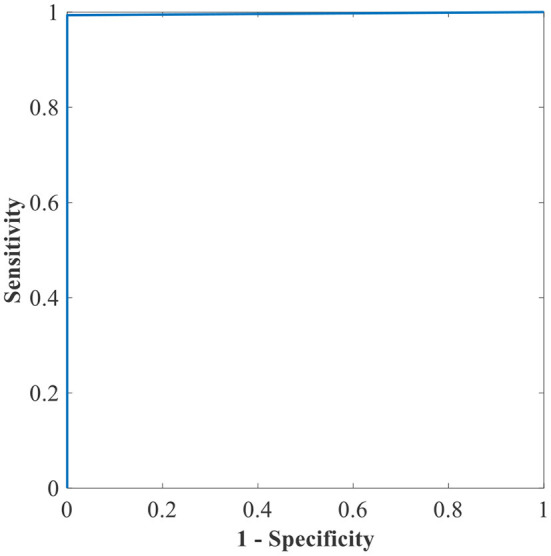
Many works have employed Machine Learning (ML) techniques in the detection of Diabetic Retinopathy (DR), a disease that affects the human eye. However, the accuracy of most DR detection methods still need improvement. Gray Wolf Optimization-Extreme Learning Machine (GWO-ELM) is one of the most popular ML algorithms, and can be considered as an accurate algorithm in the process of classification, but has not been used in solving DR detection. Therefore, this work aims to apply the GWO-ELM classifier and employ one of the most popular features extractions, Histogram of Oriented Gradients-Principal Component Analysis (HOG-PCA), to increase the accuracy of DR detection system. Although the HOG-PCA has been tested in many image processing domains including medical domains, it has not yet been tested in DR. The GWO-ELM can prevent overfitting, solve multi and binary classifications problems, and it performs like a kernel-based Support Vector Machine with a Neural Network structure, whilst the HOG-PCA has the ability to extract the most relevant features with low dimensionality. Therefore, the combination of the GWO-ELM classifier and HOG-PCA features might produce an effective technique for DR classification and features extraction. The proposed GWO-ELM is evaluated based on two different datasets, namely APTOS-2019 and Indian Diabetic Retinopathy Image Dataset (IDRiD), in both binary and multi-class classification. The experiment results have shown an excellent performance of the proposed GWO-ELM model where it achieved an accuracy of 96.21% for multi-class and 99.47% for binary using APTOS-2019 dataset as well as 96.15% for multi-class and 99.04% for binary using IDRiD dataset. This demonstrates that the combination of the GWO-ELM and HOG-PCA is an effective classifier for detecting DR and might be applicable in solving other image data types.
许多工作都在使用机器学习(ML)技术来检测影响人眼的糖尿病性视网膜病变(DR)。然而,大多数 DR 检测方法的准确性仍有待提高。灰狼优化-极限学习机(GWO-ELM)是最受欢迎的 ML 算法之一,可以被认为是分类过程中的一种准确算法,但尚未用于解决 DR 检测问题。因此,本工作旨在应用 GWO-ELM 分类器,并采用最流行的特征提取方法之一——方向梯度直方图-主成分分析(HOG-PCA),以提高 DR 检测系统的准确性。虽然 HOG-PCA 已经在包括医学领域在内的许多图像处理领域进行了测试,但尚未在 DR 中进行测试。GWO-ELM 可以防止过拟合,解决多类和二进制分类问题,其性能类似于具有神经网络结构的核支持向量机,而 HOG-PCA 具有提取低维最相关特征的能力。因此,GWO-ELM 分类器和 HOG-PCA 特征的结合可能会产生一种有效的 DR 分类和特征提取技术。所提出的 GWO-ELM 基于两个不同的数据集进行评估,即 APTOS-2019 和印度糖尿病性视网膜病变图像数据集(IDRiD),分别进行二进制和多类分类。实验结果表明,所提出的 GWO-ELM 模型具有出色的性能,在使用 APTOS-2019 数据集进行多类和二进制分类时,其准确率分别为 96.21%和 99.47%,在使用 IDRiD 数据集进行多类和二进制分类时,其准确率分别为 96.15%和 99.04%。这表明 GWO-ELM 和 HOG-PCA 的结合是一种有效的 DR 检测分类器,可能适用于解决其他图像数据类型的问题。