Indiana University Emergency Medicine Residency, Indianapolis, Indiana.
Yale School of Medicine, Department of Emergency Medicine, New Haven, Connecticut.
West J Emerg Med. 2022 Jul 11;23(4):461-467. doi: 10.5811/westjem.2022.2.52978.
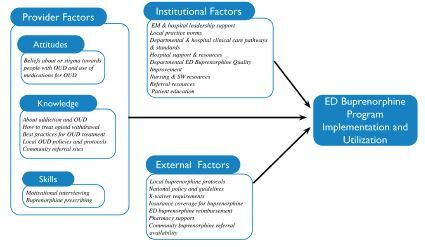
Emergency departments (ED) are increasingly providing buprenorphine to persons with opioid use disorder. Buprenorphine programs in the ED have strong support from public health leaders and emergency medicine specialty societies and have proven to be clinically effective, cost effective, and feasible. Even so, few ED buprenorphine programs currently exist. Given this imbalance between evidence-based practice and current practice, proven behavior change approaches can be used to guide local efforts to expand ED buprenorphine capacity. In this paper, we use the theory of planned behavior to identify and address the 1) clinician factors, 2) institutional factors, and 3) external factors surrounding ED buprenorphine implementation. By doing so, we seek to provide actionable and pragmatic recommendations to increase ED buprenorphine availability across different practice settings.
急诊科(ED)越来越多地为阿片类药物使用障碍患者提供丁丙诺啡。ED 中的丁丙诺啡项目得到公共卫生领导人以及急诊医学专业协会的大力支持,并且已被证明具有临床疗效、成本效益和可行性。即便如此,目前仍很少有 ED 丁丙诺啡项目。鉴于循证实践与当前实践之间的不平衡,已证实的行为改变方法可用于指导扩大 ED 丁丙诺啡能力的当地努力。在本文中,我们使用计划行为理论来确定和解决 1)临床医生因素、2)机构因素和 3)ED 丁丙诺啡实施相关的外部因素。通过这样做,我们旨在为不同实践环境提供切实可行的实用建议,以增加 ED 丁丙诺啡的可获得性。