
对 1012 名 6-9 岁儿童的听觉处理技能分析证实,6 岁儿童的 APD 测试是充分的。
Analysis of the auditory processing skills in 1,012 children aged 6-9 confirms the adequacy of APD testing in 6-year-olds.
机构信息
The Outpatient of Speech Therapy, The Children's Memorial Health Institute, Warsaw, Poland.
Department of Audiology and Phoniatrics, The Children's Memorial Health Institute, Warsaw, Poland.
出版信息
PLoS One. 2022 Aug 18;17(8):e0272723. doi: 10.1371/journal.pone.0272723. eCollection 2022.
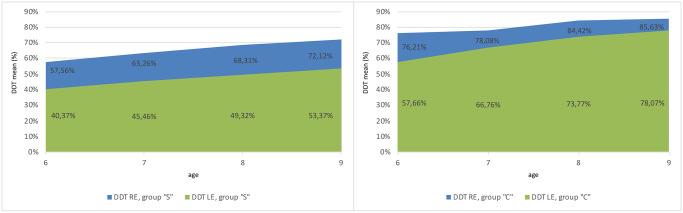
The aim of the study was to assess the validity of the use of the battery of tests assessing higher auditory functions in the diagnostic process of APD in 6-year-old children. The study involved 1,012 Polish-speaking children aged 6 to 9 years with normal hearing sensitivity. The evaluation of auditory functions was performed using the ATS Neuroflow test battery comprising: Adaptive Speech in Noise test (ASPN-S), Dichotic Digits Test (DDT) and Frequency Pattern Test (FPT). Two groups were distinguished: the group"S" (Study) containing 880 participants with APD (participants who obtained abnormal results in at least two tests) and the group"C" (Control) including 132 participants without APD. The results obtained by 6-year-old children in behavioral tests present a similar disorder's profile to those of older children in terms of the prevalence of specific deficits and their severity. Performance in the APD tests of healthy 6-year-old children is higher than 9-year-old children with APD, despite the process of physiological development of hearing functions in older children. The test assessing understanding speech in noise was the most frequently impaired among all examined, while the dichotic listening with distracted attention was the least frequently impaired function. The deficit found in DDT was opposite between patients with APD and healthy children, we called the detected phenomenon the reversed lateralization pattern. The use of DDT, FPT and ASPN-S tests to evaluate higher auditory functions in the process of diagnosing APD in 6-year-old children is justified by the lack of discrepancy in the disorder profile of 6-year-old children in comparison with older children, both in the healthy population, and in children with impaired auditory function development. Early diagnosis can be beneficial for accurate programming of therapeutic goals.
本研究旨在评估在 6 岁儿童听觉处理障碍(APD)的诊断过程中使用评估高级听觉功能的测试组合的有效性。该研究纳入了 1012 名波兰语母语、听力正常的 6 至 9 岁儿童。听觉功能评估使用了 ATS Neuroflow 测试组合,包括:自适应语音噪声测试(ASPN-S)、双耳分听测试(DDT)和频率模式测试(FPT)。将儿童分为两组:“S”组(研究组)包含 880 名 APD 患者(至少两项测试结果异常的参与者)和“C”组(对照组)包含 132 名无 APD 的参与者。6 岁儿童在行为测试中的表现与年龄较大的儿童相似,均表现为特定缺陷的患病率和严重程度相似。尽管年龄较大的儿童的听觉功能发育过程存在差异,但健康 6 岁儿童在 APD 测试中的表现高于有 APD 的 9 岁儿童。在所有检查中,理解噪声中言语的测试最常受损,而注意力分散的双耳分听是最不易受损的功能。在 DDT 中发现的缺陷在 APD 患者和健康儿童之间相反,我们称之为反向侧化模式。使用 DDT、FPT 和 ASPN-S 测试来评估 6 岁儿童 APD 诊断过程中的高级听觉功能,这是合理的,因为 6 岁儿童与年龄较大的儿童在健康人群和听觉功能发育受损的儿童中,其障碍特征没有差异。早期诊断有助于准确制定治疗目标。


 Zotero 插件