Department of Psychology, University of California, San Diego.
Department of Psychology, Stanford University.
Perspect Psychol Sci. 2023 Mar;18(2):259-274. doi: 10.1177/17456916221093593. Epub 2022 Aug 18.
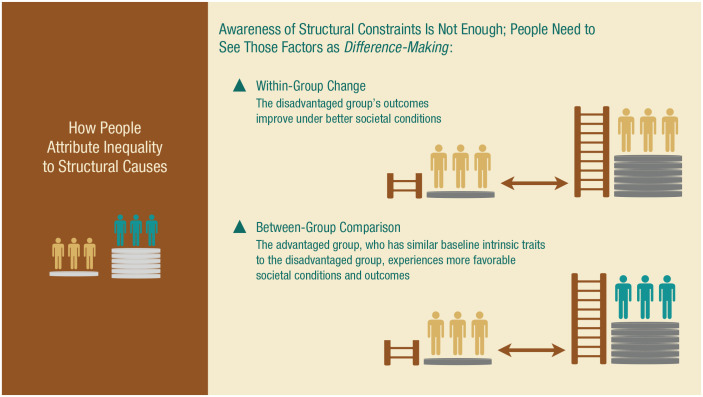
To make accurate causal inferences about social-group inequalities, people must consider . Structural causes are a distinct type of extrinsic cause-they are stable, interconnected societal forces that systematically advantage some social groups and disadvantage others. We propose a new cognitive framework to specify how people attribute inequality to structural causes. This framework is rooted in counterfactual theories of causal judgment and suggests that people will recognize structural factors as causal when they are perceived as "difference-making" for inequality above and beyond any intrinsic causes. Building on this foundation, our framework makes the following contributions. First, we propose specific types of evidence that support difference-making inferences about structural factors: (i.e., observing that disadvantaged groups' outcomes improve under better societal conditions) and well-matched (i.e., observing that advantaged group members, who have similar baseline traits to the disadvantaged group, experience more favorable societal conditions and life outcomes). Second, we consider contextual, cognitive, and motivational barriers that may complicate the availability and acceptance of this evidence. We conclude by exploring how the framework might be applied in future research examining people's causal inferences about inequality.
为了对社会群体不平等做出准确的因果推断,人们必须考虑到结构性原因。结构性原因是一种独特的外在原因,它们是稳定的、相互关联的社会力量,系统地使一些社会群体受益,而使另一些社会群体处于不利地位。我们提出了一个新的认知框架来具体说明人们如何将不平等归因于结构性原因。这个框架植根于因果判断的反事实理论,它表明,当人们认为结构性因素在不平等之外对任何内在原因都具有“产生差异”的作用时,他们就会将其视为因果因素。在此基础上,我们的框架做出了以下贡献。首先,我们提出了支持关于结构性因素产生差异推断的具体证据类型:(即观察到劣势群体的结果在社会条件改善时有所改善)和匹配良好的证据(即观察到具有与劣势群体相似基线特征的优势群体成员在社会条件和生活结果方面更有利)。其次,我们考虑了可能使这种证据的可用性和可接受性变得复杂的背景、认知和动机障碍。最后,我们探讨了该框架如何应用于未来研究,以检验人们对不平等的因果推断。