Department of Mechanical Engineering, Carnegie Mellon University, Pittsburgh, Pennsylvania, USA.
Cancer Virology Program, UPMC Hillman Cancer Center and Department of Microbiology and Molecular Genetics, University of Pittsburgh School of Medicine, Pittsburgh, Pennsylvania, USA.
J Med Virol. 2022 Dec;94(12):5808-5826. doi: 10.1002/jmv.28075. Epub 2022 Aug 30.
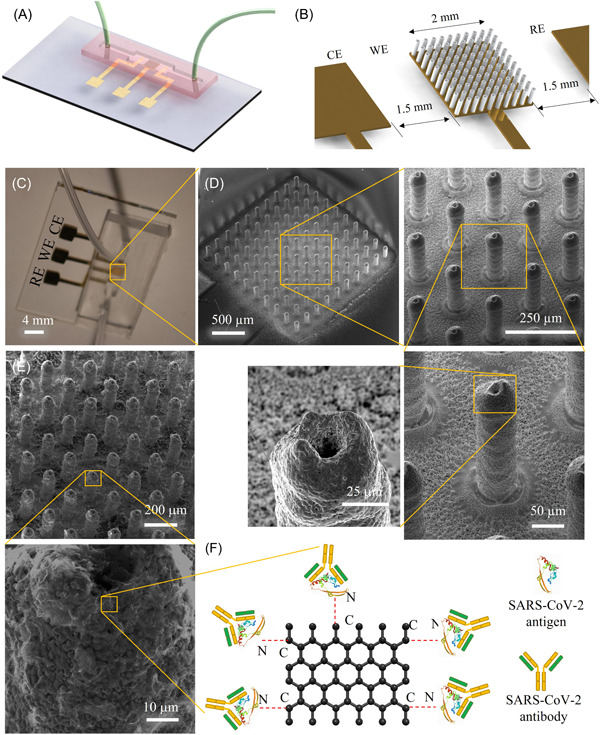
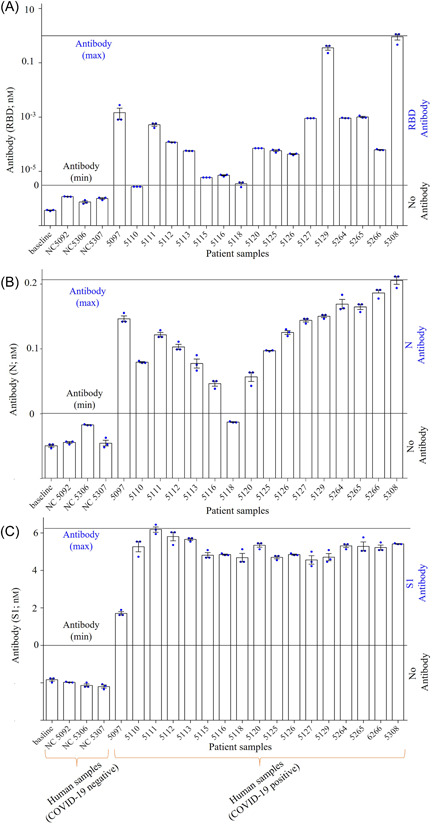
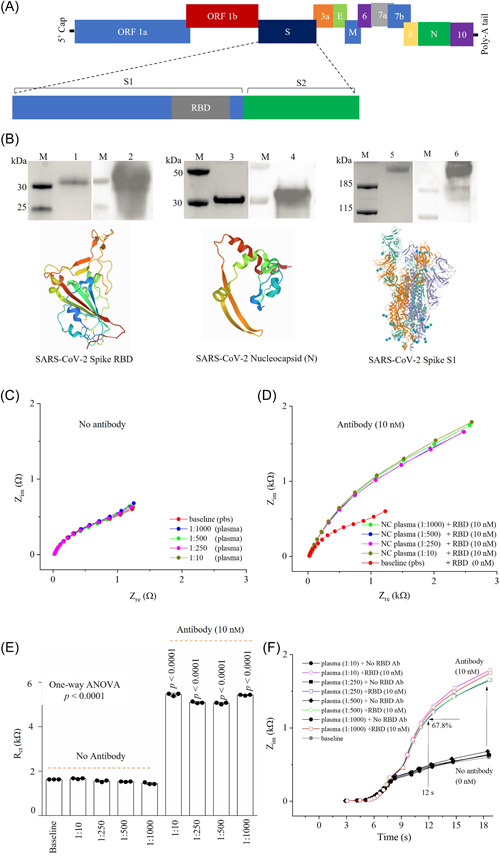
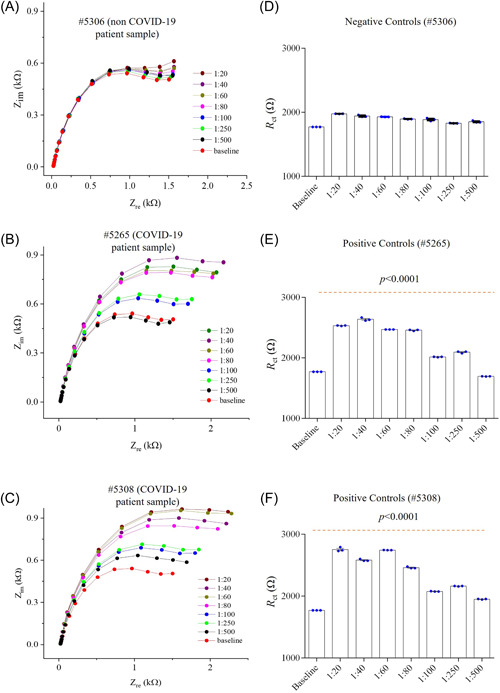
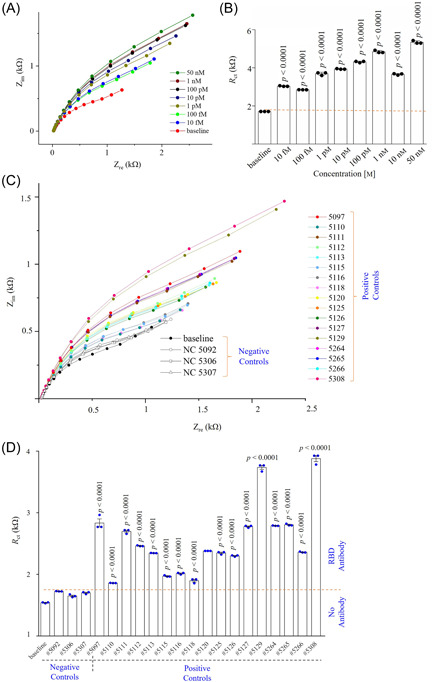
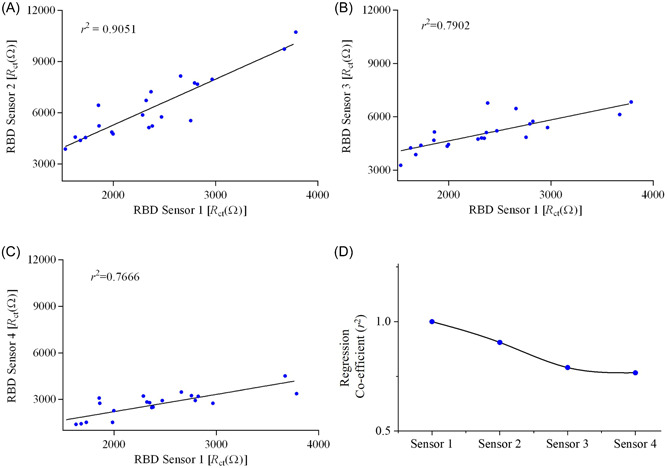
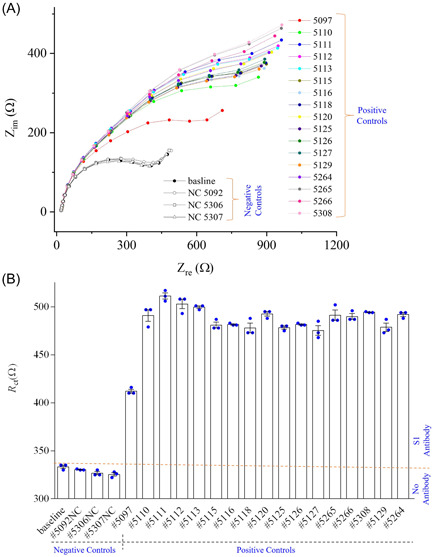
Rapid detection of antibodies during infection and after vaccination is critical for the control of infectious outbreaks, understanding immune response, and evaluating vaccine efficacy. In this manuscript, we evaluate a simple ultrarapid test for SARS-CoV-2 antibodies in COVID-19 patients, which gives quantitative results (i.e., antibody concentration) in 10-12 s using a previously reported nanomaterial-based three-dimensional (3D)-printed biosensing platform. This platform consists of a micropillar array electrode fabricated via 3D printing of aerosolized gold nanoparticles and coated with nanoflakes of graphene and specific SARS-CoV-2 antigens, including spike S1, S1 receptor-binding domain (RBD) and nucleocapsid (N). The sensor works on the principle of electrochemical transduction, where the change of sensor impedance is realized by the interactions between the viral proteins attached to the sensor electrode surface and the antibodies. The three sensors were used to test samples from 17 COVID-19 patients and 3 patients without COVID-19. Unlike other serological tests, the 3D sensors quantitatively detected antibodies at a concentration as low as picomole within 10-12 s in human plasma samples. We found that the studied COVID-19 patients had higher concentrations of antibodies to spike proteins (RBD and S1) than to the N protein. These results demonstrate the enormous potential of the rapid antibody test platform for understanding patients' immunity, disease epidemiology and vaccine efficacy, and facilitating the control and prevention of infectious epidemics.
在感染期间和接种疫苗后快速检测抗体对于控制传染病爆发、了解免疫反应和评估疫苗效果至关重要。在本文中,我们评估了一种用于 COVID-19 患者的 SARS-CoV-2 抗体的超快速简便检测方法,该方法使用先前报道的基于纳米材料的三维(3D)打印生物传感平台在 10-12s 内给出定量结果(即抗体浓度)。该平台由通过雾化金纳米粒子 3D 打印制造的微柱阵列电极组成,并涂有石墨烯和特定 SARS-CoV-2 抗原(包括刺突 S1、S1 受体结合域(RBD)和核衣壳(N))的纳米薄片。传感器基于电化学转换原理工作,传感器阻抗的变化是通过附着在传感器电极表面的病毒蛋白与抗体之间的相互作用来实现的。三个传感器用于测试来自 17 名 COVID-19 患者和 3 名非 COVID-19 患者的样本。与其他血清学检测方法不同,3D 传感器可在 10-12s 内定量检测人血浆样本中低至皮摩尔浓度的抗体。我们发现,所研究的 COVID-19 患者对刺突蛋白(RBD 和 S1)的抗体浓度高于对 N 蛋白的抗体浓度。这些结果表明,快速抗体检测平台在了解患者免疫、疾病流行病学和疫苗效果方面具有巨大潜力,并有助于控制和预防传染病的爆发。