Cioce Mario, Sacconi Andrea, Donzelli Sara, Bonomo Claudia, Perracchio Letizia, Carosi Mariantonia, Telera Stefano, Fazio Vito Michele, Botti Claudio, Strano Sabrina, Blandino Giovanni
Laboratory of Molecular Medicine and Biotechnology, University Campus Bio-Medico of Rome, Rome, Italy.
Institute of Translational Pharmacology, National Research Council of Italy (CNR), Rome, Italy.
Comput Struct Biotechnol J. 2022 Jul 28;20:4003-4008. doi: 10.1016/j.csbj.2022.07.044. eCollection 2022.
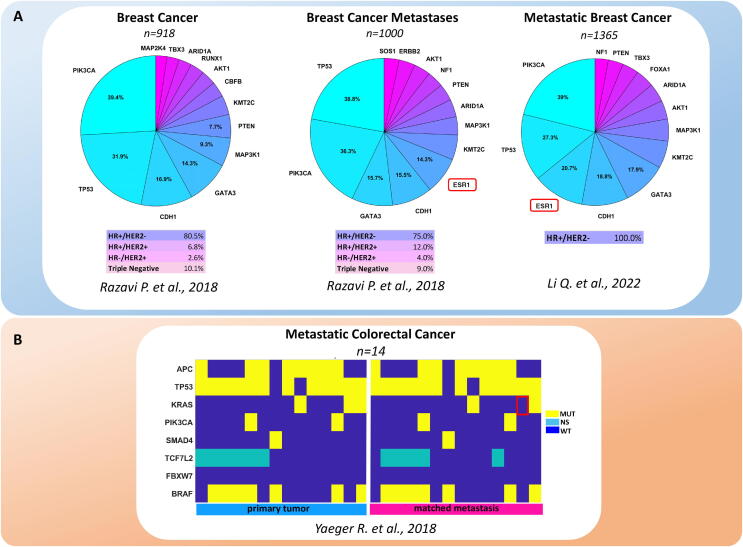
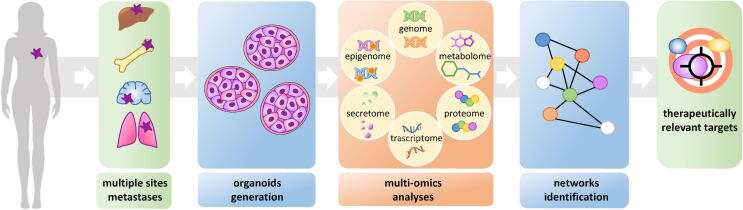
Genomics has greatly increased the understanding of the study of breast cancer (BC) and has shaped the concept of intra-tumor heterogeneity, currently recognized as a propelling force for cancer progression. In this context, knowledge and understanding of metastatic breast cancer (mBC) has somehow lagged behind that of primary breast cancer. This may be explained by the relative scarcity of matched mBC samples, however it is possible that the mutation spectrum obtained from primary BC does not capture the full complexity of the metastatic disease. Here, we provide a few examples supporting this possibility, from public databases. We evoke the need to perform an integrated multi-OMICS characterization of mBC, to obtain a broad understanding of this complex disease, whose evolution cannot be explained solely by genomics. Pertinent to this, we suggest that rather an infrequent use of Patient-Derived -Tumor-Organoids (PDTOs) may be influenced by assuming that the metastatic conditions of PDTOs growth (mPDTOs) should be similar to those of the tissue of origin. We challenge this view by suggesting that the use of "target-organ inspired" growth conditions for mPDTOs, may better fit the emerging knowledge of metastatic disease. Thus, the integrated use of multi-OMICS and of clinically relevant mPDTOs may allow a further understanding of such disease and foster therapeutically relevant advances. We believe that our points may be valid for other solid cancers.
基因组学极大地增进了对乳腺癌(BC)研究的理解,并塑造了肿瘤内异质性的概念,目前该概念被认为是癌症进展的推动力量。在这种背景下,转移性乳腺癌(mBC)的知识和理解在某种程度上落后于原发性乳腺癌。这可能是由于匹配的mBC样本相对稀缺,但也有可能从原发性BC获得的突变谱并未涵盖转移性疾病的全部复杂性。在此,我们从公共数据库中提供一些支持这种可能性的例子。我们提出需要对mBC进行综合的多组学表征,以全面了解这种复杂疾病,其演变不能仅通过基因组学来解释。与此相关的是,我们认为患者来源的肿瘤类器官(PDTOs)使用频率较低,可能是因为假设PDTOs生长的转移条件(mPDTOs)应与原发组织的条件相似。我们对这一观点提出质疑,认为使用“受靶器官启发”的mPDTOs生长条件,可能更符合转移性疾病的新认识。因此,多组学与临床相关的mPDTOs的综合应用可能有助于进一步了解此类疾病,并推动治疗相关的进展。我们相信我们的观点可能适用于其他实体癌。