Sports Health. 2023 Jul-Aug;15(4):547-557. doi: 10.1177/19417381221116345. Epub 2022 Aug 18.
Grip strength is used to estimate whole-body strength for health surveillance purposes. Explosive strength is considered important, yet economic measures able to detect early deterioration of neuromuscular capabilities are lacking. Whether handgrip maximum rate of force development (GRFD) or whole-body strength tests are better predictors of lower body power than handgrip maximum strength (GF) and their trajectories throughout the life span are unknown.
GRFD should be more closely related to lower body power than GF, and its trajectories over the life span should more closely follow that of lower body power.
Cross-sectional.
Level 2b.
A total of 613 healthy participants aged 20 to 91 years were tested for countermovement jump peak power, GF, handgrip rate of force development, and midthigh pull peak force (MTP). Cubic splines and linear models were built for age trajectories, generalized additive models for quintile curves, and linear regression was used to assess predictive quality.
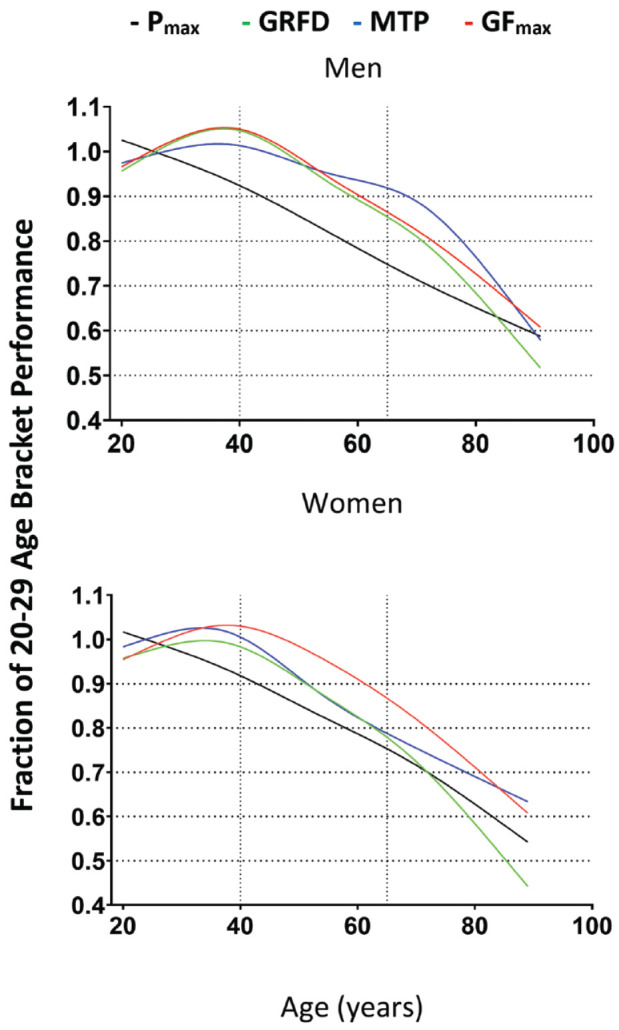
Peak power (P) declined linearly to 60% of young adult level, with GRFD, GF, and MTP remaining stable up to age 50 years and then declining more sharply to 52% to 71% of young adult levels. Trajectories were similar for male and female participants. GRFD (β = 0.17) and MTP (β = 0.08) were worse predictors of P than GF (β = 0.24) in models adjusted for age, sex, lean body mass, and vigorous physical activity levels.
GRFD was not superior to maximum strength in predicting lower body power. For health surveillance purposes, it therefore appears that GF tests are more economical and equally good predictors of lower body explosive strength at older age. The data provided can be used as norm values for healthy subjects.
Incorporating countermovement jump testing for early detection of declines in explosive capabilities might be advised.
握力用于评估全身力量,以进行健康监测。爆发力被认为很重要,但缺乏能够检测神经肌肉功能早期恶化的经济措施。手最大握力发展速率(GRFD)或全身力量测试是否比握力最大力量(GF)更能预测下肢力量,以及它们在整个生命周期中的轨迹尚不清楚。
GRFD 与下肢力量的相关性应高于 GF,其在整个生命周期中的轨迹应更接近下肢力量。
横断面研究。
2b 级。
共对 613 名年龄在 20 至 91 岁的健康参与者进行了反跳式纵跳峰值功率、GF、握力发展速率和大腿中部拉力峰值力量(MTP)测试。使用三次样条和线性模型构建年龄轨迹,使用广义加性模型构建五分位数曲线,使用线性回归评估预测质量。
峰值功率(P)呈线性下降,至年轻成年人水平的 60%,GRFD、GF 和 MTP 直到 50 岁仍保持稳定,然后急剧下降至年轻成年人水平的 52%至 71%。男性和女性参与者的轨迹相似。在调整年龄、性别、瘦体重和剧烈体力活动水平后,GRFD(β=0.17)和 MTP(β=0.08)对 P 的预测能力均差于 GF(β=0.24)。
GRFD 预测下肢力量的能力并不优于最大力量。因此,在健康监测方面,GF 测试似乎在老年时更经济,并且同样能够很好地预测下肢爆发力。提供的数据可作为健康受试者的正常值使用。
建议采用反跳式纵跳测试,以便早期发现爆发力下降。