D'Souza Ryan S, Her Yeng F
Department of Anesthesiology and Perioperative Medicine, Mayo Clinic, Rochester, Minnesota, USA
Department of Anesthesiology and Perioperative Medicine, Mayo Clinic, Rochester, Minnesota, USA.
Reg Anesth Pain Med. 2022 Aug 19;47(12):722-7. doi: 10.1136/rapm-2022-103881.
Habituation and loss of efficacy from spinal cord stimulation are commonly reported. This retrospective analysis investigated rescue of analgesia from spinal cord stimulation failure after implementing a strategy called a stimulation holiday, during which spinal cord stimulation is interrupted for a defined period and subsequently restarted.
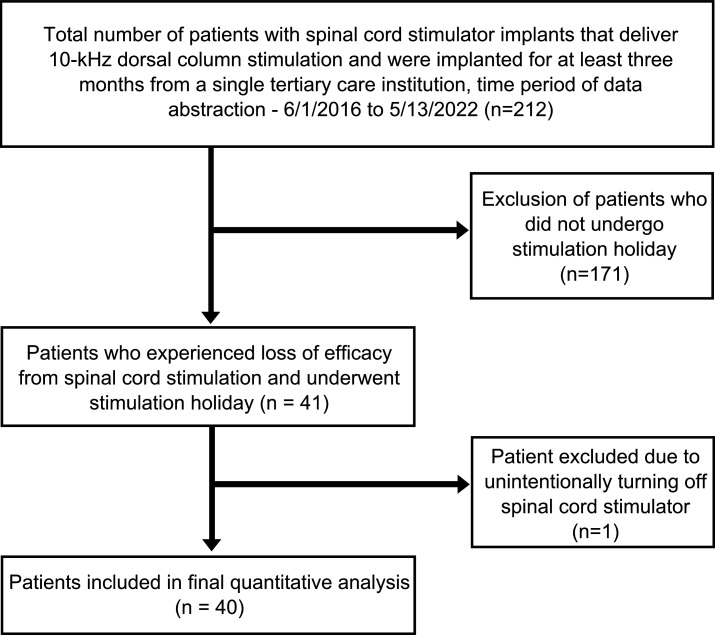
A 6-year review (June 1, 2016-May 13, 2022) from a tertiary care center was conducted on patients who underwent 10 kHz frequency dorsal column spinal cord stimulation for ≥3 months, experienced loss of efficacy (≤30% pain relief or patient self-report of lack of meaningful pain relief), subsequently underwent a stimulation holiday, and then restarted spinal cord stimulation. The primary outcome was comparison of pain relief and responder rate (≥50% relief in pain intensity) before and after stimulation holiday.
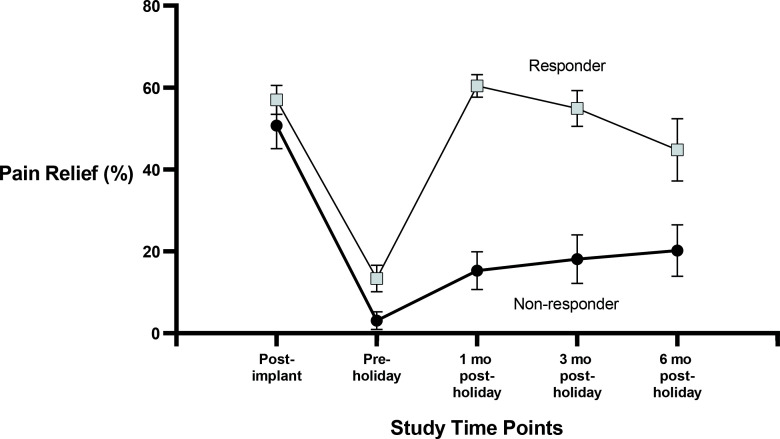
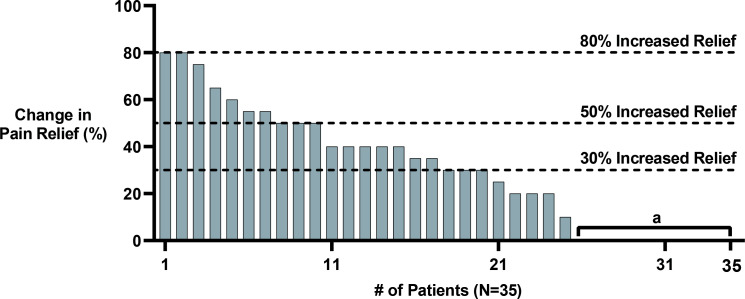
Of 212 patients, 40 (18.9%) experienced loss of efficacy at a mean follow-up period of 452.7±326.4 days after stimulator implantation and underwent stimulation holiday. Pain relief was significantly higher 1 month after stimulation holiday (39.4%±28.6%) compared with before stimulation holiday (8.7%±13.0%; mean difference 30.6%, 95% CI 21.9% to 39.3%, paired t-test p<0.001). A significantly higher responder rate (≥50% relief in pain intensity) was identified after stimulation holiday (57.5%) compared with before stimulation holiday (0%; Fisher's exact test p<0.001). Associations of superior pain relief and responder rate remained significant at 3 and 6 months after stimulation holiday.
Patients who experience loss of efficacy from spinal cord stimulation habituation could attempt a stimulation holiday rather than abandon therapy. Rescue of analgesia may be achieved after implementing a stimulation holiday and restarting spinal cord stimulation.
脊髓刺激疗法出现习惯化和疗效丧失的情况屡见不鲜。本回顾性分析探讨了在实施一种名为“刺激假期”的策略后,脊髓刺激疗法失效后镇痛效果的恢复情况。在“刺激假期”期间,脊髓刺激会中断一段规定时间,随后重新启动。
对一家三级医疗中心6年(2016年6月1日至2022年5月13日)期间接受10kHz频率背柱脊髓刺激治疗≥3个月、出现疗效丧失(疼痛缓解≤30%或患者自述疼痛缓解不显著)、随后经历“刺激假期”并重新启动脊髓刺激的患者进行了回顾。主要结局是比较“刺激假期”前后的疼痛缓解情况和缓解率(疼痛强度缓解≥50%)。
212例患者中,40例(18.9%)在刺激器植入后的平均随访期452.7±326.4天出现疗效丧失,并经历了“刺激假期”。与“刺激假期”前(8.7%±13.0%)相比,“刺激假期”后1个月的疼痛缓解率显著更高(39.4%±28.6%;平均差异30.6%,95%置信区间21.9%至39.3%,配对t检验p<0.001)。与“刺激假期”前(0%)相比,“刺激假期”后缓解率显著更高(≥50%疼痛强度缓解)(57.5%)(Fisher精确检验p<0.001)。在 “刺激假期” 后3个月和6个月,更好的疼痛缓解和缓解率之间的关联仍然显著。
因脊髓刺激习惯化而出现疗效丧失的患者可以尝试“刺激假期”而非放弃治疗。在实施“刺激假期”并重新启动脊髓刺激后,可能实现镇痛效果的恢复。