Medical Big Data Research Center, Chinese PLA General Hospital, Fuxing Road 28#, Haidian district, Beijing, 100853, China.
Health Service Department of the Guard Bureau of the Joint Staff Department, Beijing, China.
BMC Cancer. 2022 Aug 19;22(1):904. doi: 10.1186/s12885-022-10004-9.
Accumulating evidence has revealed that the gut microbiota influences the effectiveness of immune checkpoint inhibitors (ICIs) in cancer patients. As a part of the human microbiome, Helicobacter pylori (H. pylori) was reported to be associated with reduced effectiveness of anti-PD1 immunotherapy in patients with non-small-cell lung cancer (NSCLC). Gastric cancer is more closely related to H. pylori, so we conducted a retrospective analysis to verify whether the association of H. pylori and effectiveness is applicable to advanced gastric cancer (AGC) patients.
AGC patients who had evidence of H. pylori and received anti-PD-1 antibodies were enrolled in the study. The differences in the disease control rate (DCR), overall survival (OS) and progression-free survival (PFS) between the H. pylori-positive group and the negative group were compared.
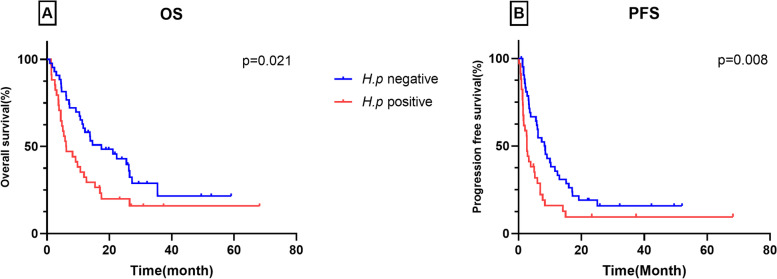
A total of 77 patients were included in this study; 34 patients were H. pylori positive, and the prevalence of H. pylori infection was 44.2%. Compared with the H. pylori-negative group, patients in the H. pylori-positive group had a higher risk of nonclinical response to anti-PD-1 antibody, with an OR of 2.91 (95% CI: 1.13-7.50). Patients in the H. pylori-negative group had a longer OS and PFS than those in the positive group, with an estimated median OS of 17.5 months vs. 6.2 months (HR = 2.85, 95% CI: 1.70-4.78; P = 0.021) and a median PFS of 8.4 months vs. 2.7 months (HR = 3.11, 95% CI: 1.96-5.07, P = 0.008). Multivariate analysis indicated that H. pylori infection was independently associated with PFS (HR = 1.90, 95% CI: 1.10-3.30; P = 0.022).
Our study unveils for the first time that H. pylori infection is associated with the outcome of immunotherapy for AGC patients. Multicenter, large sample and prospective clinical studies are needed to verify the association.
越来越多的证据表明,肠道微生物群会影响癌症患者免疫检查点抑制剂(ICI)的疗效。作为人类微生物群的一部分,幽门螺杆菌(H. pylori)被报道与非小细胞肺癌(NSCLC)患者抗 PD-1 免疫治疗效果降低有关。胃癌与 H. pylori 的关系更为密切,因此我们进行了一项回顾性分析,以验证 H. pylori 与疗效之间的关联是否适用于晚期胃癌(AGC)患者。
本研究纳入了有 H. pylori 证据且接受抗 PD-1 抗体治疗的 AGC 患者。比较 H. pylori 阳性组和阴性组之间的疾病控制率(DCR)、总生存期(OS)和无进展生存期(PFS)的差异。
本研究共纳入 77 例患者;34 例患者 H. pylori 阳性,H. pylori 感染率为 44.2%。与 H. pylori 阴性组相比,H. pylori 阳性组患者对抗 PD-1 抗体的非临床反应风险更高,OR 为 2.91(95%CI:1.13-7.50)。H. pylori 阴性组患者的 OS 和 PFS 均长于 H. pylori 阳性组,估计中位 OS 为 17.5 个月 vs. 6.2 个月(HR=2.85,95%CI:1.70-4.78;P=0.021),中位 PFS 为 8.4 个月 vs. 2.7 个月(HR=3.11,95%CI:1.96-5.07,P=0.008)。多因素分析表明,H. pylori 感染与 PFS 独立相关(HR=1.90,95%CI:1.10-3.30;P=0.022)。
本研究首次揭示 H. pylori 感染与 AGC 患者免疫治疗结局相关。需要进行多中心、大样本和前瞻性临床研究来验证这种关联。