IRCCS Humanitas Research Hospital, Rozzano, Italy; Department of Biomedical Sciences, Humanitas University, Pieve Emanuele, Italy.
Vall d'Hebron Institute of Oncology, Barcelona, Spain.
ESMO Open. 2022 Oct;7(5):100562. doi: 10.1016/j.esmoop.2022.100562. Epub 2022 Aug 18.
The anti-CD38 antibody isatuximab is approved for the treatment of relapsed/refractory multiple myeloma, but there are no data on its efficacy in solid tumors. This phase I/II study (NCT03637764) assessed the safety and activity of isatuximab plus atezolizumab (Isa + Atezo), an anti-programmed death-ligand 1 (PD-L1) antibody, in patients with immunotherapy-naive solid tumors: epithelial ovarian cancer (EOC), glioblastoma (GBM), hepatocellular carcinoma (HCC), and squamous cell carcinoma of the head and neck (SCCHN).
Phase I assessed safety, tolerability, pharmacokinetics, pharmacodynamics, and the recommended phase II dose (RP2D) of isatuximab 10 mg/kg intravenously (i.v.) every week for 3 weeks followed by once every 3 weeks + atezolizumab 1200 mg i.v. every 3 weeks. Phase II used a Simon's two-stage design to assess the overall response rate or progression-free survival rate at 6 months (GBM cohort). Interim analysis was carried out at 6 months following first dose of the last enrolled patient in each cohort. Pharmacodynamic biomarkers were tested for CD38, PD-L1, tumor-infiltrating immune cells, and FOXP3+ regulatory T cells (Tregs) in the tumor microenvironment (TME).
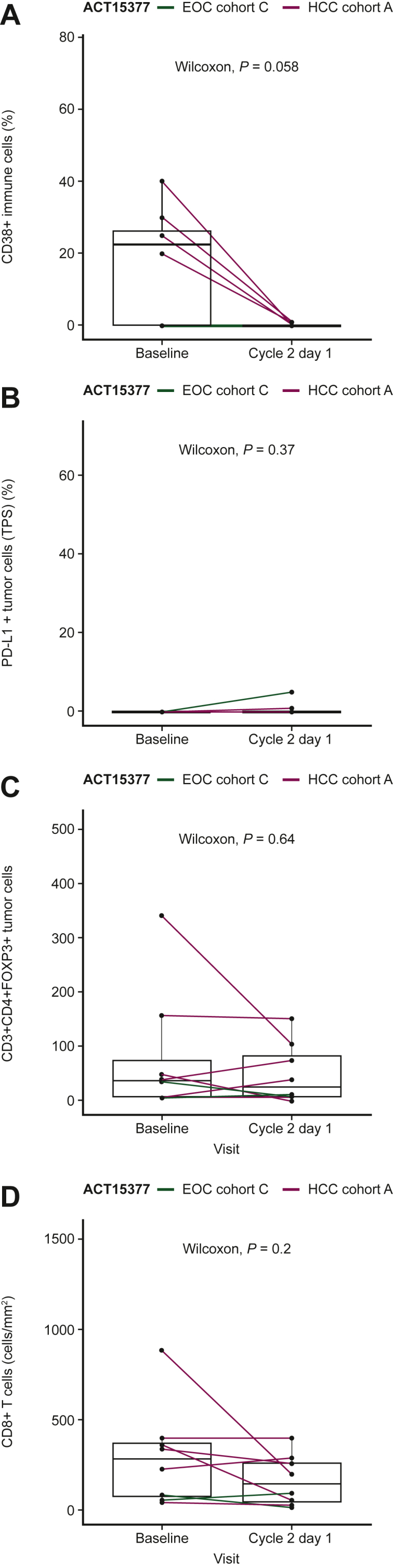
Overall, 107 patients were treated (EOC, n = 18; GBM, n = 33; HCC, n = 27; SCCHN, n = 29). In phase I, Isa + Atezo showed an acceptable safety profile, no dose-limiting toxicities were observed, and RP2D was confirmed. Most patients experienced ≥1 treatment-emergent adverse event (TEAE), with ≤48.5% being grade ≥3. The most frequent TEAE was infusion reactions. The study did not continue to stage 2 based on prespecified targets. Tumor-infiltrating CD38+ immune cells were reduced and almost cleared after treatment. Isa + Atezo did not significantly modulate Tregs or PD-L1 expression in the TME.
Isa + Atezo had acceptable safety and tolerability. Clinical pharmacodynamic evaluation revealed efficient target engagement of isatuximab via treatment-mediated reduction of CD38+ immune cells in the TME. Based on clinical data, CD38 inhibition does not improve responsiveness to PD-L1 blockade in these patients.
抗 CD38 抗体伊沙妥昔单抗已获批用于治疗复发/难治性多发性骨髓瘤,但在实体瘤方面尚无疗效数据。这项 I/II 期研究(NCT03637764)评估了在免疫治疗初治的实体瘤患者中,伊沙妥昔单抗联合阿替利珠单抗(Isa+Atezo),一种抗程序性死亡配体 1(PD-L1)抗体的安全性和活性:上皮性卵巢癌(EOC)、胶质母细胞瘤(GBM)、肝细胞癌(HCC)和头颈部鳞状细胞癌(SCCHN)。
I 期评估了伊沙妥昔单抗 10 mg/kg 静脉注射(iv.)每 3 周一次,共 3 次,随后每 3 周一次+阿替利珠单抗 1200 mg iv.每 3 周一次的安全性、耐受性、药代动力学、药效学和推荐的 II 期剂量(RP2D)。II 期采用 Simon 的两阶段设计,评估 6 个月时的总缓解率或无进展生存率(GBM 队列)。在每个队列中最后入组患者首次给药后 6 个月进行中期分析。在肿瘤微环境(TME)中检测 CD38、PD-L1、肿瘤浸润免疫细胞和 FOXP3+调节性 T 细胞(Tregs)等药效学生物标志物。
共有 107 例患者接受了治疗(EOC,n=18;GBM,n=33;HCC,n=27;SCCHN,n=29)。在 I 期,Isa+Atezo 具有可接受的安全性,未观察到剂量限制性毒性,且确认了 RP2D。大多数患者发生≥1 次治疗相关不良事件(TEAE),≤48.5%为 3 级及以上。最常见的 TEAE 是输注反应。根据预设目标,研究并未继续进入 II 期。治疗后肿瘤浸润 CD38+免疫细胞减少且几乎清除。Isa+Atezo 并未显著调节 TME 中的 Tregs 或 PD-L1 表达。
Isa+Atezo 具有可接受的安全性和耐受性。临床药效学评估显示,通过治疗介导的 TME 中 CD38+免疫细胞减少,伊沙妥昔单抗的靶向作用得到有效发挥。基于临床数据,CD38 抑制并不能改善这些患者对 PD-L1 阻断的反应。