Department of General Surgery, 904th Hospital of Joint Logistic Support Force of PLA (Suzhou), Suzhou, 215007, China.
Department of General Surgery, Suzhou BOE hospital, Suzhou, China.
J Cardiothorac Surg. 2022 Aug 20;17(1):194. doi: 10.1186/s13019-022-01940-5.
To evaluate the serum D-dimer level and its diagnostic and prognostic predictive value in patients with different types of aortic dissection.
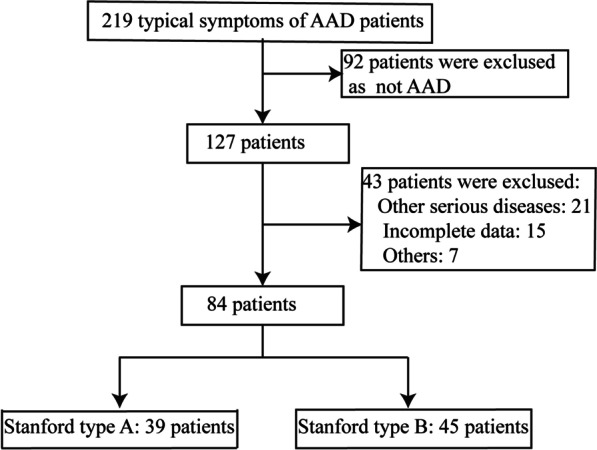
Eighty-four aortic dissection patients who were diagnosed clinically in our hospital from January 2017 to January 2021 were selected for the study. All patients were divided into Stanford type A (39 cases) and Stanford type B (45 cases) groups. The serum D-dimer level was detected at 1 h, 6 h, 12 h, 24 h, and 72 h after admission to the hospital, and its expression level with different types of aortic dissection was analyzed. The relationship between D-dimer and the prognosis of patients was also analyzed.
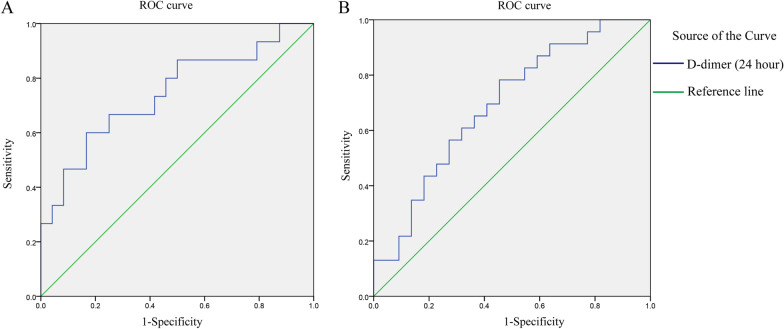
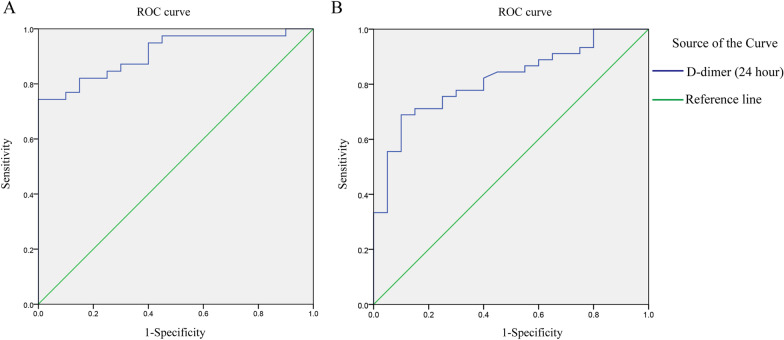
The serum D-dimer levels of patients in group A were significantly higher than those in group B at 6 h, 12 h, 24 h, and 72 h after admission, and the differences were statistically significant. In group A, 16 patients died, and 23 patients survived, while in group B, 18 patients died, and 27 patients survived. The serum D-dimer level of the dead and surviving patients in group A was significantly higher than that of group B, and the serum D-dimer level of dead patients in groups A and B was significantly higher than that of surviving patients. For diagnostic value, the AUC was 0.89, sensitivity was 76.92%, specificity was 90.00% in group A, and the AUC was 0.82, sensitivity was 71.11%, and specificity was 85.00% in group B. For the prognostic predicted value, the AUC was 0.74 in group A, while the AUC was 0.69 in group B.
D-dimer has different serum levels in different types of aortic dissection patients, with higher levels in Stanford A. Serum D-dimer levels may be used as a better biomarker to diagnose the two types of aortic dissection and play an important role in patient prognostic prediction, especially Stanford type A.
评估不同类型主动脉夹层患者的血清 D-二聚体水平及其诊断和预后预测价值。
选择 2017 年 1 月至 2021 年 1 月我院临床诊断的 84 例主动脉夹层患者进行研究。所有患者均分为 Stanford 型 A(39 例)和 Stanford 型 B(45 例)两组。入院后 1 h、6 h、12 h、24 h、72 h 检测血清 D-二聚体水平,分析其在不同类型主动脉夹层中的表达水平。还分析了 D-二聚体与患者预后的关系。
入院后 6 h、12 h、24 h、72 h,A 组患者血清 D-二聚体水平明显高于 B 组,差异有统计学意义。A 组中 16 例死亡,23 例存活,B 组中 18 例死亡,27 例存活。A 组死亡患者的血清 D-二聚体水平明显高于 B 组,A 组和 B 组死亡患者的血清 D-二聚体水平明显高于存活患者。诊断价值方面,A 组 AUC 为 0.89,灵敏度为 76.92%,特异度为 90.00%,B 组 AUC 为 0.82,灵敏度为 71.11%,特异度为 85.00%。预后预测价值方面,A 组 AUC 为 0.74,B 组 AUC 为 0.69。
不同类型主动脉夹层患者的血清 D-二聚体水平不同,Stanford A 型水平较高。血清 D-二聚体水平可能作为两种类型主动脉夹层的更好生物标志物,在患者预后预测中发挥重要作用,尤其是 Stanford 型 A。