LOEWE Centre for Translational Biodiversity Genomics (LOEWE-TBG), Senckenberg Biodiversity and Climate Research Centre, Georg-Voigt-Str. 14-16, 60325, Frankfurt am Main, Germany.
Institute for Environmental Sciences, University of Koblenz-Landau, Fortstrasse 7, 76829, Landau, Germany.
BMC Genomics. 2022 Aug 22;23(1):600. doi: 10.1186/s12864-022-08571-z.
For over a century, scientists have studied host-pathogen interactions between the crayfish plague disease agent Aphanomyces astaci and freshwater crayfish. It has been hypothesised that North American crayfish hosts are disease-resistant due to the long-lasting coevolution with the pathogen. Similarly, the increasing number of latent infections reported in the historically sensitive European crayfish hosts seems to indicate that similar coevolutionary processes are occurring between European crayfish and A. astaci. Our current understanding of these host-pathogen interactions is largely focused on the innate immunity processes in the crayfish haemolymph and cuticle, but the molecular basis of the observed disease-resistance and susceptibility remain unclear. To understand how coevolution is shaping the host's molecular response to the pathogen, susceptible native European noble crayfish and invasive disease-resistant marbled crayfish were challenged with two A. astaci strains of different origin: a haplogroup A strain (introduced to Europe at least 50 years ago, low virulence) and a haplogroup B strain (signal crayfish in lake Tahoe, USA, high virulence). Here, we compare the gene expression profiles of the hepatopancreas, an integrated organ of crayfish immunity and metabolism.
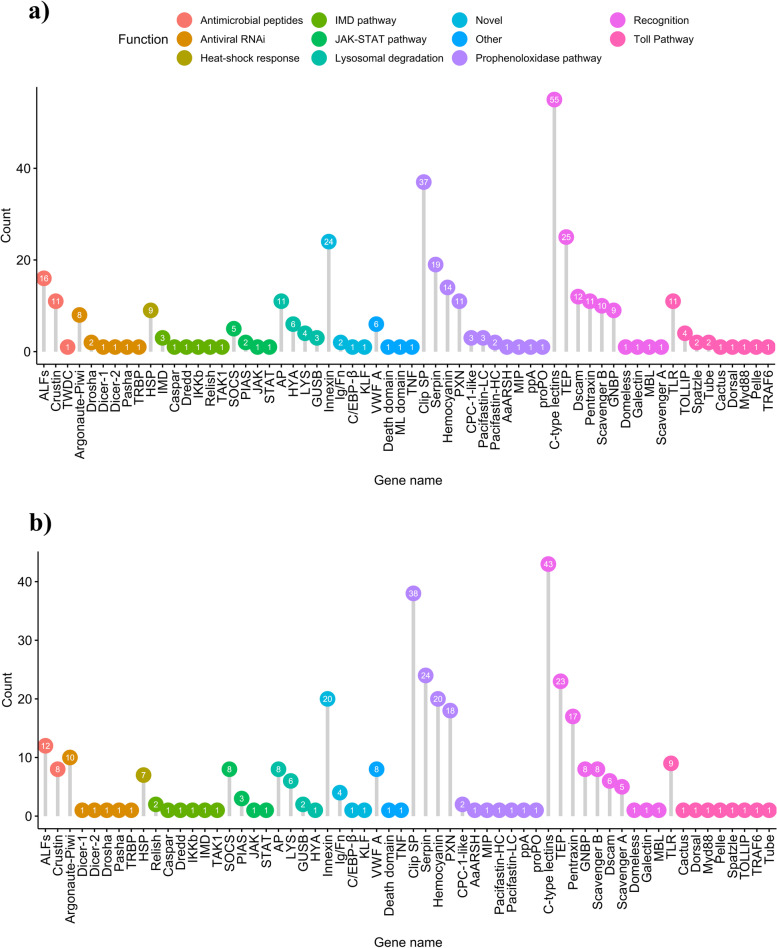
We characterised several novel innate immune-related gene groups in both crayfish species. Across all challenge groups, we detected 412 differentially expressed genes (DEGs) in the noble crayfish, and 257 DEGs in the marbled crayfish. In the noble crayfish, a clear immune response was detected to the haplogroup B strain, but not to the haplogroup A strain. In contrast, in the marbled crayfish we detected an immune response to the haplogroup A strain, but not to the haplogroup B strain.
We highlight the hepatopancreas as an important hub for the synthesis of immune molecules in the response to A. astaci. A clear distinction between the innate immune response in the marbled crayfish and the noble crayfish is the capability of the marbled crayfish to mobilise a higher variety of innate immune response effectors. With this study we outline that the type and strength of the host immune response to the pathogen is strongly influenced by the coevolutionary history of the crayfish with specific A. astaci strains.
一个多世纪以来,科学家们一直在研究螯虾疫病病原体阿氏阿星虫与淡水螯虾之间的宿主-病原体相互作用。人们假设,北美的螯虾宿主具有抗疾病能力,这是由于它们与病原体之间长期的共同进化。同样,在历史上敏感的欧洲螯虾宿主中报告的潜伏感染数量不断增加,这似乎表明欧洲螯虾与阿氏阿星虫之间也在发生类似的共同进化过程。我们目前对这些宿主-病原体相互作用的理解主要集中在螯虾血淋巴和甲壳的先天免疫过程上,但观察到的抗性和易感性的分子基础仍不清楚。为了了解共同进化如何塑造宿主对病原体的分子反应,我们用两种来自不同起源的阿氏阿星虫菌株(至少 50 年前引入欧洲的低毒力单倍型 A 菌株和来自美国塔霍湖的信号螯虾的高毒力单倍型 B 菌株)对易感的本地欧洲高贵螯虾和入侵的抗疾病螯虾进行了挑战。在这里,我们比较了肝胰腺的基因表达谱,肝胰腺是螯虾免疫和代谢的综合器官。
我们在这两个螯虾物种中鉴定了几个新的先天免疫相关基因群。在所有挑战组中,我们在高贵螯虾中检测到 412 个差异表达基因(DEGs),在大理石螯虾中检测到 257 个 DEGs。在高贵螯虾中,我们检测到单倍型 B 菌株明显的免疫反应,但对单倍型 A 菌株没有反应。相比之下,在大理石螯虾中,我们检测到对单倍型 A 菌株的免疫反应,但对单倍型 B 菌株没有反应。
我们强调肝胰腺是合成对阿氏阿星虫免疫分子的重要枢纽。大理石螯虾和高贵螯虾之间先天免疫反应的明显区别在于,大理石螯虾能够调动更多种类的先天免疫反应效应物。通过这项研究,我们概述了宿主对病原体的免疫反应的类型和强度强烈受到螯虾与特定阿氏阿星虫菌株共同进化历史的影响。