
简明疼痛问卷简表土耳其语版本在癌症疼痛患者中的信效度
The reliability and validity of the Turkish version of the brief pain inventory-short form in patients with cancer pain.
作者信息
Balta Selin, Ünal-Ulutatar Çağrı, Mirzayeva Samaya, Başkaya Mehmet Çetin, Akyüz Gülseren
机构信息
Pain Medicine Clinic, Konya Training and Research Hospital, Konya, Türkiye.
Department of Physical Medicine and Rehabilitation, Sancaktepe Şehit Prof. Dr. Ilhan Varank Training and Research Hospital, Istanbul, Türkiye.
出版信息
Turk J Phys Med Rehabil. 2022 Jun 1;68(2):214-221. doi: 10.5606/tftrd.2022.6634. eCollection 2022 Jun.
OBJECTIVES
The aim of this study was to evaluate the reliability and validity of the Turkish version of the Brief Pain Inventory (BPI-TR) in patients with cancer pain.
PATIENTS AND METHODS
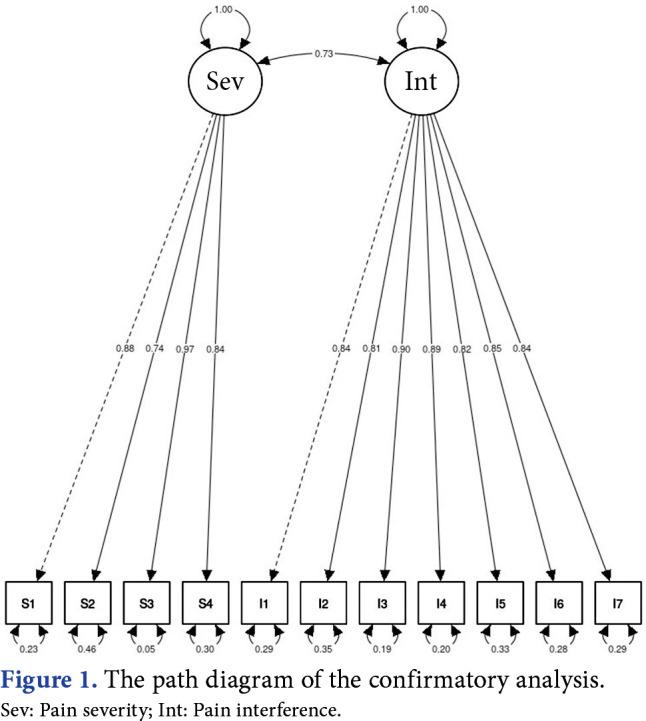
The study included 130 patients (70 females, 60 males; mean age: 56.1±13.3 years; range, 18 to 87 years) diagnosed with any type and stage of cancer between April 2017 and March 2018. Brief Pain Inventory, Pain Disability Index, EORTC QLQ C30 and Pain Management Index were used to collect data. The reliability of the scale was tested with internal consistency and its validity with construct validity. Cronbach`s alpha values of >0.70 were accepted as the threshold for internal consistency. Construct validity was tested in the context of structural validity with factor analysis and also tested in terms of convergent construct validity by investigating its correlation with the Pain Disability Index (PDI) and the European Organization for Research and Treatment of Cancer Quality of Life Questionnaire Core 30 (EORTC QLQ-C30).
RESULTS
The internal consistency of pain severity and pain-related interference was found as 0.91 and 0.95, respectively. The alpha coefficient was found to be between 0.795 and 0.873 for the pain severity index and between 0.729 and 0.861 for the pain-related interference index. There was a clear link between the BPI-TR pain severity index and the ninth question in the EORTC QLQ-C30 (rho=0.66, p<0.05). The association between the BPI-TR interference index and the 19th question in the EORTC QLQ-C30 was also strong (rho=0.77, p<0.05). The correlation between the BPI-TR interference index and the PDI was found to be moderate (rho=0.50, p<0.05).
CONCLUSION
The BPI-TR was found to be a reliable and legitimate tool to evaluate cancer pain in the Turkish population.
目的
本研究旨在评估土耳其语版简明疼痛问卷(BPI - TR)在癌症疼痛患者中的信度和效度。
患者与方法
本研究纳入了2017年4月至2018年3月期间诊断为任何类型和阶段癌症的130例患者(70例女性,60例男性;平均年龄:56.1±13.3岁;范围18至87岁)。使用简明疼痛问卷、疼痛残疾指数、欧洲癌症研究与治疗组织生活质量问卷C30版(EORTC QLQ C30)和疼痛管理指数收集数据。采用“内部一致性”检验量表的信度,采用“结构效度”检验其效度。Cronbach's α值>0.70被视为内部一致性的阈值。通过因子分析在结构效度的背景下检验结构效度,并通过调查其与疼痛残疾指数(PDI)和欧洲癌症研究与治疗组织生活质量问卷核心30项(EORTC QLQ - C30)的相关性来检验收敛结构效度。
结果
疼痛严重程度和疼痛相关干扰的内部一致性分别为0.91和0.95。疼痛严重程度指数的α系数在0.795至0.873之间,疼痛相关干扰指数的α系数在0.729至0.861之间。BPI - TR疼痛严重程度指数与EORTC QLQ - C30中的第九个问题之间存在明显关联(rho = 0.66,p<0.05)。BPI - TR干扰指数与EORTC QLQ - C30中的第19个问题之间的关联也很强(rho = 0.77,p<0.05)。发现BPI - TR干扰指数与PDI之间的相关性为中等(rho = 0.50,p<0.05)。
结论
BPI - TR被发现是评估土耳其人群癌症疼痛的可靠且合理的工具。
 Zotero 插件