Tso Chak Foon, Lam Carson, Calvert Jacob, Mao Qingqing
Dascena, Inc., Houston, TX, United States.
Montera Inc., San Francisco, CA, United States.
Front Pediatr. 2022 Aug 4;10:886212. doi: 10.3389/fped.2022.886212. eCollection 2022.
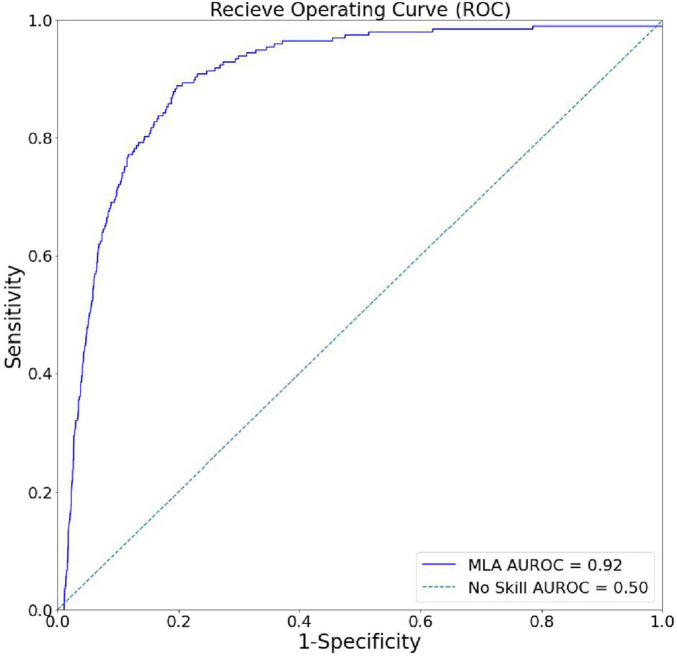
Respiratory syncytial virus (RSV) causes millions of infections among children in the US each year and can cause severe disease or death. Infections that are not promptly detected can cause outbreaks that put other hospitalized patients at risk. No tools besides diagnostic testing are available to rapidly and reliably predict RSV infections among hospitalized patients. We conducted a retrospective study from pediatric electronic health record (EHR) data and built a machine learning model to predict whether a patient will test positive to RSV by nucleic acid amplification test during their stay. Our model demonstrated excellent discrimination with an area under the receiver-operating curve of 0.919, a sensitivity of 0.802, and specificity of 0.876. Our model can help clinicians identify patients who may have RSV infections rapidly and cost-effectively. Successfully integrating this model into routine pediatric inpatient care may assist efforts in patient care and infection control.
呼吸道合胞病毒(RSV)每年在美国数百万儿童中引发感染,可导致严重疾病或死亡。未及时发现的感染可引发疫情,使其他住院患者面临风险。除诊断检测外,没有其他工具可快速、可靠地预测住院患者中的RSV感染情况。我们利用儿科电子健康记录(EHR)数据进行了一项回顾性研究,并建立了一个机器学习模型,以预测患者在住院期间通过核酸扩增检测RSV是否呈阳性。我们的模型表现出出色的区分能力,受试者操作特征曲线下面积为0.919,灵敏度为0.802,特异性为0.876。我们的模型可以帮助临床医生快速且经济高效地识别可能感染RSV的患者。将该模型成功整合到常规儿科住院护理中,可能有助于患者护理和感染控制工作。