Gülşen Murat, Yalçın Sıddıka Songül
Department of Autism, Special Mental Needs and Rare Diseases, Turkish Ministry of Health, Ankara, Türkiye.
Division of Social Pediatrics, Department of Pediatrics, Hacettepe University Faculty of Medicine, Ankara, Türkiye.
Turk Arch Pediatr. 2024 Jul 1;59(4):345-352. doi: 10.5152/TurkArchPediatr.2024.24076.
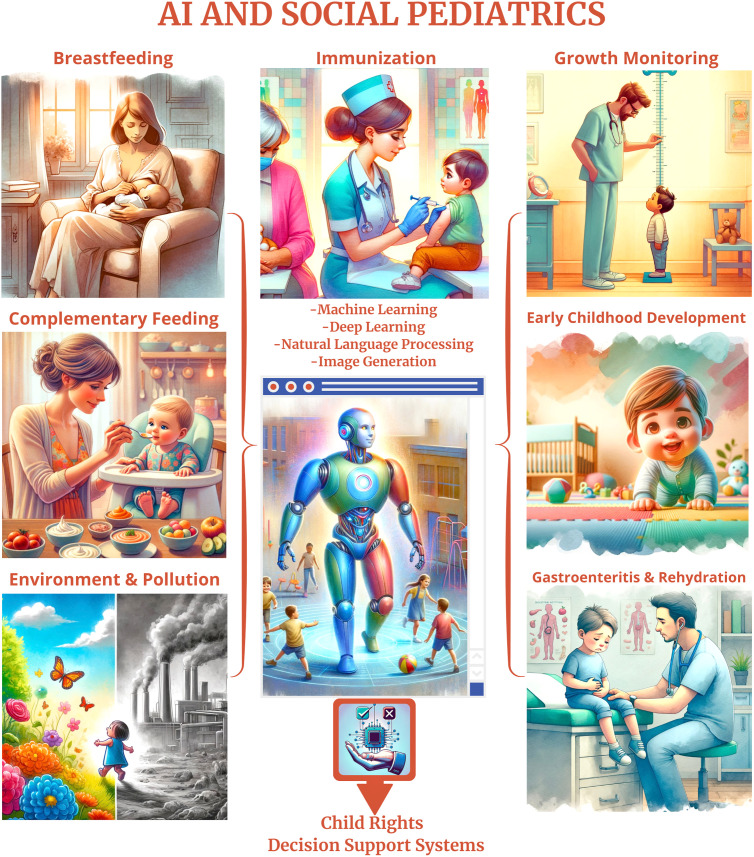
This comprehensive review explores the integration of artificial intelligence (AI) in the field of social pediatrics, emphasizing its potential to revolutionize child healthcare. Social pediatrics, a specialized branch within the discipline, focuses on the significant influence of societal, environmental, and economic factors on children's health and development. This field adopts a holistic approach, integrating medical, psychological, and environmental considerations. This review aims to explore the potential of AI in revolutionizing child healthcare from social pediatrics perspective. To achieve that, we explored AI applications in preventive care, growth monitoring, nutritional guidance, environmental risk factor prediction, and early detection of child abuse. The findings highlight AI's significant contributions in various areas of social pediatrics. Artificial intelligence's proficiency in handling large datasets is shown to enhance diagnostic processes, personalize treatments, and improve overall healthcare management. Notable advancements are observed in preventive care, growth monitoring, nutritional counseling, predicting environmental risks, and early child abuse detection. We find that integrating AI into social pediatric healthcare aims to enhance the effectiveness, accessibility, and equity of pediatric health services. This integration ensures high-quality care for every child, regardless of their social background. The study elucidates AI's multifaceted applications in social pediatrics, including natural language processing, machine learning algorithms for health outcome predictions, and AI-driven tools for health and environmental monitoring, collectively fostering a more efficient, informed, and responsive pediatric healthcare system.
这篇全面的综述探讨了人工智能(AI)在社会儿科学领域的整合,强调了其变革儿童医疗保健的潜力。社会儿科学是该学科内的一个专业分支,专注于社会、环境和经济因素对儿童健康与发展的重大影响。该领域采用整体方法,整合了医学、心理和环境等多方面的考量。本综述旨在从社会儿科学的角度探讨人工智能在变革儿童医疗保健方面的潜力。为实现这一目标,我们探讨了人工智能在预防保健、生长监测、营养指导、环境风险因素预测以及儿童虐待早期检测等方面的应用。研究结果凸显了人工智能在社会儿科学各个领域的重大贡献。人工智能处理大型数据集的能力被证明可增强诊断过程、实现治疗个性化并改善整体医疗管理。在预防保健、生长监测、营养咨询、环境风险预测以及儿童虐待早期检测等方面均有显著进展。我们发现,将人工智能整合到社会儿科医疗保健中旨在提高儿科医疗服务的有效性、可及性和公平性。这种整合确保为每个儿童提供高质量的护理,无论其社会背景如何。该研究阐明了人工智能在社会儿科学中的多方面应用,包括自然语言处理、用于健康结果预测的机器学习算法以及用于健康和环境监测的人工智能驱动工具,共同促进一个更高效、明智和响应迅速的儿科医疗保健系统。