Cao Chun, Meng Qian
Northeast Normal University, 5268, Renmin Street, Changchun, China.
Changchun University of Science and Technology, 7186, Weixing Road, Changchun, China.
Curr Psychol. 2022 Aug 15:1-14. doi: 10.1007/s12144-022-03630-w.
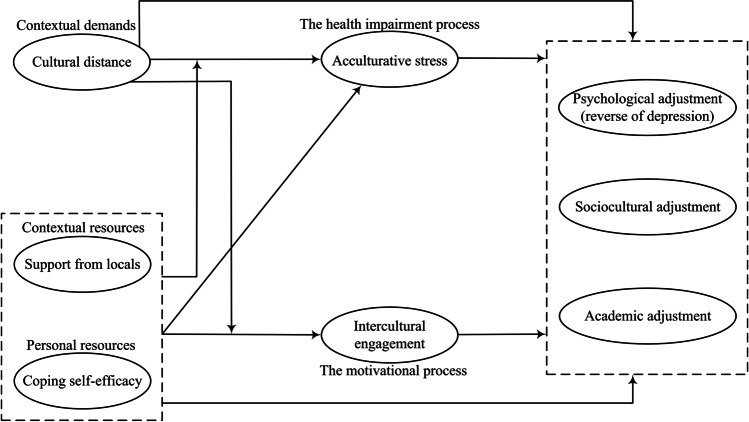
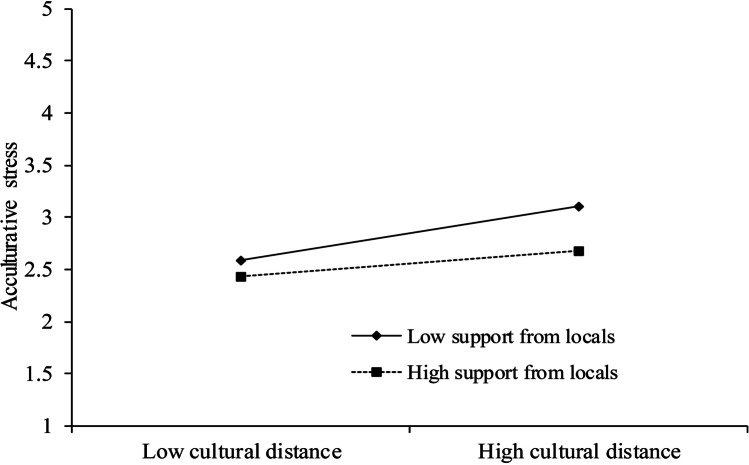
China has become one of the leading study abroad destinations worldwide. Recent research also indicates that international students encounter diverse life challenges and mental health issues in China. Therefore, scholars have shown increasing interest in their adjustment in Chinese social and academic settings. Seeking theoretical guidance from the Job Demands-Resources Model with mediation and moderation assumptions, our study aimed to test the dual processes (i.e., the health impairment process and the motivational process) leading to academic, sociocultural, and psychological adjustment, among international students sojourning in China. Using a convenience sampling method, our study recruited 1,001 participants (535 males and 466 females; = 22.73; = 1.62) who completed an online survey including scales of perceived cultural distance (contextual demands), social support from local members (contextual resources), coping self-efficacy (personal resources), acculturative stress, intercultural engagement, as well as three types of cross-cultural adjustment (academic, sociocultural, and psychological adjustment). Results based on the structural equation modeling (SEM) analyses indicated that perceived cultural distance had indirect relationships with the three types of adjustment through the mediator of acculturative stress. Social support from locals had indirect relationships with the three types of adjustment through the mediators of acculturative stress and intercultural engagement. Coping self-efficacy had indirect relationships with academic and sociocultural adjustment through the mediator of intercultural engagement. Additionally, social support from locals was revealed as a moderator that buffered the relationship between perceived cultural distance and acculturative stress. These mediated and moderated relationships not only confirmed the dual processes underlying international student adjustment, but also added new knowledge of how demands and resources can interplay to predict the dual processes.
中国已成为全球主要的留学目的地之一。近期研究还表明,国际学生在中国会遇到各种生活挑战和心理健康问题。因此,学者们对他们在中国社会和学术环境中的适应情况越来越感兴趣。本研究以具有中介和调节假设的工作需求-资源模型为理论指导,旨在检验在中国留学的国际学生学术、社会文化和心理适应的双重过程(即健康损害过程和激励过程)。本研究采用便利抽样方法,招募了1001名参与者(535名男性和466名女性;平均年龄=22.73岁;标准差=1.62),他们完成了一项在线调查,包括感知文化距离量表(情境需求)、当地成员的社会支持(情境资源)、应对自我效能感(个人资源)、文化适应压力、跨文化参与,以及三种跨文化适应类型(学术、社会文化和心理适应)。基于结构方程模型(SEM)分析的结果表明,感知文化距离通过文化适应压力这一中介与三种适应类型存在间接关系。当地人的社会支持通过文化适应压力和跨文化参与这两个中介与三种适应类型存在间接关系。应对自我效能感通过跨文化参与这一中介与学术和社会文化适应存在间接关系。此外,当地人的社会支持被发现是一个调节变量,缓冲了感知文化距离与文化适应压力之间的关系。这些中介和调节关系不仅证实了国际学生适应的双重过程,还增加了关于需求和资源如何相互作用以预测双重过程的新知识。