Quiroga Borja, Ortiz Alberto, Cabezas-Reina Carlos Jesús, Ruiz Fuentes María Carmen, López Jiménez Verónica, Zárraga Larrondo Sofía, Toapanta Néstor, Molina Gómez María, de Sequera Patricia, Sánchez-Álvarez Emilio
IIS-La Princesa, Nephrology Department, Hospital de la Princesa, Madrid, Spain.
IIS-Fundación Jimenez Diaz, School of Medicine, Universidad Autónoma de Madrid, Fundación Renal Iñigo Alvarez de Toledo-IRSIN, REDinREN, Instituto de Investigación Carlos III, Madrid, Spain.
Clin Kidney J. 2022 Jun 3;15(9):1685-1697. doi: 10.1093/ckj/sfac135. eCollection 2022 Sep.
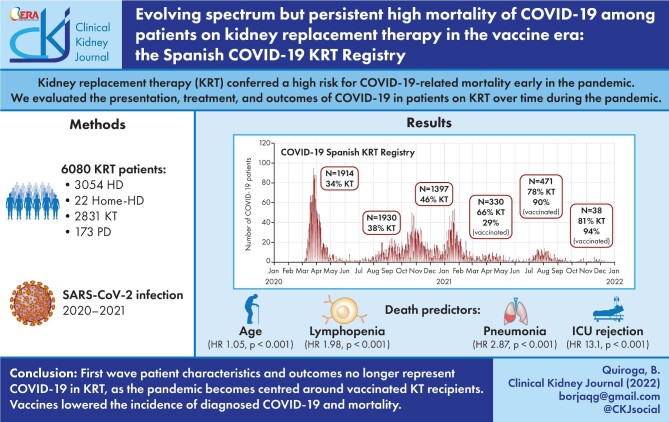
Kidney replacement therapy (KRT) conferred a high risk for coronavirus disease 2019 (COVID-19) related mortality early in the pandemic. We evaluate the presentation, treatment and outcomes of COVID-19 in patients on KRT over time during the pandemic.
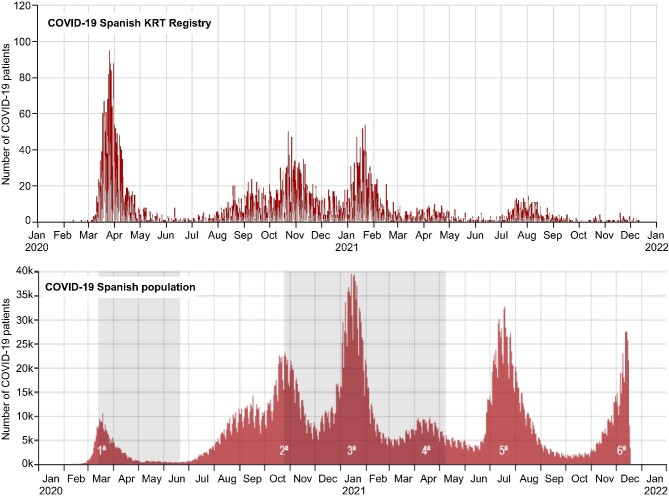
This registry-based study involved 6080 dialysis and kidney transplant (KT) patients with COVID-19, representing roughly 10% of total Spanish KRT patients. Epidemiology, comorbidity, infection, vaccine status and treatment data were recorded, and predictors of hospital admission, intensive care unit (ICU) admission and mortality were evaluated.
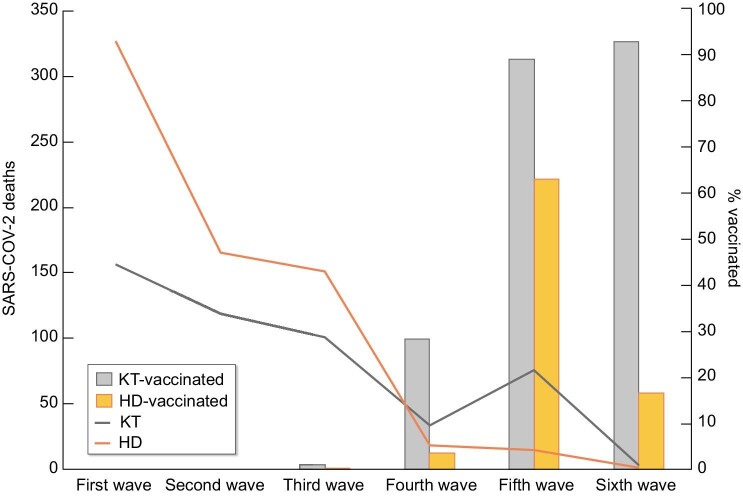
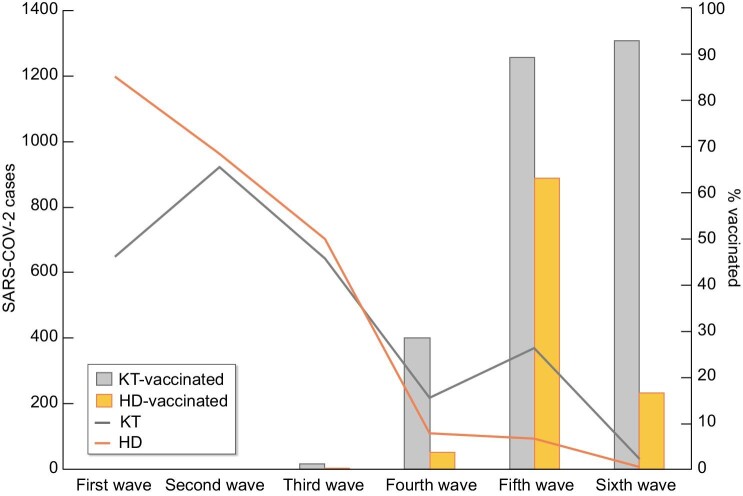
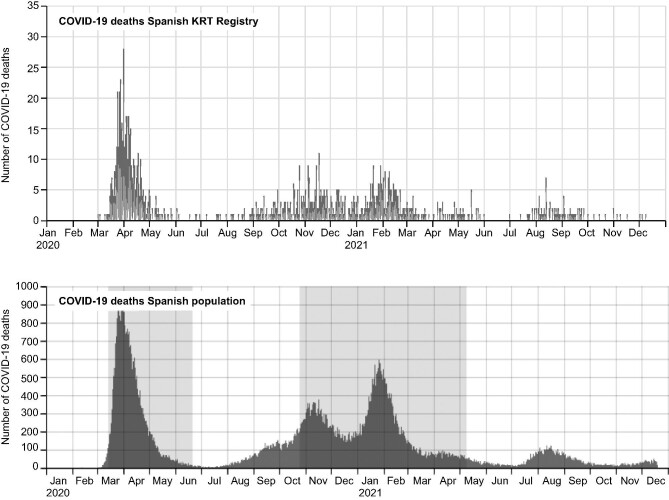
Vaccine introduction decreased the number of COVID-19 cases from 1747 to 280 per wave. Of 3856 (64%) COVID-19 KRT patients admitted to the hospital, 1481/3856 (38%) were admitted during the first of six waves. Independent predictors for admission included KT and the first wave. During follow-up, 1207 patients (21%) died, 500/1207 (41%) during the first wave. Among vaccinated patients, mortality was 19%, mostly affecting KT recipients. Overall, independent predictors for mortality were older age, disease severity (lymphopaenia, pneumonia) and ICU rejection. Among patient factors, older age, male sex, diabetes, KT and no angiotensin receptor blockers (ARB) were independent predictors of death. In KT recipients, individual immunosuppressants were independent predictors of death. Over time, patient characteristics evolved and in later pandemic waves, COVID-19 was mainly diagnosed in vaccinated KT recipients; in the few unvaccinated dialysis patients, ICU admissions increased and mortality decreased (28% for the first wave and 16-22% thereafter).
The clinical presentation and outcomes of COVID-19 during the first wave no longer represent COVID-19 in KRT patients, as the pandemic has become centred around vaccinated KT recipients. Vaccines lowered the incidence of diagnosed COVID-19 and mortality. However, mortality remains high despite increased access to ICU care.
在疫情早期,肾脏替代治疗(KRT)使2019冠状病毒病(COVID-19)相关死亡风险升高。我们评估了疫情期间接受KRT治疗的患者感染COVID-19后的临床表现、治疗及转归情况。
这项基于登记处的研究纳入了6080例感染COVID-19的透析和肾移植(KT)患者,约占西班牙KRT患者总数的10%。记录了流行病学、合并症、感染情况、疫苗接种状况及治疗数据,并评估了住院、入住重症监护病房(ICU)及死亡的预测因素。
疫苗接种使每波COVID-19病例数从1747例降至280例。在3856例(64%)因COVID-19入院的KRT患者中,1481/3856例(38%)在六波疫情的第一波期间入院。入院的独立预测因素包括肾移植和第一波疫情。随访期间,1207例患者(21%)死亡,其中500/1207例(41%)在第一波疫情期间死亡。在接种疫苗的患者中,死亡率为19%,主要影响肾移植受者。总体而言,死亡的独立预测因素为年龄较大、疾病严重程度(淋巴细胞减少、肺炎)及ICU拒收。在患者因素中,年龄较大、男性、糖尿病、肾移植及未使用血管紧张素受体阻滞剂(ARB)是死亡的独立预测因素。在肾移植受者中,个体免疫抑制剂是死亡的独立预测因素。随着时间推移,患者特征发生了变化,在疫情后期,COVID-19主要在接种疫苗的肾移植受者中被诊断出来;在少数未接种疫苗的透析患者中,ICU入院率增加而死亡率下降(第一波为28%,此后为16%-22%)。
由于疫情已围绕接种疫苗的肾移植受者展开,第一波疫情期间COVID-19的临床表现和转归情况已不能代表KRT患者感染COVID-19的情况。疫苗降低了COVID-19的确诊率和死亡率。然而,尽管进入ICU治疗的机会增加,但死亡率仍然很高。