Division of Nephrology, Department of Internal Medicine, Medical University of Graz, Graz, Austria.
Department of Medicine I, Klinik Favoriten, Vienna, Austria.
Front Public Health. 2023 Aug 10;11:1218188. doi: 10.3389/fpubh.2023.1218188. eCollection 2023.
Hemodialysis (HD) patients are a COVID-19 high risk population due to comorbidities and impaired immune response. Vaccines, advent of effective treatment and the emergence of novel variants have fundamentally changed the pandemic. We aimed to assess temporal changes of COVID-19 in HD patients of our catchment area, and risk factors for severe and fatal course.
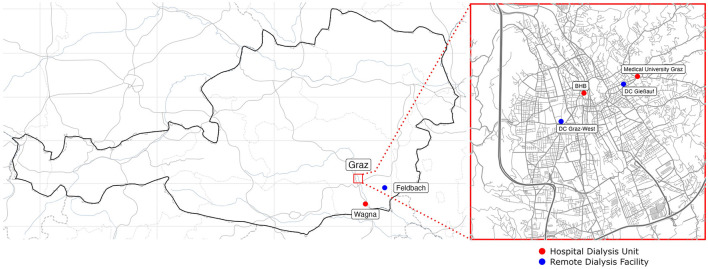
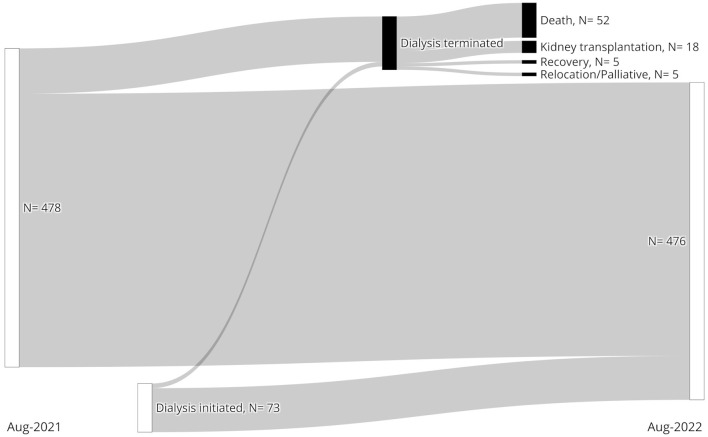
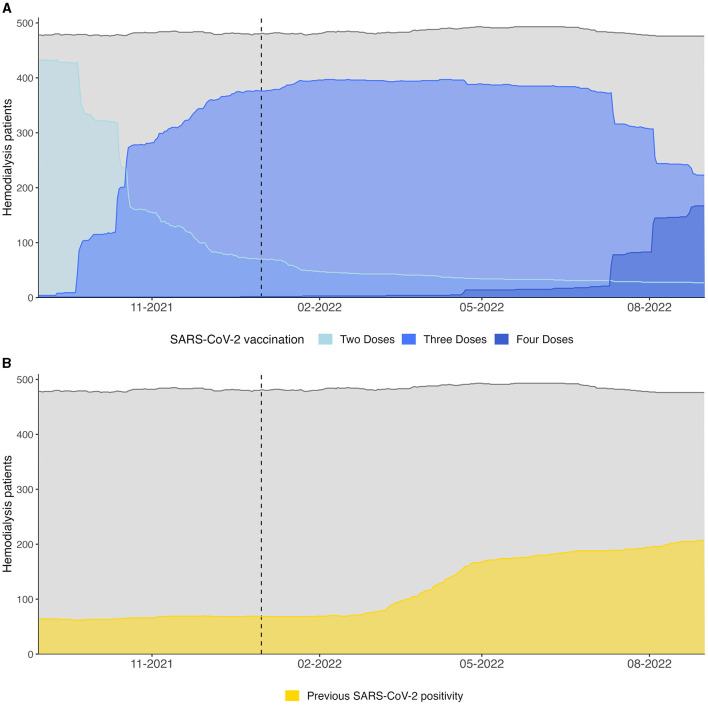
We retrospectively collected data from 274 patients admitted to the Medical University Graz, Austria for HD between 1st of May 2020 and 31st of August 2022. We analyzed clinical and demographic data between different COVID-19 waves and assessed factors associated with hospitalization, ICU admission and mortality by logistic regression. To further evaluate the dialysis at-risk population, we collected demographic and vaccination data between August 2021 and August 2022.
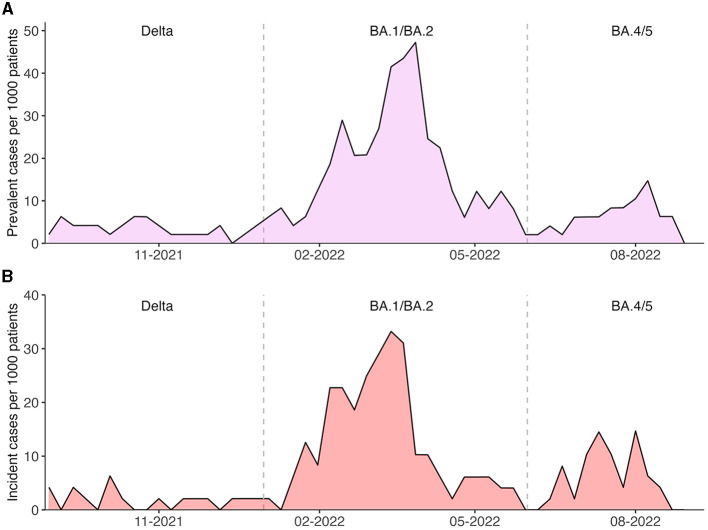
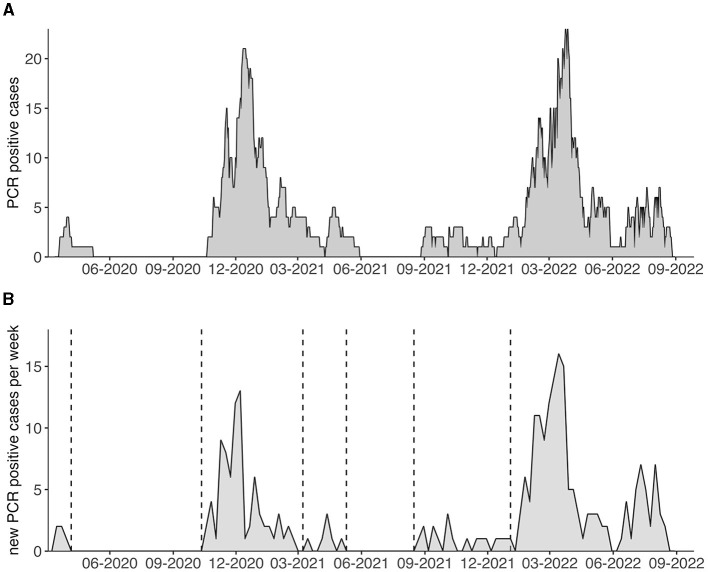
Time of infection and SARS-CoV-2 sequencing data allowed for distinction of five separate waves of infection with different impact on the dialysis population: While in the initial four waves frequencies of hospitalization, necessity of critical care and mortality were around 60%, 10% and 20%, respectively. These events became rare during the large fifth wave, when Omicron had become the dominant variant. Although only 16.9% had to be hospitalized, this resulted in 29 hospital admissions, due to the high prevalence of COVID-19 during the Omicron era. Furthermore, we observed similar clinical outcomes with BA.4/5 as with BA.1/BA.2 Omicron sublineages. The proportion of previously infected increased simultaneously with the number of vaccination doses in our dialysis population. Vaccination at time of positivity and infection with an Omicron variant conferred protection against hospitalization and mortality in univariate analysis, but only infection with an Omicron variant remained a robust predictor for these outcomes in multivariable analysis.
While a fourth of our at-risk population became infected during the Omicron wave, mortality was almost non-existent. Several concomitant factors have contributed to the decrease of COVID-19 severity in HD patients. This trend appears to be continued with BA.4/5, which was equally mild as BA.1 and BA.2 in our well vaccinated dialysis population.
由于合并症和免疫反应受损,血液透析(HD)患者是 COVID-19 的高危人群。疫苗、有效治疗方法的出现和新型变体的出现从根本上改变了大流行。我们旨在评估我们收治区域内 HD 患者 COVID-19 的时间变化,并确定严重和致命病程的危险因素。
我们回顾性地收集了 2020 年 5 月 1 日至 2022 年 8 月 31 日期间在奥地利格拉茨医科大学接受 HD 治疗的 274 名患者的数据。我们分析了不同 COVID-19 波之间的临床和人口统计学数据,并通过逻辑回归评估了与住院、重症监护病房入院和死亡率相关的因素。为了进一步评估透析高危人群,我们收集了 2021 年 8 月至 2022 年 8 月的人口统计学和疫苗接种数据。
感染时间和 SARS-CoV-2 测序数据允许将感染分为五个不同的波,每个波对透析人群的影响不同:在最初的四个波中,住院、需要重症监护和死亡率的频率分别约为 60%、10%和 20%。在奥密克戎成为主要变体时,这些事件变得很少。尽管只有 16.9%的人需要住院治疗,但由于奥密克戎时代 COVID-19 的高患病率,仍有 29 人住院。此外,我们观察到 BA.4/5 与 BA.1/BA.2 奥密克戎亚系具有相似的临床结局。在我们的透析人群中,随着疫苗接种剂量的增加,以前感染的比例也在增加。在单变量分析中,阳性时接种疫苗和感染奥密克戎变体可预防住院和死亡,但在多变量分析中,只有感染奥密克戎变体仍然是这些结果的可靠预测因素。
虽然我们的高危人群中有四分之一在奥密克戎波期间感染,但死亡率几乎不存在。几个同时存在的因素导致 HD 患者 COVID-19 严重程度降低。在我们接种疫苗良好的透析人群中,这种趋势似乎随着 BA.4/5 的出现而继续,BA.4/5 与 BA.1 和 BA.2 一样轻微。