Giffin Nick A, Guerra Gonzalo, Robinson Joan, Joynt Chloe, Rebeyka Ivan, Ben Sivarajan V
Division of Pediatric Emergency Medicine, Stollery Children's Hospital, University of Alberta, Edmonton, Alberta, Canada.
Pediatric Cardiac Intensive Care Unit, Division of Pediatric Critical Care, Stollery Children's Hospital, University of Alberta, Edmonton, Alberta, Canada.
JTCVS Open. 2021 Mar 26;6:211-219. doi: 10.1016/j.xjon.2021.03.009. eCollection 2021 Jun.
This study investigates the influence of timing of surgery among infants with congenital heart disease and active respiratory tract infections in a contemporary Western Canadian cohort.
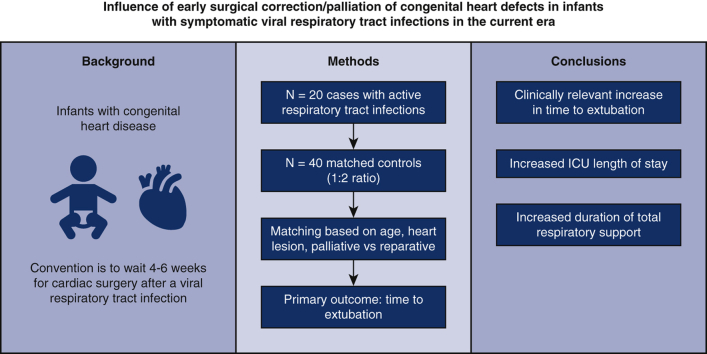
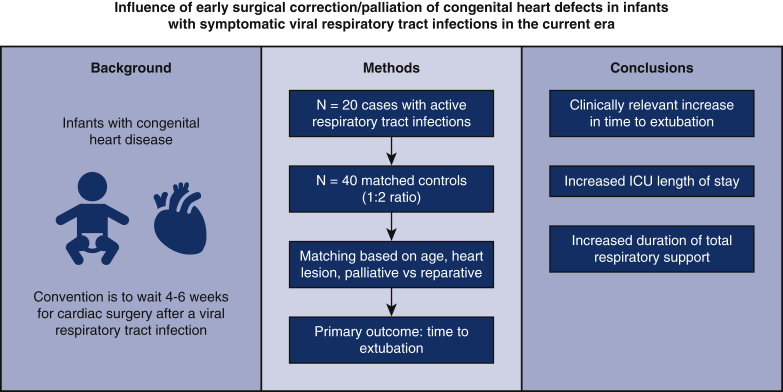
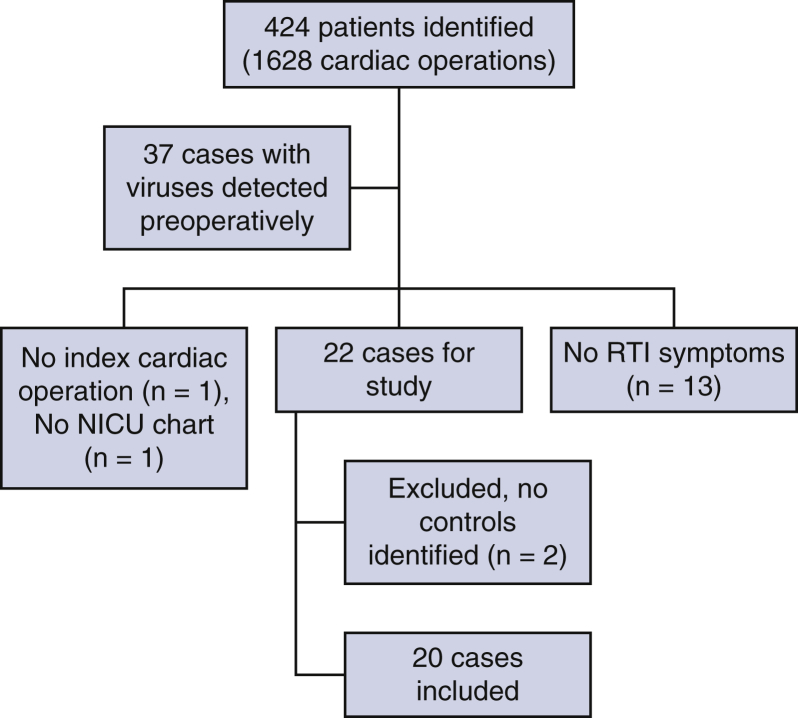
This was a retrospective matched cohort study of infants aged 1 week to 6 months undergoing surgical repair of congenital heart disease between 2014 and 2017. Case patients had active respiratory tract infections preoperatively and were matched to control patients based on primary heart lesion. The primary outcome was time to extubation.
We identified 20 cases (median age, 3.4 months [range, 2.4-4.3 months]) that were matched to 40 controls (1:2 ratio). In case patients, surgery occurred at a median of 1 day after the positive viral testing. There were no statistically significant differences between cases and controls in time to extubation (59 vs 34 hours [ = .12]), postoperative vasoactive scores at 24 hours (0 vs 0 [ = .53]), 48 hours (0 vs 0 [ = .23]), maximum vasoactive score in postoperative period (5 vs 5.5 [ = .54]), or time to hospital discharge (13 vs 12 days [ = .39]). Case patients had increased duration of total respiratory support (including noninvasive ventilation, 3.5 vs 2 days [ = .02]) and postoperative intensive care unit length of stay (5.5 vs 3 days [ = .01]).
Cardiac surgery on infants with congenital heart disease during an acute viral respiratory tract infection may yield a clinically relevant prolongation in time to extubation.
本研究调查了加拿大西部当代队列中,先天性心脏病合并活动性呼吸道感染婴儿的手术时机影响。
这是一项回顾性匹配队列研究,研究对象为2014年至2017年间接受先天性心脏病手术修复的1周龄至6个月龄婴儿。病例患者术前有活动性呼吸道感染,并根据原发性心脏病变与对照患者进行匹配。主要结局是拔管时间。
我们确定了20例病例(中位年龄3.4个月[范围2.4 - 4.3个月]),并与40例对照(1:2比例)进行匹配。在病例患者中,手术在病毒检测呈阳性后的中位1天进行。病例组和对照组在拔管时间(59小时对34小时[P = 0.12])、术后24小时血管活性评分(0对0[P = 0.53])、48小时(0对0[P = 0.23])、术后期间最大血管活性评分(5对5.5[P = 0.54])或出院时间(13天对12天[P = 0.39])方面无统计学显著差异。病例患者的总呼吸支持时间(包括无创通气,3.5天对2天[P = 0.02])和术后重症监护病房住院时间(5.5天对3天[P = 0.01])增加。
先天性心脏病婴儿在急性病毒性呼吸道感染期间进行心脏手术,可能会导致拔管时间出现临床相关的延长。