Pediatrics, University of California, San Francisco, Calif; Cardiovascular Research Institute, University of California, San Francisco, Calif.
Unidad de Cirugia Cardiovascular de Guatemala, Guatemala City, Guatemala.
J Thorac Cardiovasc Surg. 2014 Jan;147(1):442-50. doi: 10.1016/j.jtcvs.2013.03.023. Epub 2013 Apr 9.
The objective of this study was to determine the association between preoperative nutritional status and postoperative outcomes in children undergoing surgery for congenital heart defects (CHD).
Seventy-one patients with CHD were enrolled in a prospective, 2-center cohort study. We adjusted for baseline risk differences using a standardized risk adjustment score for surgery for CHD. We assigned a World Health Organization z score for each subject's preoperative triceps skin-fold measurement, an assessment of total body fat mass. We obtained preoperative plasma concentrations of markers of nutritional status (prealbumin, albumin) and myocardial stress (B-type natriuretic peptide [BNP]). Associations between indices of preoperative nutritional status and clinical outcomes were sought.
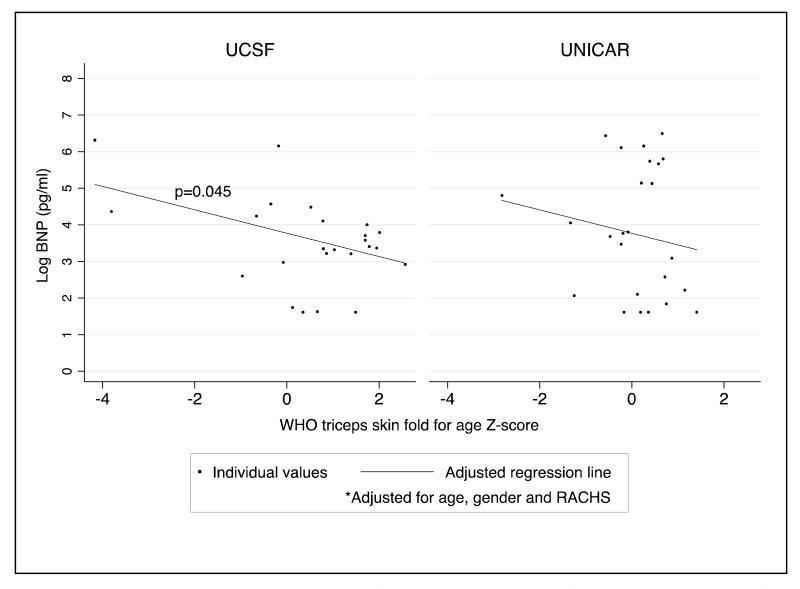
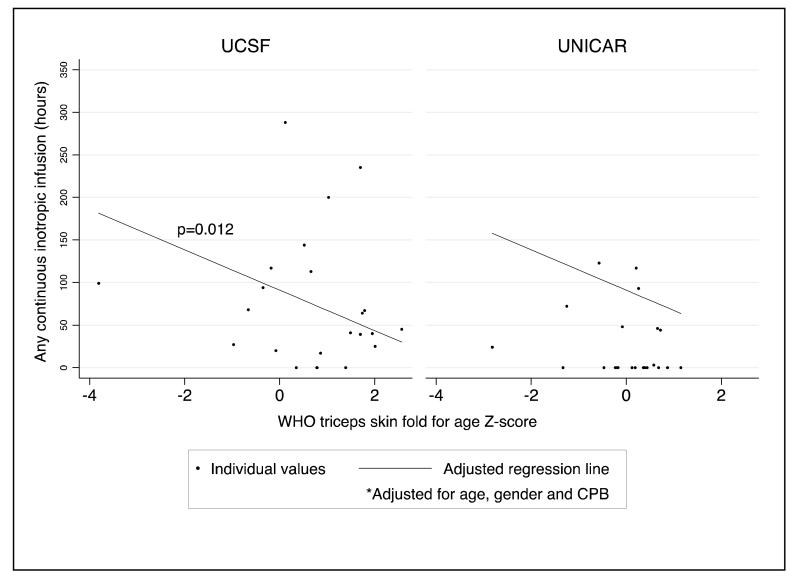
Subjects had a median (interquartile range [IQR]) age of 10.2 (33) months. In the University of California at San Francisco (UCSF) cohort, duration of mechanical ventilation (median, 19 hours; IQR, 29 hours), length of intensive care unit stay (median, 5 days; IQR 5 days), duration of any continuous inotropic infusion (median, 66 hours; IQR 72 hours), and preoperative BNP levels (median, 30 pg/mL; IQR, 75 pg/mL) were associated with a lower preoperative triceps skin-fold z score (P < .05). Longer duration of any continuous inotropic infusion and higher preoperative BNP levels were also associated with lower preoperative prealbumin (12.1 ± 0.5 mg/dL) and albumin (3.2 ± 0.1; P < .05) levels.
Lower total body fat mass and acute and chronic malnourishment are associated with worse clinical outcomes in children undergoing surgery for CHD at UCSF, a resource-abundant institution. There is an inverse correlation between total body fat mass and BNP levels. Duration of inotropic support and BNP increase concomitantly as measures of nutritional status decrease, supporting the hypothesis that malnourishment is associated with decreased myocardial function.
本研究旨在确定术前营养状况与先天性心脏病(CHD)患儿手术术后结果之间的关系。
71 例 CHD 患儿纳入前瞻性、2 中心队列研究。我们使用 CHD 手术标准化风险调整评分调整了基线风险差异。我们为每位受试者的术前肱三头肌皮褶测量值(全身脂肪量的评估)分配了世界卫生组织 z 评分。我们获得了术前营养状况标志物(前白蛋白、白蛋白)和心肌应激标志物(B 型利钠肽 [BNP])的血浆浓度。寻找术前营养状况指标与临床结果之间的关系。
受试者的中位(四分位距 [IQR])年龄为 10.2(33)个月。在旧金山加利福尼亚大学(UCSF)队列中,机械通气时间(中位数,19 小时;IQR,29 小时)、重症监护病房住院时间(中位数,5 天;IQR,5 天)、任何持续正性肌力输注时间(中位数,66 小时;IQR,72 小时)和术前 BNP 水平(中位数,30 pg/ml;IQR,75 pg/ml)与较低的术前肱三头肌皮褶 z 评分相关(P <.05)。较长时间的任何持续正性肌力输注和较高的术前 BNP 水平也与较低的术前前白蛋白(12.1 ± 0.5 mg/dL)和白蛋白(3.2 ± 0.1;P <.05)水平相关。
在资源丰富的 UCSF,全身脂肪量减少以及急性和慢性营养不良与 CHD 患儿手术术后结果较差相关。全身脂肪量与 BNP 水平呈负相关。正性肌力支持时间和 BNP 同时增加,而营养状况指标下降,支持营养不良与心肌功能下降相关的假说。