Department of Internal Medicine, Telemedicine Center, Shanghai Municipal Eighth People's Hospital, Shanghai, China.
Department of Internal Medicine, Division of Nephrology, Shanghai Municipal Eighth People's Hospital, Shanghai, China.
Front Public Health. 2022 Aug 8;10:935684. doi: 10.3389/fpubh.2022.935684. eCollection 2022.
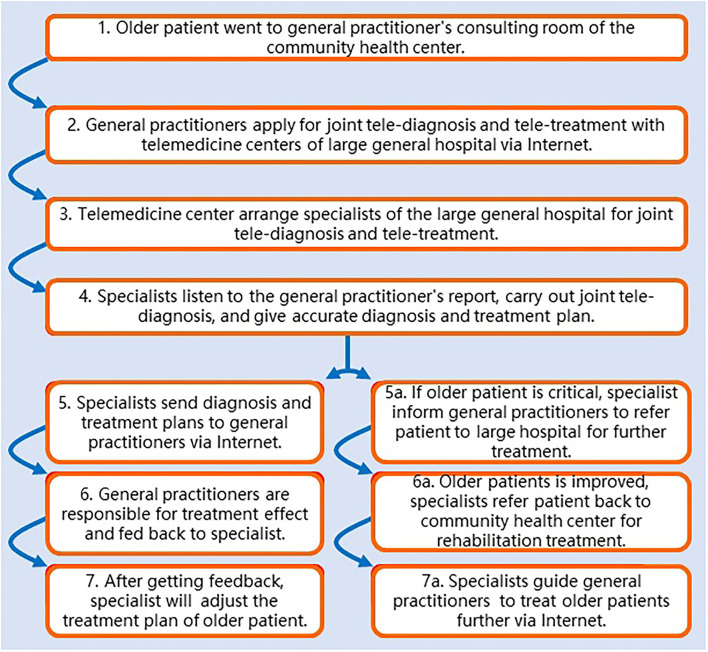
Elderly patients are associated with a higher risk of nosocomial cross infection during the COVID-19 pandemic. Providing medical services and primary care for elderly patients is a worldwide challenge. A new telegeriatrics system was established to provide medical services and primary care for elderly patients treated by family physicians. This study aimed to describe the operation mechanism of the new system and investigate the demands of telegeriatrics medical services for elderly patients treated by family physicians during the COVID-19 pandemic.
A total of 1,353 elderly patients (aged≥60) treated by family physicians were enrolled. The proportion of the top 10 diseases of elderly patients applying the new system was analyzed. Differences in main diseases between elderly patients applying telegeriatrics medical services and outpatients in hospitals were compared. Differences between the new telegeriatrics system in our study and telemedicine systems of other studies in other countries were analyzed.
Constituent ratios of chronic kidney disease, type 2 diabetes mellitus, and coronary heart disease have the highest rate in elderly patients applying the new telegeriatrics system. Digestive diseases, cardiovascular diseases, and neurology diseases were the top three diseases of elderly outpatients.
This is the first time that a new telegeriatrics system has been applied to provide medical services for elderly patients treated by family physicians during the COVID-19 pandemic. Chronic kidney disease, Type 2 diabetes mellitus, and coronary heart disease were found to be the top three diseases of elderly patients applying telegeriatrics medical services during the COVID-19 pandemic, which were different from the outpatients in general hospitals. The new telegeriatrics system guarantees elderly patients get equal rights to medical services. Results will provide a basis for the government health administrative department to formulate new telegeriatrics policies for elderly patients.
在 COVID-19 大流行期间,老年患者存在更高的医院交叉感染风险。为老年患者提供医疗服务和初级保健是全球范围内的挑战。建立了新的远程老年医学系统,为家庭医生治疗的老年患者提供医疗服务和初级保健。本研究旨在描述新系统的运作机制,并调查 COVID-19 大流行期间家庭医生治疗的老年患者对远程老年医学服务的需求。
共纳入 1353 名接受家庭医生治疗的老年患者(年龄≥60 岁)。分析应用新系统的老年患者前 10 种疾病的构成比。比较应用远程老年医学服务的老年患者与医院门诊患者的主要疾病差异。分析本研究中新的远程老年医学系统与其他国家远程医疗系统的差异。
应用新远程老年医学系统的老年患者中,慢性肾脏病、2 型糖尿病和冠心病的构成比最高。消化疾病、心血管疾病和神经疾病是老年门诊患者的前三位疾病。
这是首次在 COVID-19 大流行期间应用新的远程老年医学系统为家庭医生治疗的老年患者提供医疗服务。研究发现,慢性肾脏病、2 型糖尿病和冠心病是 COVID-19 大流行期间应用远程老年医学服务的老年患者的前三种疾病,与综合医院的门诊患者不同。新的远程老年医学系统保障了老年患者享有平等的医疗服务权利。研究结果将为政府卫生行政部门制定针对老年患者的新远程老年医学政策提供依据。