Cardiology Division, Department of Biomedical, Metabolic and Neural Sciences, Policlinico di Modena, University of Modena and Reggio Emilia, Modena, Italy.
Clinical and Experimental Medicine PhD Program, University of Modena and Reggio Emilia, Modena, Italy.
Eur J Clin Invest. 2023 Jan;53(1):e13862. doi: 10.1111/eci.13862. Epub 2022 Sep 7.
The number of patients with cardiac implantable electronic devices (CIEDs) undergoing radiotherapy (RT) for cancer treatment is growing. At present, prevalence and predictors of RT-induced CIEDs malfunctions are not defined.
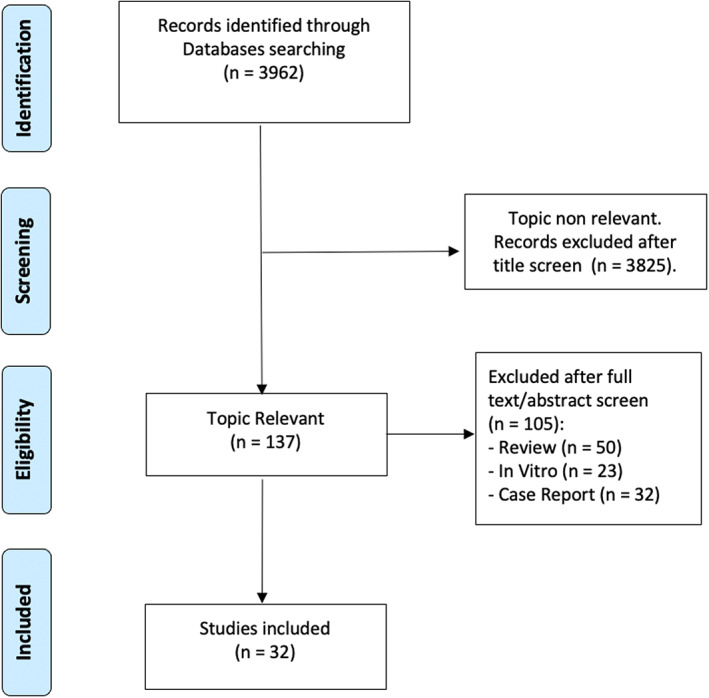
Systematic review and meta-analysis conducted following the PRISMA recommendations. PubMed, Scopus and Google Scholar were searched from inception to 31/01/2022 for studies reporting RT-induced malfunctions in CIEDs patients. Aim was to assess the prevalence of RT-induced CIEDs malfunctions and identify potential predictors.
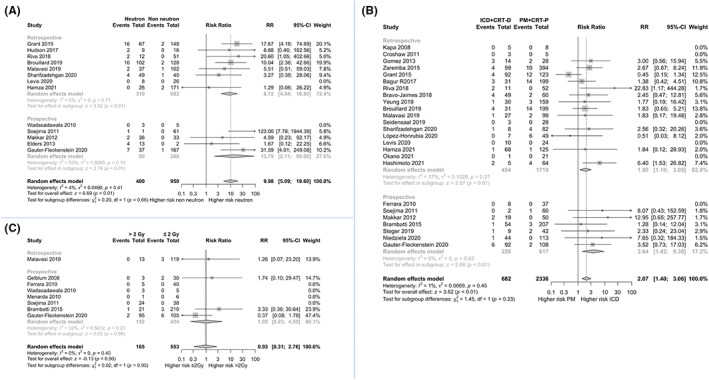
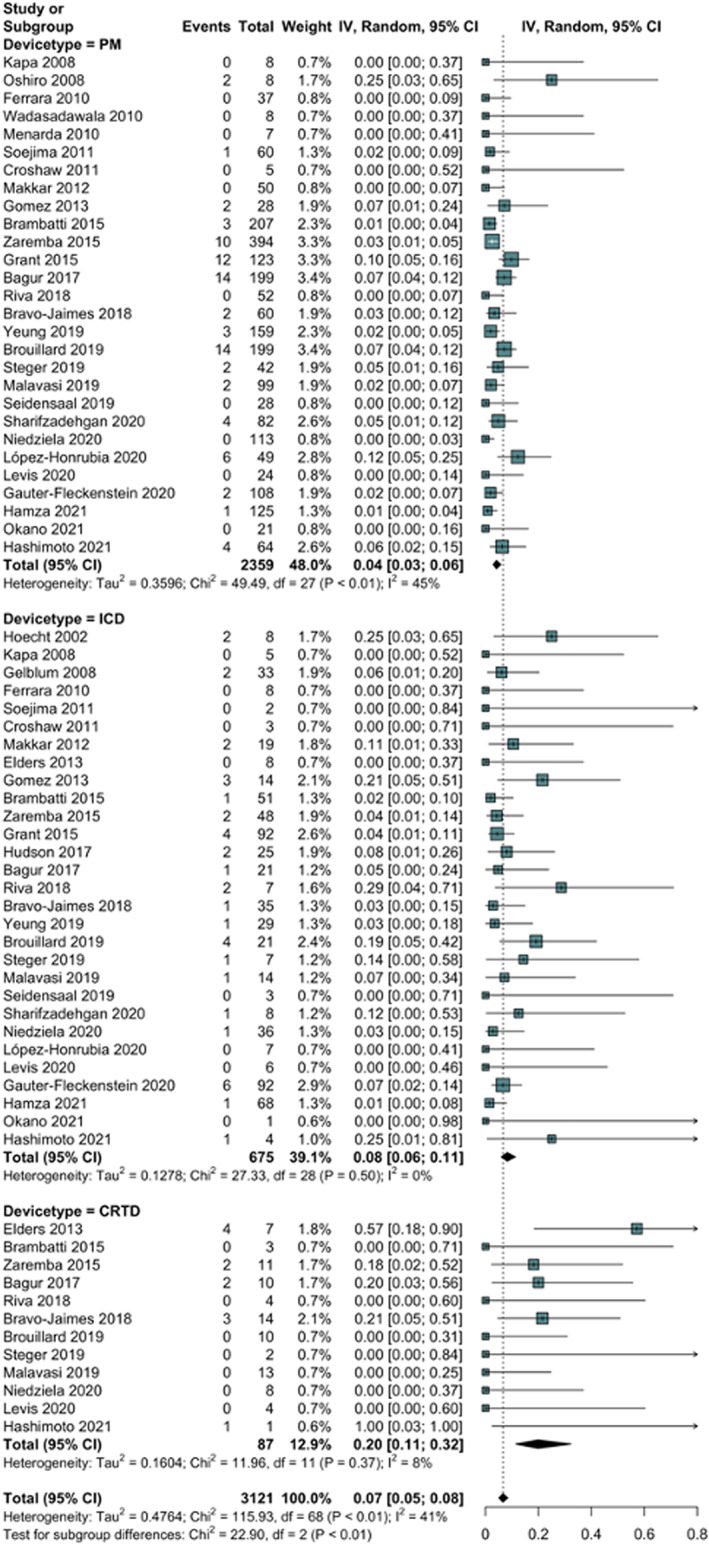
Thirty-two out of 3962 records matched the inclusion criteria and were included in the meta-analysis. A total of 135 CIEDs malfunctions were detected among 3121 patients (6.6%, 95% confidence interval [CI]: 5.1%-8.4%). The pooled prevalence increased moving from pacemaker (PM) to implantable cardioverter defibrillator (ICD), and cardiac resynchronization therapy and defibrillator (CRT-D) groups (4.1%, 95% CI: 2.9-5.8; 8.2% 95% CI: 5.9-11.3; and 19.8%, 95% CI: 11.4-32.2 respectively). A higher risk ratio (RR) of malfunctions was found when neutron-producing energies were used as compared to non-neutron-producing energies (RR 9.98, 95% CI: 5.09-19.60) and in patients with ICD/CRT-D as compared to patients with PM/CRT-P (RR 2.07, 95% CI: 1.40-3.06). On the contrary, no association was found between maximal radiation dose at CIED >2 Gy and CIEDs malfunctions (RR 0.93; 95% CI: 0.31-2.76).
Radiotherapy related CIEDs malfunction had a prevalence ranging from 4% to 20%. The use of neutron-producing energies and more complex devices (ICD/CRT-D) were associated with higher risk of device malfunction, while the radiation dose at CIED did not significantly impact on the risk unless higher doses (>10 Gy) were used.
因癌症治疗而行放射治疗(RT)的心脏植入式电子设备(CIED)患者数量正在增加。目前,RT 引起的 CIED 故障的患病率和预测因素尚不清楚。
按照 PRISMA 建议进行系统评价和荟萃分析。从成立到 2022 年 1 月 31 日,在 PubMed、Scopus 和 Google Scholar 上搜索了报告 CIED 患者 RT 引起的故障的研究。目的是评估 RT 引起的 CIED 故障的患病率,并确定潜在的预测因素。
在 3962 条记录中,有 32 条符合纳入标准并纳入荟萃分析。在 3121 名患者中,共发现 135 例 CIED 故障(6.6%,95%置信区间[CI]:5.1%-8.4%)。从起搏器(PM)到植入式心律转复除颤器(ICD)、心脏再同步治疗和除颤器(CRT-D)组,总体患病率逐渐升高(4.1%,95%CI:2.9-5.8;8.2%,95%CI:5.9-11.3;19.8%,95%CI:11.4-32.2)。与非中子产生能量相比,使用产生中子的能量时,故障的风险比(RR)更高(RR 9.98,95%CI:5.09-19.60),与 PM/CRT-P 患者相比,ICD/CRT-D 患者的 RR 更高(RR 2.07,95%CI:1.40-3.06)。相反,CIED 处的最大辐射剂量>2Gy 与 CIED 故障之间没有关联(RR 0.93;95%CI:0.31-2.76)。
放射治疗相关的 CIED 故障的患病率在 4%到 20%之间。使用产生中子的能量和更复杂的设备(ICD/CRT-D)与设备故障的风险增加相关,而 CIED 处的辐射剂量除非剂量较高(>10Gy),否则不会显著影响风险。