Buekers Jurgen, Remy Sylvie, Bessems Jos, Govarts Eva, Rambaud Loïc, Riou Margaux, Tratnik Janja Snoj, Stajnko Anja, Katsonouri Andromachi, Makris Konstantinos C, De Decker Annelies, Morrens Bert, Vogel Nina, Kolossa-Gehring Marike, Esteban-López Marta, Castaño Argelia, Andersen Helle Raun, Schoeters Greet
Unit Health, VITO, Flemish Institute for Technological Research, 2400 Mol, Belgium.
Department of Environmental and Occupational Health, Santé Publique France, 94415 Saint-Maurice, France.
Toxics. 2022 Aug 12;10(8):470. doi: 10.3390/toxics10080470.
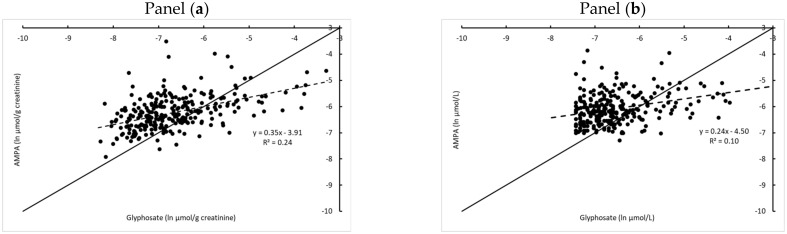
Few data are available on the exposure of children to glyphosate (Gly) in Europe. Within HBM4EU, new HBM exposure data were collected from aligned studies at five sampling sites distributed over Europe (studies: SLO CRP (SI); ORGANIKO (CY); GerES V-sub (DE); 3XG (BE); ESTEBAN (FR)). Median Gly concentrations in urine were below or around the detection limit (0.1 µg/L). The 95th percentiles ranged between 0.18 and 1.03 µg Gly/L. The ratio of AMPA (aminomethylphosphonic acid; main metabolite of Gly) to Gly at molar basis was on average 2.2 and the ratio decreased with higher Gly concentrations, suggesting that other sources of AMPA, independent of metabolism of Gly to AMPA in the monitored participants, may concurrently operate. Using reverse dosimetry and HBM exposure data from five European countries (east, west and south Europe) combined with the proposed ADI (acceptable daily intake) of EFSA for Gly of 0.1 mg/kg bw/day (based on histopathological findings in the salivary gland of rats) indicated no human health risks for Gly in the studied populations at the moment. However, the absence of a group ADI for Gly+AMPA and ongoing discussions on e.g., endocrine disrupting effects cast some uncertainty in relation to the current single substance ADI for Gly. The carcinogenic effects of Gly are still debated in the scientific community. These outcomes would influence the risk conclusions presented here. Finally, regression analyses did not find clear associations between urinary exposure biomarkers and analyzed potential exposure determinants. More information from questionnaires targeting exposure-related behavior just before the sampling is needed.
在欧洲,关于儿童接触草甘膦(Gly)的数据很少。在HBM4EU项目中,从分布于欧洲的五个采样点的一致性研究中收集了新的人体生物监测(HBM)暴露数据(研究:斯洛文尼亚CRP研究(斯洛文尼亚);ORGANIKO研究(塞浦路斯);德国环境调查V-子项目(德国);3XG研究(比利时);ESTEBAN研究(法国))。尿中草甘膦的中位数浓度低于或接近检测限(0.1μg/L)。第95百分位数在0.18至1.03μg草甘膦/升之间。氨基甲基膦酸(AMPA,草甘膦的主要代谢物)与草甘膦的摩尔比平均为2.2,且该比值随草甘膦浓度升高而降低,这表明在被监测参与者中,除了草甘膦代谢为AMPA之外,AMPA的其他来源可能同时存在。利用反向剂量测定法以及来自五个欧洲国家(东欧、西欧和南欧)的人体生物监测暴露数据,结合欧洲食品安全局(EFSA)针对草甘膦提出的每日可接受摄入量(ADI)为0.1mg/kg体重/天(基于大鼠唾液腺的组织病理学发现),表明目前所研究人群中草甘膦对人体健康没有风险。然而,由于缺乏草甘膦+AMPA的群体ADI,并且关于例如内分泌干扰效应等仍在进行讨论,这给目前草甘膦的单一物质ADI带来了一些不确定性。草甘膦的致癌作用在科学界仍存在争议。这些结果会影响此处给出的风险结论。最后,回归分析未发现尿暴露生物标志物与所分析的潜在暴露决定因素之间存在明确关联。需要从针对采样前与暴露相关行为的问卷中获取更多信息。