Faridah Lia, Suroso Djoko Santoso Abi, Fitriyanto Muhammad Suhardjono, Andari Clarisa Dity, Fauzi Isnan, Kurniawan Yonatan, Watanabe Kozo
Parasitology Laboratory, Biomedical Laboratory Group, Faculty of Medicine, Universitas Padjadjaran, Bandung 40161, Indonesia.
Parasitology Division, Department of Biomedical Science, Faculty of Medicine, Universitas Padjadjaran, Bandung 45363, Indonesia.
Trop Med Infect Dis. 2022 Aug 8;7(8):172. doi: 10.3390/tropicalmed7080172.
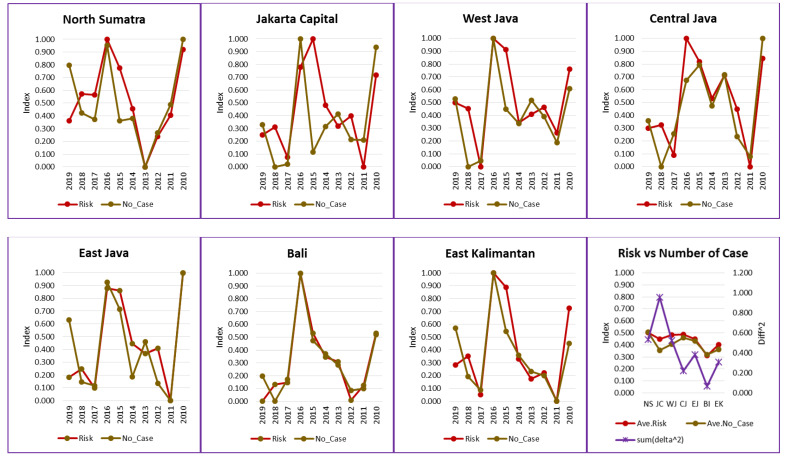
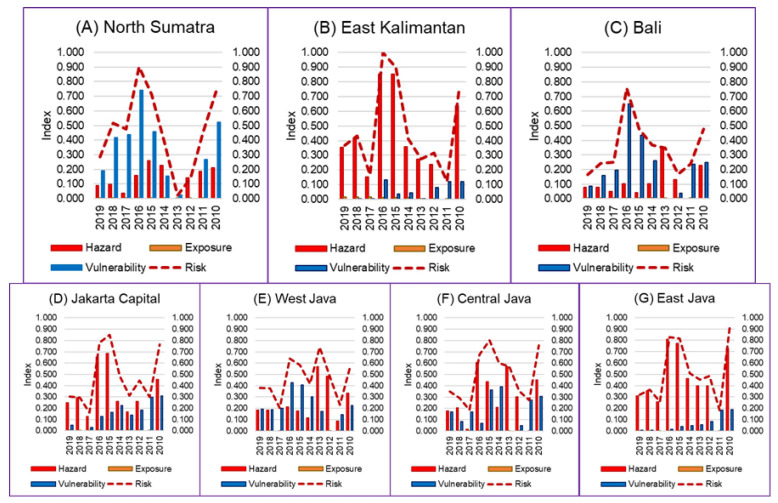
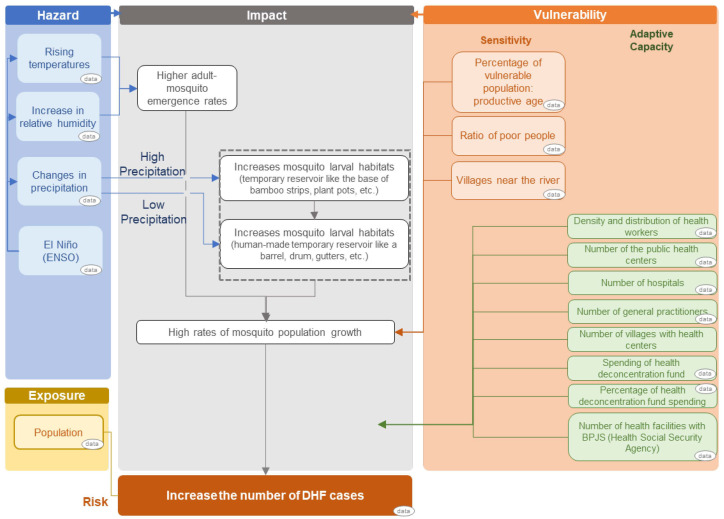
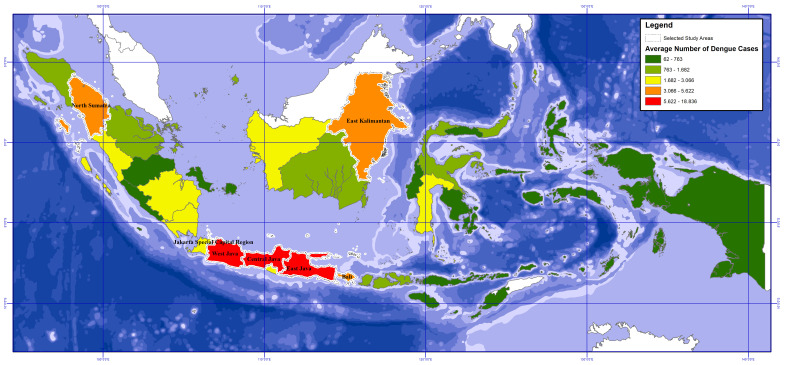
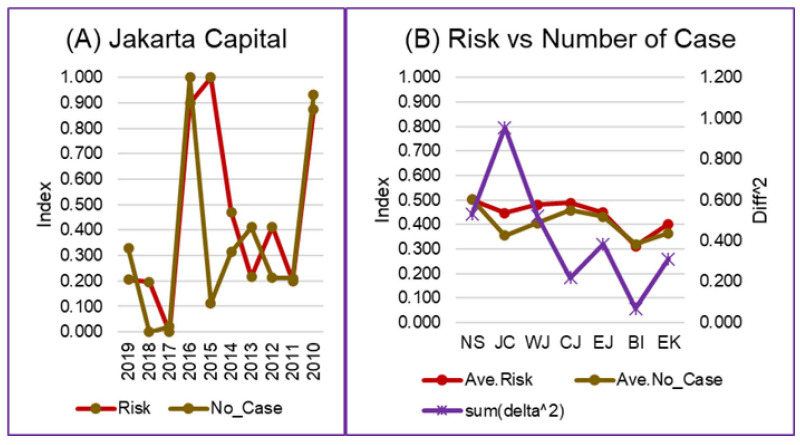
(1) Background: This paper will present an elaboration of the risk assessment methodology by Deutsche Gesellschaft für Internationale Zusammenarbeit GmbH (GIZ), Eurac Research and United Nations University Institute for Environment and Human Security (UNU-EHS) for the assessment of dengue. (2) Methods: We validate the risk assessment model by best-fitting it with the number of dengue cases per province using the least-square fitting method. Seven out of thirty-four provinces in Indonesia were chosen (North Sumatra, Jakarta Capital, West Java, Central Java, East Java, Bali and East Kalimantan). (3) Results: A risk assessment based on the number of dengue cases showed an increased risk in 2010, 2015 and 2016 in which the effects of El Nino and La Nina extreme climates occurred. North Sumatra, Bali, and West Java were more influenced by the vulnerability component, in line with their risk analysis that tends to be lower than the other provinces in 2010, 2015 and 2016 when El Nino and La Nina occurred. (4) Conclusion: Based on data from the last ten years, in Jakarta Capital, Central Java, East Java and East Kalimantan, dengue risks were mainly influenced by the climatic hazard component while North Sumatra, Bali and West Java were more influenced by the vulnerability component.
(1) 背景:本文将详细阐述德国国际合作机构(GIZ)、欧洲应用科学研究中心(Eurac Research)和联合国大学环境与人类安全研究所(UNU-EHS)用于登革热评估的风险评估方法。(2) 方法:我们使用最小二乘法将风险评估模型与每个省份的登革热病例数进行最佳拟合,从而验证该模型。在印度尼西亚的34个省份中选择了7个(北苏门答腊、雅加达首都特区、西爪哇、中爪哇、东爪哇、巴厘岛和东加里曼丹)。(3) 结果:基于登革热病例数的风险评估显示,在2010年、2015年和2016年出现了风险增加的情况,当时发生了厄尔尼诺和拉尼娜极端气候。北苏门答腊、巴厘岛和西爪哇受脆弱性因素的影响更大,这与它们在2010年、2015年和2016年厄尔尼诺和拉尼娜发生时的风险分析结果一致,其风险往往低于其他省份。(4) 结论:根据过去十年的数据,在雅加达首都特区、中爪哇、东爪哇和东加里曼丹,登革热风险主要受气候危害因素影响,而北苏门答腊、巴厘岛和西爪哇受脆弱性因素的影响更大。