Nyandwi Elias, Veldkamp Tom, Amer Sherif, Ruberanziza Eugene, Rujeni Nadine, Umulisa Ireneé
Centre for Geographic Information Systems and Remote Sensing, College of Science and Technology, University of Rwanda, KN 73 Street, (Avenue de l'Armée), Kigali P.O. Box 4285, Rwanda.
Faculty of Geo-Information Science and Earth Observation, University of Twente, 7522 NB Enschede, The Netherlands.
Trop Med Infect Dis. 2022 Aug 22;7(8):202. doi: 10.3390/tropicalmed7080202.
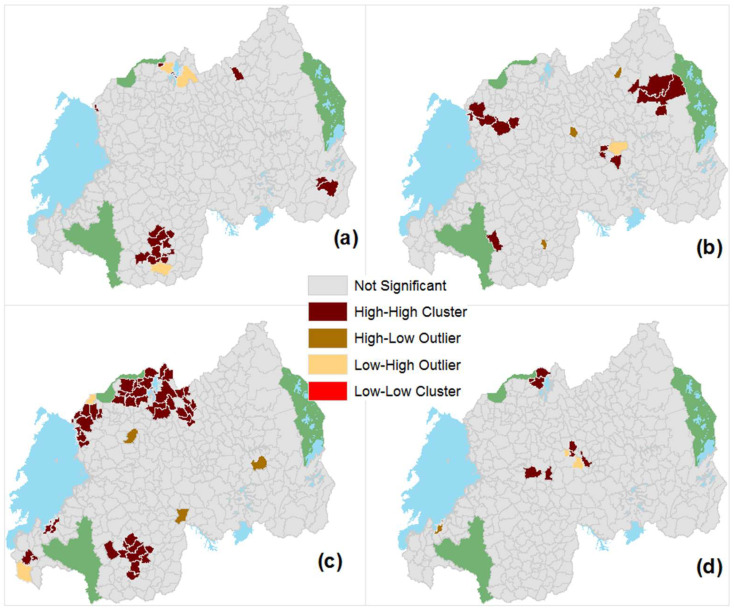
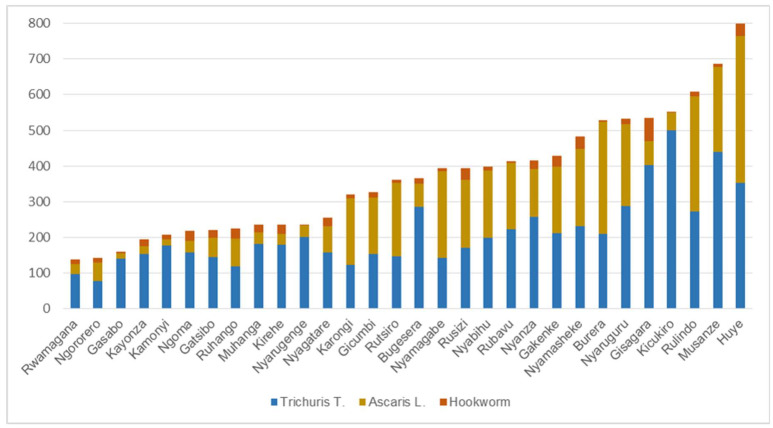
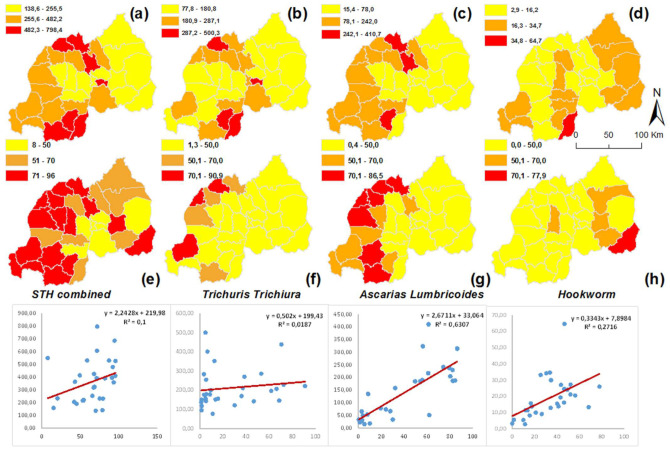
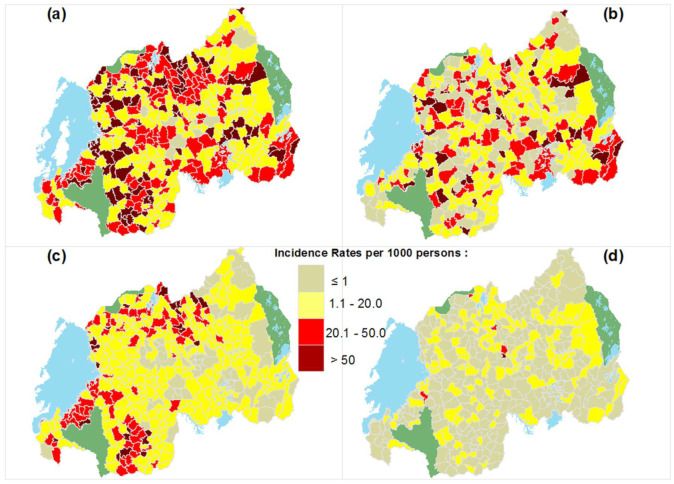
Background. Soil-transmitted helminths (STH) are parasitic diseases with significant public health impact. Analysis is generally based on cross-sectional prevalence surveys; outcomes are mostly aggregated to larger spatial units. However, recent research demonstrates that infection levels and spatial patterns differ between STH species and tend to be localized. Methods. Incidence data of STHs including roundworm (Ascaris lumbricoides), whipworm (Trichuris trichiura) and hookworms per primary health facility for 2008 were linked to spatially delineated primary health center service areas. Prevalence data per district for individual and combined STH infections from the 2008 nationwide survey in Rwanda were also obtained. Results. A comparison of reported prevalence and incidence data indicated significant positive correlations for roundworm (R2 = 0.63) and hookworm (R2 = 0.27). Weak positive correlations were observed for whipworm (R2 = 0.02) and the three STHs combined (R2 = 0.10). Incidence of roundworm and whipworm were found to be focalized with significant spatial autocorrelation (Moran’s I > 0: 0.05−0.38 and p ≤ 0.03), with (very) high incidence rates in some focal areas. In contrast, hookworm incidence is ubiquitous and randomly distributed (Moran’s I > 0: 0.006 and p = 0.74) with very low incidence rates. Furthermore, an exploratory regression analysis identified relationships between helminth infection cases and potential environmental and socio-economic risk factors. Conclusions. Findings show that the spatial distribution of STH incidence is significantly associated with soil properties (sand proportion and pH), rainfall, wetlands and their uses, population density and proportion of rural residents. Identified spatial patterns are important for guiding STH prevention and control programs.
背景。土壤传播的蠕虫病(STH)是对公共卫生有重大影响的寄生虫病。分析通常基于横断面患病率调查;结果大多汇总到更大的空间单元。然而,最近的研究表明,不同种类的土壤传播蠕虫病感染水平和空间模式存在差异,且往往呈局部性。方法。将2008年每个初级卫生设施的蛔虫(蛔虫)、鞭虫(鞭虫)和钩虫等土壤传播蠕虫病的发病率数据与在空间上划定的初级卫生中心服务区相关联。还获得了卢旺达2008年全国调查中每个地区的单个和合并土壤传播蠕虫病感染的患病率数据。结果。报告的患病率和发病率数据比较表明,蛔虫(R2 = 0.63)和钩虫(R2 = 0.27)存在显著正相关。鞭虫(R2 = 0.02)和三种土壤传播蠕虫病合并(R2 = 0.10)观察到弱正相关。发现蛔虫和鞭虫的发病率呈聚集性,具有显著的空间自相关性(莫兰指数I > 0:0.05 - 0.38且p ≤ 0.03),在一些聚集区域发病率(非常)高。相比之下,钩虫发病率普遍存在且随机分布(莫兰指数I > 0:0.006且p = 0.74),发病率非常低。此外,探索性回归分析确定了蠕虫感染病例与潜在环境和社会经济风险因素之间的关系。结论。研究结果表明,土壤传播蠕虫病发病率的空间分布与土壤性质(沙比例和pH值)、降雨量、湿地及其用途、人口密度和农村居民比例显著相关。确定的空间模式对指导土壤传播蠕虫病的预防和控制计划很重要。