Vo Thi Thuy Tien, Huynh Thao Duy, Wang Ching-Shuen, Lai Kuei-Hung, Lin Zih-Chan, Lin Wei-Ning, Chen Yuh-Lien, Peng Tzu-Yu, Wu Ho-Cheng, Lee I-Ta
School of Dentistry, College of Oral Medicine, Taipei Medical University, Taipei 11031, Taiwan.
Lab of Biomaterial, Department of Histology, Embryology, and Genetics, Pham Ngoc Thach University of Medicine, Ho Chi Minh City 72500, Vietnam.
Antioxidants (Basel). 2022 Aug 20;11(8):1619. doi: 10.3390/antiox11081619.
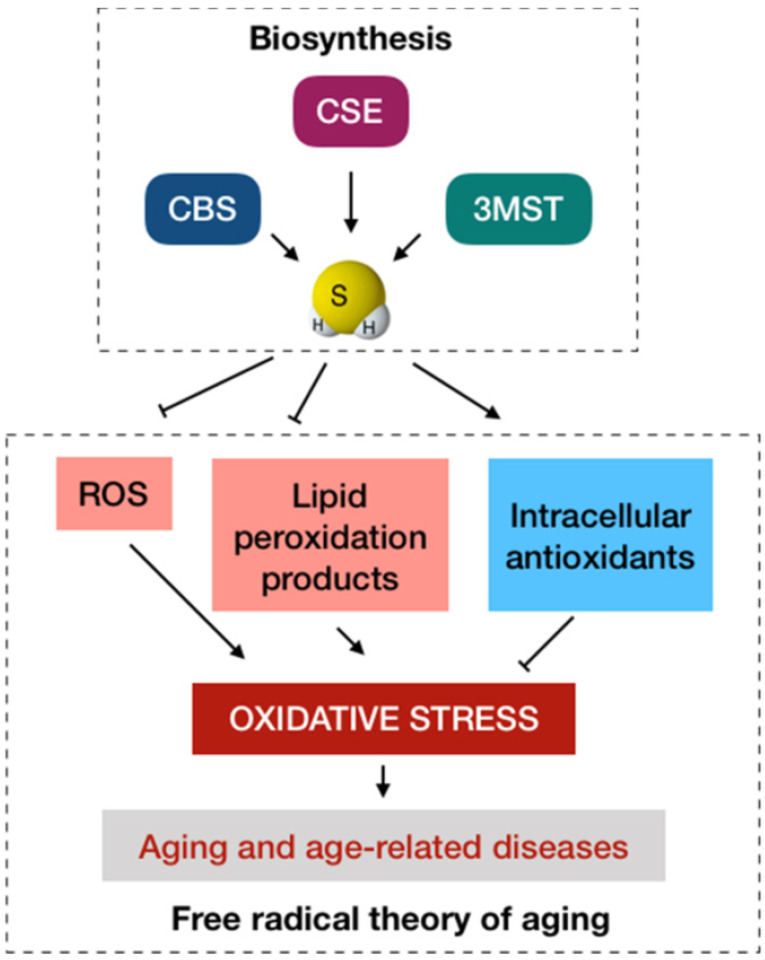
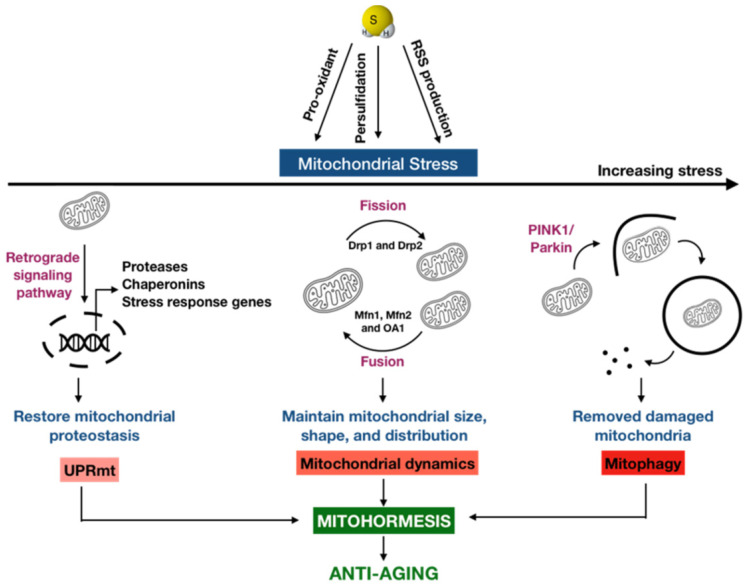
The growing increases in the global life expectancy and the incidence of chronic diseases as a direct consequence have highlighted a demand to develop effective strategies for promoting the health of the aging population. Understanding conserved mechanisms of aging across species is believed helpful for the development of approaches to delay the progression of aging and the onset of age-related diseases. Mitochondrial hormesis (or mitohormesis), which can be defined as an evolutionary-based adaptive response to low-level stress, is emerging as a promising paradigm in the field of anti-aging. Depending on the severity of the perceived stress, there are varying levels of hormetic response existing in the mitochondria called mitochondrial stress response. Hydrogen sulfide (HS) is a volatile, flammable, and toxic gas, with a characteristic odor of rotten eggs. However, HS is now recognized an important gaseous signaling molecule to both physiology and pathophysiology in biological systems. Recent studies that elucidate the importance of HS as a therapeutic molecule has suggested its protective effects beyond the traditional understanding of its antioxidant properties. HS can also be crucial for the activation of mitochondrial stress response, postulating a potential mechanism for combating aging and age-related diseases. Therefore, this review focuses on highlighting the involvement of HS and its sulfur-containing derivatives in the induction of mitochondrial stress response, suggesting a novel possibility of mitohormesis through which this gaseous signaling molecule may promote the healthspan and lifespan of an organism.
全球预期寿命的不断增长以及随之而来的慢性病发病率上升,凸显了制定有效策略以促进老年人口健康的需求。人们认为,了解不同物种间保守的衰老机制有助于开发延缓衰老进程和预防与年龄相关疾病的方法。线粒体应激反应(或线粒体 hormesis),可定义为对低水平应激的一种基于进化的适应性反应,正成为抗衰老领域一种有前景的范例。根据所感知应激的严重程度,线粒体中存在不同水平的应激反应,称为线粒体应激反应。硫化氢(HS)是一种挥发性、易燃且有毒的气体,有臭鸡蛋的特征气味。然而,HS 现在被认为是生物系统中生理和病理生理过程的一种重要气体信号分子。近期阐明 HS 作为治疗分子重要性的研究表明,其保护作用超出了对其抗氧化特性的传统认识。HS 对于激活线粒体应激反应也可能至关重要,这为对抗衰老及与年龄相关疾病提出了一种潜在机制。因此,本综述着重强调 HS 及其含硫衍生物在诱导线粒体应激反应中的作用,提示这种气体信号分子可能通过一种新的线粒体应激反应机制来促进生物体的健康寿命和寿命。